
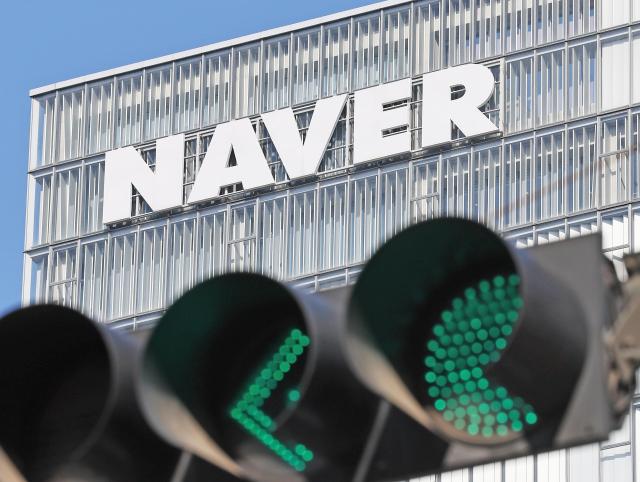
Sales for the first three months of this year reached 2.79 trillion won (US$1.99 billion), up 10.3 percent from the same period last year, backed by steady growth across its diverse business sectors despite intensifying competition and challenges in emerging technologies including artificial intelligence (AI).
Operating profit jumped 15 percent to 505.3 billion won, but net profit tumbled 23.8 percent to 423.7 billion won.
The search-related division, which takes the lion's share of the company's business sectors, saw an 11.9 percent surge in revenue to 1.01 trillion won, driven by AI-optimized advertising.
The commerce unit followed with a 12 percent growth on-year, with on-platform transaction volume increasing by 10.1 percent.
The fintech division saw an 11 percent increase, processing 19.6 trillion won in payments through its app Naver Pay, up 17.4 percent from the previous year.
"Naver secured unmatched competitiveness by building an ecosystem that AI cannot replace, connecting our own content and data," said CEO Choi Soo-yeon.
Addressing concerns about AI's impact on the market overall, Choi commented that, based on internal data, there were no adverse effects, with traffic continuing to rise for business-related queries where the company maintains relative strength, compared to market rivals.
Naver also revealed plans to launch a service in partnership with grocery delivery app Kurly in the second half of the year, further strengthening its recently launched separate shopping platform.
Kim Dong-young
Kim Dong-young is a bilingual journalist at AJU Press (AJP), covering Korean tech, energy, and bio/pharma.
He reports from the field at events like CES and APEC, runs AJP's YouTube channels,
and is pursuing a master's at Sogang's MOT program.
Copyright ⓒ Aju Press All rights reserved.
Related News
-
 Naver's AI pivot signals Korea's bid for global tech prominence
Naver buildings in Seongnam, Gyeonggi Province/ Courtesy of Naver Editor's Note: This article is the 14th installment in our series on Asia's top 100 companies, exploring the strategies, challenges, and innovations driving the region's most influential corporations. SEOUL, April 17 (AJP) - Once a modest search engine born out of a Samsung SDS skunkworks project in the late 1990s, Naver Corp. has reimagined itself as South Korea's digital juggernaut. Now, the tech conglomerate is placing an ambitious bet on artificial intelligence, virtual content, and a sprawling ecosystem of digital services — staking its future not just on national dominance, but global relevance. In a move emblematic of its evolving identity, Naver announced a strategic partnership with Hyundai Motor Group on March 28 during the automaker's annual developer conference. The collaboration will integrate Naver's generative AI model, HyperCLOVA X, into Hyundai's software-defined vehicles, creating in-car AI assistants tailored to individual drivers — and, more broadly, signaling Naver's deeper incursion into the auto-tech sector. But the Hyundai deal is only one node in a rapidly expanding web. Through its corporate venture arm D2SF, Naver recently invested in Scone, a startup focused on virtual IP and digital content. Earlier in March, the company unveiled "MotionStage," an advanced 3D content studio, at its second headquarters. The facility enhances its capabilities in immersive media — an area seen as ripe for monetization amid growing demand for virtual and AI-driven experiences. Naver's head of app division Lee Jae-hoo speaks at the Pleos 25 conference, March 28, 2025. Courtesy of Naver The pivot comes as international players exit the South Korean market, leaving space for domestic champions. Following Twitch's withdrawal earlier this year, Naver's livestreaming platform Chzzk has surged, reporting a 910,000 increase in monthly active users in January — a 55 percent year-over-year leap that places it within striking distance of market leader Soop. Naver's influence extends to e-commerce, where its AI-powered Plus Store app became the most downloaded shopping platform in the country this March, surpassing even global powerhouse Temu, according to data from analytics firm IGA Works. Internationally, Naver is pursuing a multifaceted expansion strategy: investing in U.S.-based customer-to-customer marketplaces, offering fintech solutions, and collaborating with Saudi Arabia on digital infrastructure in property development. This global push reflects the company’s transformation since its founding in 1997 as "Web Glider," a Samsung-backed internal startup. After spinning out as Naver Com in 1999 under founder Lee Hae-jin, the company quickly rose to prominence. It was rebranded as NHN (Next Human Network) in 2001, then reclaimed the Naver name in 2013 after a corporate split. Now, it is reaping the rewards of years of reinvention. For the 2024 fiscal year, Naver posted revenue of 10.7 trillion won (approximately $7.9 billion), up 11 percent from the prior year. Operating profit soared 32.9 percent to 1.98 trillion won, while fourth-quarter revenue climbed 13.7 percent to 2.89 trillion won — marking eight straight quarters of profit growth. A screenshot of Naver's streaming service Chzzk/ AJP Kim Dong-young Naver Map's "Be Local" ad for foreign visitors/ Courtesy of Naver Speaking in February, CEO Choi Soo-yeon framed 2025 as a "crucial" year for operationalizing Naver’s "On-Service AI" strategy. "We will enhance our platforms with AI technology to create new value and business opportunities, ultimately strengthening Naver’s unique competitive edge," she said. In keeping with that vision, Naver this month launched its "Be Local" campaign via its mapping service, highlighting cultural hotspots for tourists through collaborations with brands like CJ Olive Young, Musinsa, and Innisfree. Foreign visitors can access translated reviews and directions through Papago, Naver's AI-powered translation tool, which converts Korean text into English, Chinese, and Japanese. The return of Lee Hae-jin as chair of Naver's board on March 26 — seven years after stepping down — adds a symbolic and strategic layer to the company's transformation. His reappointment is widely interpreted as a move to sharpen Naver's focus in the escalating global AI arms race, particularly through HyperCLOVA X, first launched in 2023. In public remarks following his return, Lee offered a philosophical rationale for Naver's expansion: "It's incredibly unfortunate for the world to rely on just one or two AI platforms. To preserve the diversity of the internet, we need a wide range of search engines and services." To that end, Naver is leaving the door open to international cooperation. "We are open to collaboration with global big tech firms and various external LLMs," Choi noted in February. "Such discussions are ongoing." While the competition is fierce — with models like ChatGPT, Claude, and Gemini dominating headlines — Naver continues to leverage its local expertise, deep user base, and technological agility to carve out a distinct presence. What began as a humble search engine has matured into one of Asia's most versatile digital players — and one of the world's tech firms to watch. Naver Chairman Lee Hae-jin speaks at a shareholders' meeting in Naver's headquarters, March 26, 2025. Courtesy of Naver Naver's MotionStage studio/ Courtesy of Naver
-
 Forum highlights surging data center demand powered by AI boom
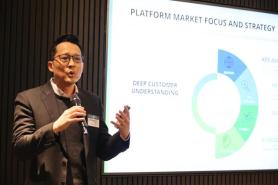
Mark Fan, CEO of Empyrion Digital, gives a speech on data centers in a forum in Seoul, March 6, 2025. AJP Han Jun-gu SEOUL, March 07 (AJP) - Industry leaders gathered in Seoul on Thursday to discuss the rapid evolution of data centers, as artificial intelligence infrastructure fuels unprecedented power demands across the country. "Despite land and power constraints, data center capacity in the Greater Seoul Area reached 520 megawatts in the second half of 2024, marking a 15 percent year-on-year increase," said John Pritchard, head of Cushman & Wakefield’s data center advisory group in Korea. "With 638 megawatts currently in the development pipeline, total capacity in the region is expected to surpass 1 gigawatt in the near future." Seoul's data center vacancy rate has fallen to just 6 percent, with the southwestern Seoul cluster accounting for 26 percent of the city’s total capacity. Pritchard noted that while South Korea has a population of 51 million, its total data center capacity stands at just 697 megawatts — significantly lower than Singapore’s 1,000 megawatts, despite the city-state having only 6 million residents. The power requirements of data centers are evolving at an unprecedented pace. Hong Ji-won, director at Empyrion Digital, highlighted the shift: "Traditional data centers required just a few kilowatts per rack. But as companies like Amazon, Naver, and Kakao entered the market, demand rose to around 10 kilowatts per rack. AI data centers now require 40, 60, or even over 130 kilowatts per rack." This surge in energy consumption is driving a shift from traditional air cooling to more efficient liquid cooling solutions. "Water is approximately 3,500 times more effective at absorbing heat than air in the same volume," Hong explained. Empyrion Digital is preparing to launch its AI-ready data center in Seoul’s Gangnam area in August 2025. CEO Mark Fan emphasized the company's customer-focused approach, noting that the new facility will offer a total capacity of 40 megawatts, including 29.4 megawatts dedicated to IT load. "Each floor will provide 4.2 megawatts of capacity, with ceiling heights exceeding 7 meters on standard floors and 8.25 meters on AI-specialized floors," Hong added. "This is significantly higher than competitors’ ceilings, which range between 6 and 6.5 meters, enabling better heat management."
-
 With AI in focus, Naver, Kakao brace for earnings
Naver founder Lee Hae-jin answers reporters' questions at Naver Green Factory in Seongnam, Gyeonggi Province, March 26, 2025. Yonhap SEOUL, April 23 (AJP) - South Korea’s leading tech companies, Naver and Kakao, are set to release their first-quarter earnings for 2025 next month, amid intensifying pressure to keep pace in the rapidly evolving landscape of artificial intelligence. According to a filing with the Financial Supervisory Service on Wednesday, Naver will announce its results on May 9 via a conference call, while Kakao is scheduled to release its earnings a day earlier, on May 8. Analysts anticipate that Naver will report revenue of 2.8 trillion won (approximately $2.05 billion) for the first quarter, representing a year-on-year increase of 10.9 percent. Operating profit is projected to rise 16.6 percent to 512.3 billion won. Naver, which crossed 10 trillion won in annual revenue for the first time last year, continues to post record quarterly figures. However, the company has faced criticism for lagging in the global race to develop competitive AI technologies. The return of founder Lee Hae-jin as chairman of the board last month has signaled a renewed strategic focus. Lee has pledged to prioritize artificial intelligence and new business ventures, underscoring the urgency with which the company is approaching the current wave of technological transformation. In the first quarter, Naver launched “AI Briefing,” a generative AI-powered search service integrated into some of its platforms, including Place. It also introduced the Naver Plus Store, a standalone shopping app, as part of an aggressive push into e-commerce. “While advertising revenue may soften slightly due to economic conditions, growth in commerce will sustain the upward trend in operating profit,” said Oh Dong-hwan, an analyst at Samsung Securities. He added that the near-term impact of the new app and AI service would likely be limited. Kakao, by contrast, is expected to report a year-on-year decline in both revenue and profit. Analysts project revenue of 1.94 trillion won, down 2.5 percent, and operating profit of 105.6 billion won, a 12.2 percent drop. The company has faced a series of challenges in recent months, including regulatory scrutiny and legal issues involving its founder, Kim Beom-su. Investigations into key business units such as Kakao Mobility have added to the strain. In February, Kakao sought to reset its strategic direction by announcing a partnership with OpenAI CEO Sam Altman during his visit to Korea. The collaboration reflects a contrasting approach to Naver’s “sovereign AI” model, with Kakao favoring a more integrative orchestration strategy. Internally, Kakao continues to restructure, spinning off its Daum portal service and reportedly weighing the sale of stakes in Kakao Entertainment and Kakao Mobility. Despite plans to launch its own AI-based “Kanana” service in the first half of the year, the product has yet to debut. The OpenAI collaboration remains in its early stages, with few tangible outcomes to date. “The content segment, which contributes nearly half of Kakao’s revenue, will remain under pressure in the near term,” said Nam Hyo-ji, an analyst at SK Securities. “However, we expect performance to improve in the latter half of the year as optimism builds around the OpenAI partnership.”