A vast steel wall, rising slowly over the horizon.
INS Vikrant. India's first indigenous aircraft carrier. It takes several more minutes to pull alongside her and for the boarding bridge to be secured. Nobody speaks much. We are all just staring.
The first stop is not the flight deck. It is somewhere far more unexpected — the hangar bay.
Descend below deck and the scale hits you immediately. Roughly the size of two football fields, the hangar bay is the carrier's garage at sea — a cavernous steel chamber where up to 20 aircraft can be parked, serviced, and armed between sorties.
Jets are chained to the floor with heavy-duty fittings, barely shifting even as the 45,000-ton ship rolls through open water. Technicians maneuver them into position on hydraulic turntables with practiced efficiency. Two 30-ton elevators on the starboard side stand ready to lift aircraft up through armored doors to the flight deck above — doors that stay sealed whenever the carrier is underway.
We ride one of those elevators up. Slowly, the hangar bay disappears beneath us, replaced by open sky and a rush of sea wind.
It is the deck itself.
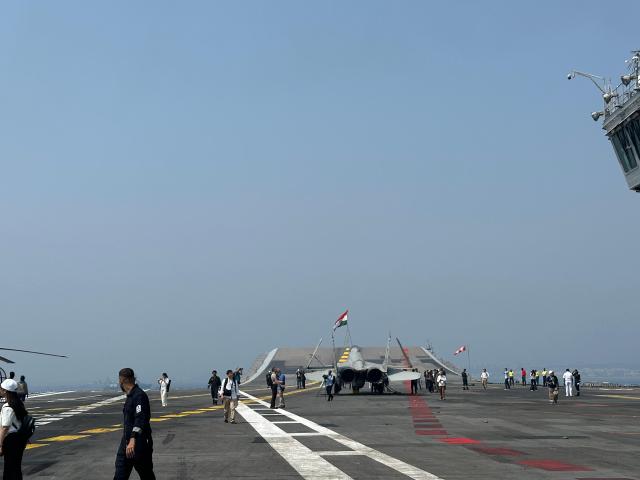
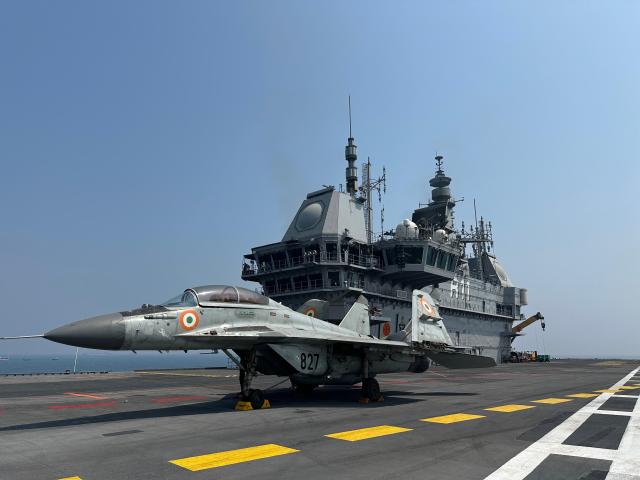
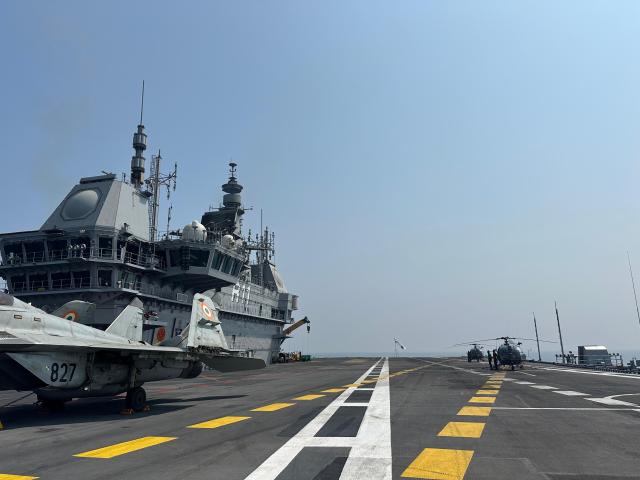
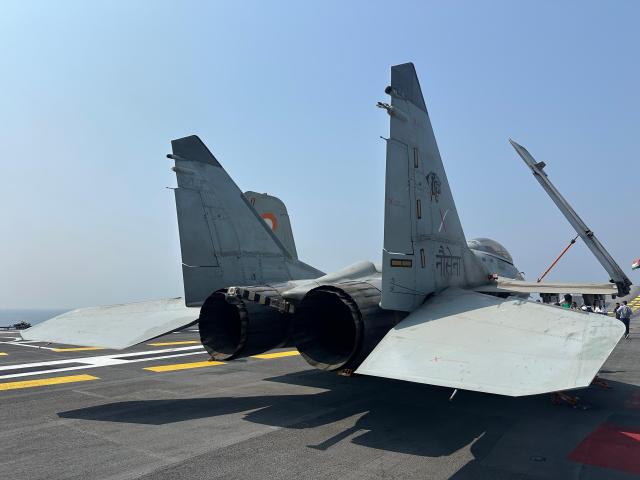
The flight deck stretches 262.5 meters in length and more than 60 meters across — roughly two and a half football fields — hosting around thirty aircraft, including MiG-29K fighters.
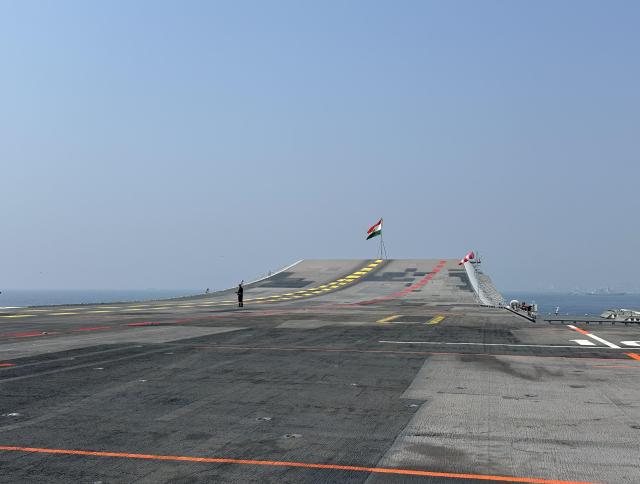
Look down and you will notice the lines painted across the steel: bright yellow and red, sharp and deliberate. The yellow line is a landing alignment guide, helping pilots center their aircraft on approach. The red Safety Line marks zones that are absolutely off-limits during flight operations — a boundary between routine and catastrophe, protecting crew from the lethal force of jet blast.
"Crossing beyond that line can mean risking your life," one officer says grimly, his eyes fixed on the runway ahead of us.
At the bow, the deck curves sharply upward into a 14-degree ski-jump ramp. There are no catapults here — aircraft launch on engine thrust alone, hurled skyward by the ramp's angle and their own power.
Landing, however, is another matter entirely.
"Landing is the real challenge," one pilot tells us. "You're coming in at hundreds of kilometers per hour, and your tailhook has to catch one of just three wires stretched across the deck. The system adjusts the tension in a split second — based on your speed and weight — and that's what brings you to a dead stop in such a short distance."
If the hook fails to catch, the pilot immediately powers back up, circles around, and comes in for another attempt.
After the deck tour, we are escorted into a sealed briefing room deep inside the ship. Mobile signals vanish instantly. No Wi-Fi, no reception — just steel walls and the hum of machinery.
Moments ago, we stood under open sky. Now, there is nothing but metal in every direction.
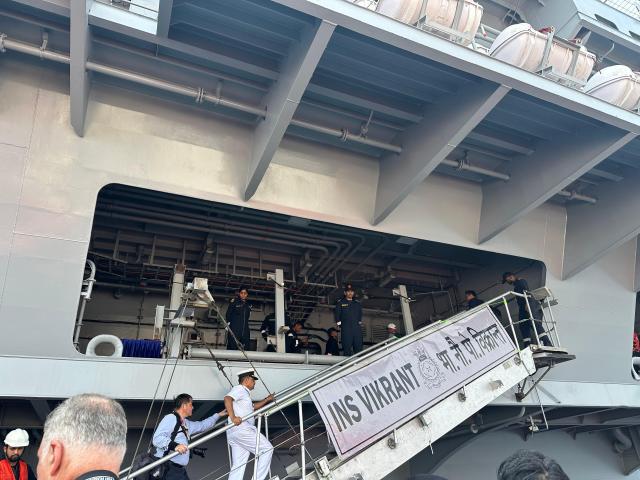
Beneath the flight deck lies a world of its own — more than 2,200 compartments housing around 1,700 crew members, who cycle between long deployments at sea and intensive maintenance periods in port. Vikrant generates enough electricity to power thousands of homes. Her onboard hospital has an ICU and a CT scanner. Three automated galleys produce nearly 5,000 meals a day.
"The naan from the baking room is actually really delicious," one crew member says with a grin. Even here, morale is part of the mission.
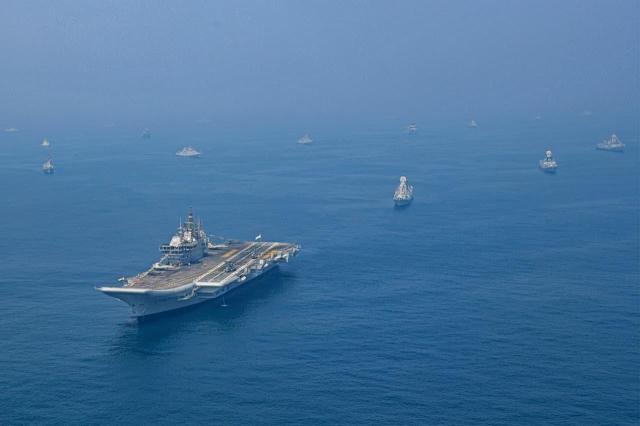
Back at the edge of the deck, steel meets open water. The horizon stretches without end.
The carrier holds steady. And standing here, at the edge of a floating city in the middle of the Indian Ocean, that feels like the most remarkable thing of all.

Copyright ⓒ Aju Press All rights reserved.