

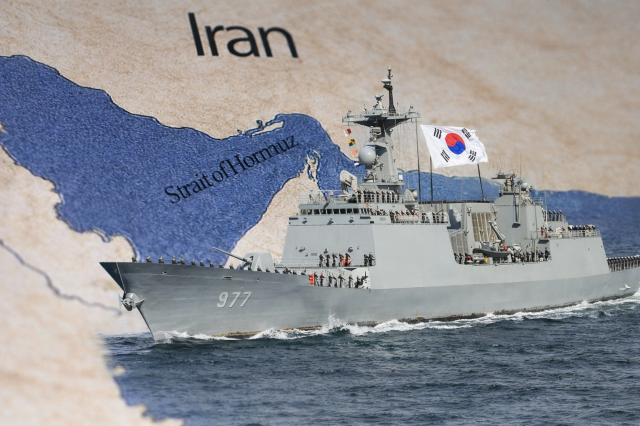
Iran’s Islamic Revolutionary Guard Corps has attacked at least 10 vessels, including tankers and tugboats, using missiles and surface drones, and threats to strike any attempting to pass the waterway off Iran coastline.
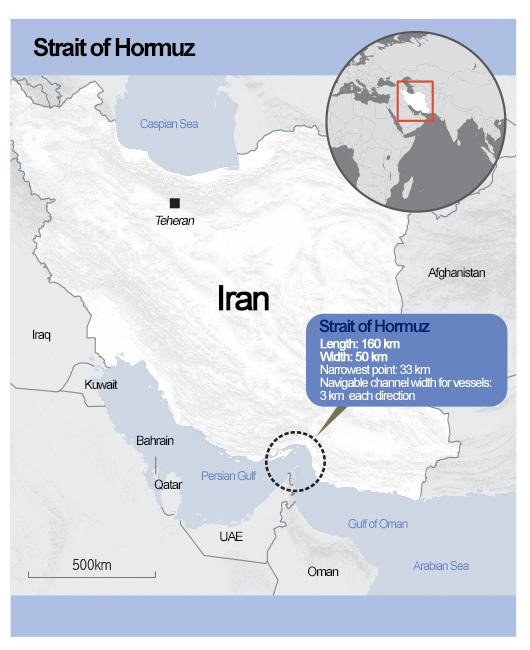
A strategic chokepoint between Iran to the north and Oman to the south, the Strait of Hormuz is just 30 kilometers at its narrowest point. Much of the cargo that passes through it is bound for South Korea, Japan, China and India, which together account for roughly 70 percent of global output.
The main threat to tankers and escorting warships comes from land-based anti-ship missiles and suicide drones, experts say.
While much of Iran’s conventional naval and air assets, along with some missile bases, have reportedly been put out of action by successive U.S. and Israeli strikes, there is a broad consensus that not all launch sites have been eliminated.
At sea, Iran’s forces are limited to small boats and unmanned surface vessels. Even if these assets attempt to lay mines or carry out surprise attacks, modern naval forces are capable of detecting and neutralizing such threats, experts say.
But without neutralizing Iran’s dispersed coastal missile batteries and long-range drone platforms, simply reinforcing naval escort operations would leave U.S. and allied ships operating for weeks or even months under persistent aerial threats.
“As long as land-based threats remain, maritime escort operations are structurally limited to a temporary fix, and inherently dangerous,” one analyst said.
A South Korean naval officer, speaking on terms of anonymity, explained that fully ensuring the safety of tankers would require deployment of ground forces to secure Iranian-held islands near the strait and installation of air defense systems to block missile and drone launches. It would also require completely neutralizing land-based launch sites.
“Even with such measures, missiles launched from deeper inland would remain a threat, meaning multiple brigades, or even division-level ground forces, along with layered air defense systems would be necessary,” he said.
“Without addressing land-based threats, sending more escort ships is less about managing risk and more about dispersing it,” he said.
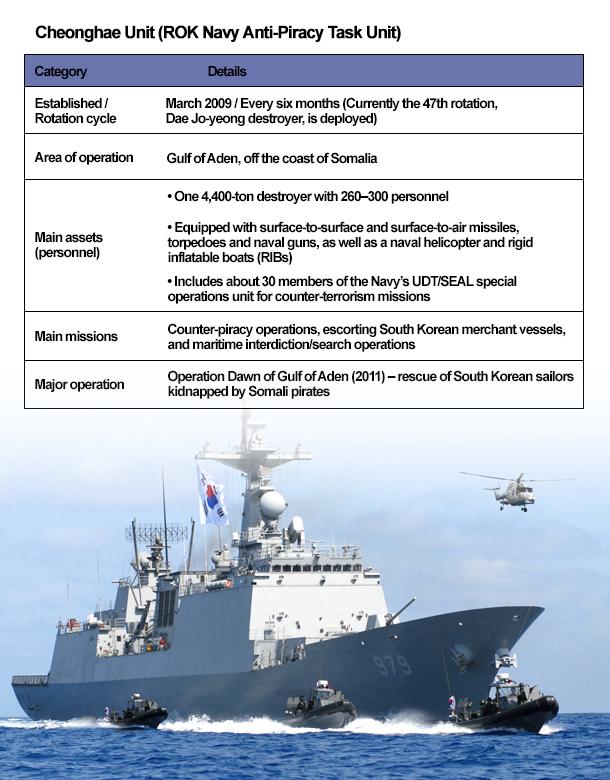
While the unit’s 4,000-ton-class destroyers are equipped with close-in weapon systems, surface-to-air missiles, and torpedoes, experts agree that they are not designed for the kind of high-intensity threat environment currently seen in the Strait of Hormuz.
“In reality, the Cheonghae Unit can engage only a limited number of targets at once,” said Jeong Kyung-woon, a researcher at the Korea Association of Military Studies. “Given radar and system constraints, the unit lacks the means to effectively counter multiple incoming drones or missiles.”
However, this picture might change if South Korea operates under U.S. command and control, being integrated into American intelligence networks and missile defense systems.
Paik Seung-hoon, a researcher at the Middle East Institute of Hankuk University of Foreign Studies, said that in such a case, participation with just two or three ships could be feasible as part of a combined task force.
“However, there’s a fundamental issue,” Paik said. “If South Korea operates under U.S. wartime operational control, it would be seen as endorsing and participating in the conflict against Iran.”
“If, on the other hand, Seoul wants to carry out an independent mission, as it did in 2020, when it retained wartime operational control and focused on protecting Korean merchant vessels, it would need to deploy a separate fleet of around 10 ships, including Aegis destroyers, submarines, and mine countermeasure vessels,” he said.
Sources say that, within military circles, there is a growing consensus that if South Korea is to deploy naval assets to the Strait of Hormuz, it would need to form a new task group centered on Aegis destroyers. Such a force would require not only close-in defense systems but also advanced air and missile defense capabilities to intercept Iranian threats, along with logistics and maintenance support for sustained operations far from home waters.
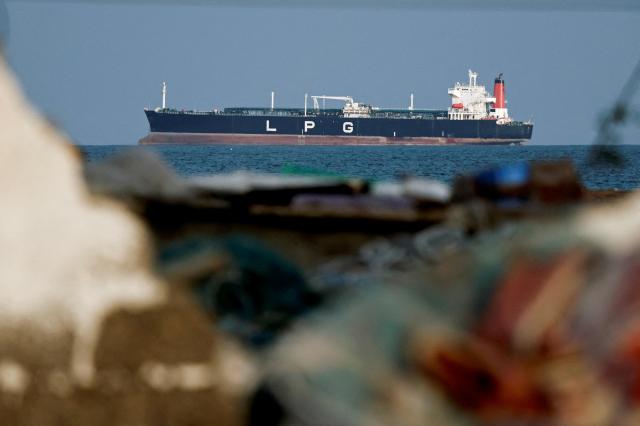
Operational difficulties extend to sustainment. The naval officer said it takes three to four weeks for a 7,000-ton-class Aegis destroyer to reach the Strait of Hormuz from South Korea. Once deployed, ships typically require resupply every 15 days for fuel, food, and ammunition.
“In near-war conditions, returning to port for resupply is virtually impossible,” he noted. “A fully self-sustaining expeditionary task group, with large supply ships enabling continuous operations at sea, would be necessary.”
Caught between alliance pressure and operational limitations, Seoul faces a difficult dilemma: given the close defense relations, it cannot easily ignore Washington’s request, yet it also cannot readily commit to a mission that may exceed its capabilities.
“At the same time, South Korea must clearly define the nature of its mission, including command structure and assigned roles, before making any decision,” he said.

Copyright ⓒ Aju Press All rights reserved.
