

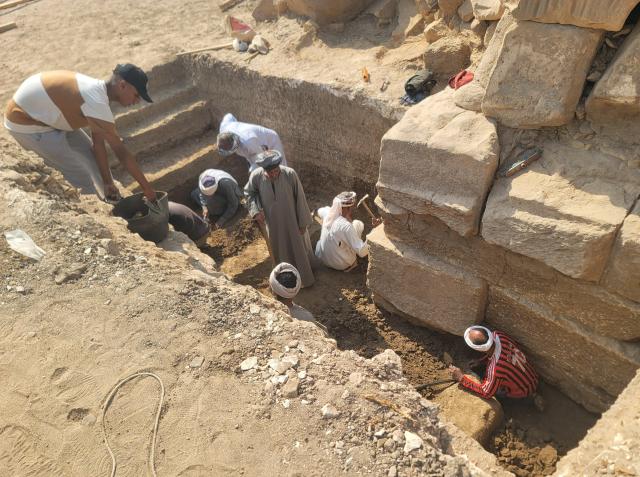
The Korea Heritage Service and the Korea National University of Cultural Heritage said on 9 that they have made major academic findings during a restoration project at the pylon gate of the Ramesseum Temple in Luxor, Egypt, including the discovery of a cartouche bearing the name of Ramses II.
The work is part of the Korea Heritage Service’s official development assistance project, titled “Capacity building for sustainable cultural heritage tourism resource development in Luxor, Egypt.”
A cartouche is an oval enclosure used in ancient Egypt to set apart and emphasize a pharaoh’s name, which otherwise would be written in a line of hieroglyphs.
The discovery was confirmed during an excavation survey on the north side of the pylon. Investigators also identified multiple layers spanning from the period when the pylon was built through modern times, securing materials that help reconstruct how the Ramesseum was built and altered over time.
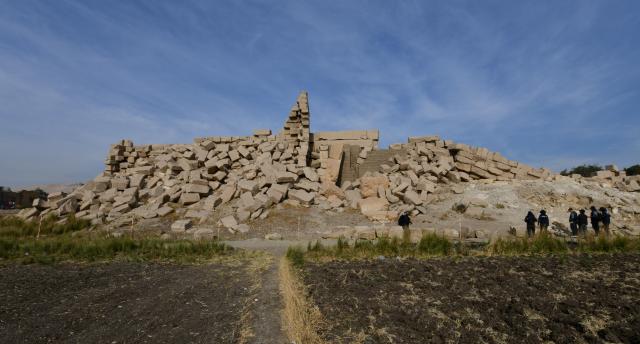
A French research team previously found a cartouche of Ramses II while excavating the temple’s innermost sanctuary, but this is the first time one has been discovered at the pylon, the agencies said.
Hisham El Leithy, secretary-general of Egypt’s Supreme Council of Antiquities, said the newly found cartouche differs in form from those previously identified and is expected to provide an important clue for determining the construction sequence of structures within the Ramesseum. He also said researchers confirmed a carved stone element bearing a new place name that supports the extent of Ramses II’s territorial expansion.
The Korea Heritage Service and the university said they also identified soil layers that could help estimate how stone was transported and how the structure was built, providing baseline data for restoring the pylon to its original form. A temporary protective shelter is now being installed, and once completed, dismantling and full-scale restoration of the pylon are expected to accelerate.
* This article has been translated by AI.
Copyright ⓒ Aju Press All rights reserved.