

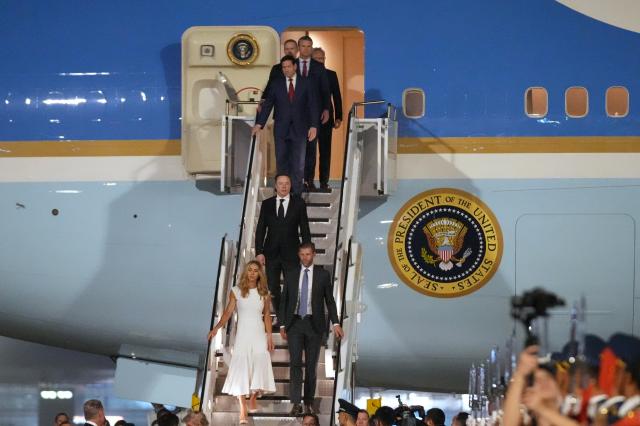
President Donald Trump's visit to China is notable for the unusual presence of Secretary of Defense Pete Hegseth, marking the first time a U.S. defense secretary has accompanied a president to China since Richard Nixon's historic trip in 1972, according to the South China Morning Post (SCMP) on May 14.
The last visit by a U.S. defense secretary to China occurred nearly eight years ago, when then-Secretary James Mattis traveled there in June 2018 during Trump's first term.
SCMP reported that Hegseth's attendance signals a commitment from both nations to enhance military communication as a means of easing tensions and managing crises. The summit is expected to address issues such as nuclear weapons, U.S. arms sales to Taiwan, and the restoration and expansion of military-to-military communication channels.
Hegseth's participation also indicates that Chinese Defense Minister Li Shangfu will be present at the summit. During Trump's previous visit to China in 2017, only Li Zuocheng, then head of the Joint Staff Department of the Central Military Commission, represented the People's Liberation Army.
As U.S.-China competition extends beyond trade into technology and national security, analysts suggest that the relationship has entered a phase of 'technological security competition.' The lines between commercial and military applications of technologies such as semiconductors, artificial intelligence, quantum computing, and satellite technology are increasingly blurred, highlighting the need for closer military communication.
Jupeng, a professor at Nanjing University, emphasized in the Singapore United Daily that U.S.-China relations are not limited to trade and economics. He noted that the resumption of institutionalized high-level communication between the two militaries is crucial for stabilizing relations and preventing conflict escalation. He added that as AI is increasingly applied to military equipment and operations, regular consultations and exchanges between the two militaries could present significant opportunities for both sides, especially given the lack of established international security norms and governance rules.
There are also interpretations that Trump is mindful of domestic political messaging, with the Nordic-based Chinese media outlet, Nordic Times, suggesting that he aims to project a tough image on security issues to U.S. voters.
In addition to Hegseth, Trump's delegation includes key figures from diplomatic, security, and economic sectors, such as Secretary of State Marco Rubio, Treasury Secretary Scott Vessen, and USTR Representative Jamieson Greer. The United Daily noted that this meeting is designed as a high-level strategic communication session that clearly demands practical cooperation.
Wang Dong, a professor at Peking University's School of International Relations, remarked that the U.S. perceives this visit as a comprehensive high-level strategic communication encompassing political, security, and economic issues. He indicated that economic and trade cooperation, along with market and industry matters, will be central topics, with the visit aimed at achieving tangible cooperation outcomes.
* This article has been translated by AI.
Copyright ⓒ Aju Press All rights reserved.