

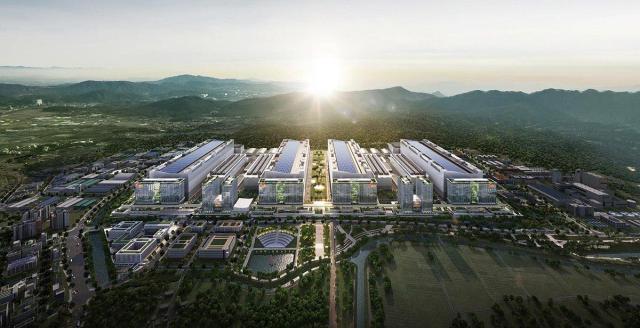
The southern Gyeonggi region, connecting Yongin, Pyeongtaek, Hwaseong, and Suwon, is emerging as a new growth axis in the metropolitan real estate market, driven by the semiconductor industry. The government's plan for a semiconductor mega-cluster, coupled with significant investments from Samsung Electronics and SK Hynix, has shifted residential demand patterns, fueled by performance bonuses, interest in non-regulated areas, and expectations for expanded transportation networks like the GTX.
Historically, the southern Gyeonggi real estate market has been influenced by accessibility to Seoul and new city infrastructure. However, proximity to semiconductor industry hubs and residential demand have become key factors. The so-called 'Yongpyeonghwa-su' semiconductor belt, which encompasses Yongin, Pyeongtaek, Hwaseong, and Suwon, is gaining attention for this reason.
According to industry sources, the government plans to attract a total of 622 trillion won in private investment to develop the world's largest semiconductor mega-cluster in southern Gyeonggi by 2047. This initiative aims to add 16 new fabs, including 13 production fabs and three research fabs, to the existing 19 production and two research fabs in the region.
Yongin will serve as the central hub, with a national industrial complex for advanced system semiconductors being established in the area of Yongin's I-dong and Namsa-eup. According to Yongin City, this industrial complex will cover 7.77 million square meters, with development scheduled from 2023 to 2031. Samsung plans to invest 360 trillion won in this area by 2052. Additionally, SK Hynix is involved in the Yongin Semiconductor Cluster in Wonsam-myeon.
Pyeongtaek and Hwaseong are already functioning as semiconductor hubs, centered around Samsung's production facilities. The Pyeongtaek Godeok International Planning District has established itself as a residential area supporting the Samsung Pyeongtaek Campus, while Hwaseong has integrated industry and housing through the Samsung Hwaseong and Giheung campuses and the Dongtan New Town. Suwon serves as a research and talent hub, supported by Samsung's headquarters and R&D facilities, along with universities and business centers.
Market trends are also changing. According to the Korea Real Estate Agency, as of May 25, the cumulative increase in apartment prices this year has been 8.16% in Yongin Suji, 5.30% in Yongin Giheung, 4.73% in Suwon Yeongtong, and 4.48% in Hwaseong Dongtan. In comparison, the average increase in Seoul was 3.68%, with Songpa at 2.38% and Gangnam at 0.16%, highlighting the significant price growth in the major semiconductor areas of southern Gyeonggi.
Transaction trends support this shift. In April, apartment sales in Gyeonggi increased by 20.1% compared to the same month last year, while sales in Gangnam's four districts dropped by 24.3%. Dongtan saw a remarkable 112% increase in transactions in the first quarter, with 2,283 deals recorded, indicating that rising prices are accompanied by increased transactions.
Another factor bolstering the semiconductor belt is liquidity. In February, SK Hynix paid its employees a performance bonus equivalent to 2,964% of their base salary. While it is difficult to directly link performance bonuses to rising property prices, analysts suggest that high-income jobs and cash flow are supporting housing demand in southern Gyeonggi.
The regulatory environment also plays a role. Following the real estate measures implemented in October last year, areas of Seoul and parts of Gyeonggi were designated as regulated zones, with Suwon's Yeongtong, Jangan, and Paldal districts, as well as Yongin's Suji district, classified as adjustment target areas and speculative overheating zones. In contrast, regions like Hwaseong Dongtan, Yongin Cheoin, and Pyeongtaek are classified as having relatively fewer regulatory burdens, raising the possibility of capital movement.
The expansion of transportation networks is another factor accelerating regional integration. The GTX-A line from Suseo to Dongtan is set to open in March 2024, enhancing accessibility to Dongtan. The Indukwon-Dongtan line, which will connect Anyang, Uiwang, Suwon, Yongin, and Dongtan, is under development with a target completion in 2028. The overlap of the semiconductor industry and the expanded rail network increases the likelihood that major cities in southern Gyeonggi will form a cohesive living area.
However, there are disparities within the semiconductor belt itself. While prices and transactions have surged in Yongin Suji, Giheung, Suwon Yeongtong, and Hwaseong Dongtan, Pyeongtaek has seen a slower recovery in its sales market due to the absorption of large-scale developments like the Godeok International New Town and Brain City. Nonetheless, demand for housing near the Samsung Pyeongtaek Campus remains strong.
An industry insider stated, "The essence of the Yongpyeonghwa-su semiconductor belt is not merely an industrial complex boon. It is forming a broad growth axis where semiconductor production facilities, R&D, partner companies, transportation networks, and residential demand are moving in tandem." They added, "However, within the same semiconductor belt, regional differentiation is inevitable due to factors such as the volume of new housing, regulatory status, and the pace of transportation network expansion."
* This article has been translated by AI.

Copyright ⓒ Aju Press All rights reserved.