

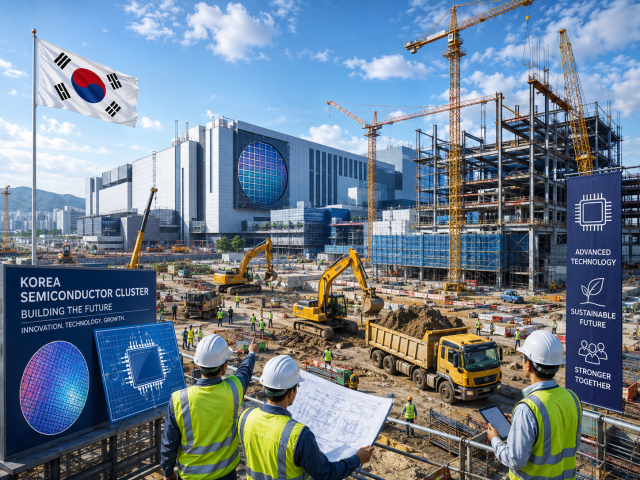
Construction companies are accelerating their efforts to tap into the housing market in the semiconductor belt of southern Gyeonggi Province, including Yongin and Pyeongtaek. As the housing market remains sluggish and the construction industry faces challenges, the anticipation of long-term residential demand is growing due to the establishment of additional production and research fabs in the Yongin, Pyeongtaek, Hwaseong, and Suwon areas.
According to the real estate industry on May 31, construction firms are highlighting the accessibility to semiconductor industrial complexes and proximity to workplaces as key marketing points for their projects in southern Gyeonggi. The government has announced plans to attract a total of 622 trillion won in private investment to create the world's largest semiconductor mega-cluster, drawing attention to the so-called 'Yong-Pyeong-Hwa-Su' semiconductor belt in the housing market.
Yongin is the area where construction companies are most actively promoting the benefits of the semiconductor industry. Hyundai Engineering & Construction is offering the 'Hillstate Yongin Mark Valley' project in the Agok-ri area of Nam-sa-eup, emphasizing its proximity to the national industrial complex for advanced system semiconductors and the Yongin semiconductor cluster. This development will consist of 660 units.
Daewoo Engineering & Construction is also targeting demand from the semiconductor belt in Yongin. The company is currently marketing the 'Yongin Prugio One Cluster Park,' highlighting the benefits of the Yongin advanced system semiconductor cluster and the convenience of commuting to industrial complexes. This project will feature six buildings with a total of 710 units, ranging from 80 to 134 square meters, across 29 floors.
In Pyeongtaek, supply is continuing around the Godeok International Planning District, which is considered a residential area supporting Samsung Electronics' Pyeongtaek campus. A consortium led by Woomee Construction is offering the 'Pyeongtaek Godeok Woomeelin Prestige,' targeting demand from the Samsung campus. Kumho Construction is also presenting 'Godeok New Town Atera,' a public housing project with 630 units in Block A-63 of the Godeok International Planning District.
For construction firms, the semiconductor belt provides a clear marketing advantage in a sluggish housing market. Developments near industrial complexes are expected to attract workers during the establishment of large production facilities, and demand for housing is likely to increase once operations begin, as more employees and research personnel move into the area.
Supply conditions are also noteworthy. The cumulative number of housing units available in Gyeonggi Province this year has reached 26,030, a 53.9% increase compared to the previous year, while unsold units have decreased by 8.3% to 12,205. During the same period, the number of completed units has dropped by 38.9% to 21,209. This suggests that while new supply is increasing, the reduction in unsold units and the decline in completed units indicate a steady demand for new apartments.
In Yongin's Cheoin District, the focus is shifting towards land, compensation, and infrastructure ahead of apartment developments. According to the Ministry of Land, Infrastructure and Transport, the national industrial complex in Icheon and Nam-sa-eup is set to receive project approval by December 2024, with compensation negotiations expected to begin by the end of 2025, and construction slated to start in the second half of 2026. The Korea Land and Housing Corporation (LH) is also planning to initiate construction of the industrial complex after finalizing land sales in the second half of this year.
In contrast to Yongin, Pyeongtaek has already demonstrated the effectiveness of its production base. Demand for housing near the Samsung Electronics Pyeongtaek campus has formed around the Godeok International Planning District, with further supply continuing. However, the pace of recovery in the sales market is relatively slow as the area absorbs large-scale developments like Godeok New Town and Brain City.
A representative from a construction firm noted, "Not all projects in the semiconductor belt will succeed just because of the name. The absorption of demand will vary based on the distance to the industrial complexes, the timing of transportation network openings, pricing, and the volume of units available for occupancy."
He added, "Factors such as the commencement of national industrial complexes, compensation, subsequent supply in the Godeok International Planning District, the impact of the GTX-A line opening, and demand from Samsung Electronics' headquarters and research and development will be key elements in marketing these developments."
* This article has been translated by AI.

Copyright ⓒ Aju Press All rights reserved.