

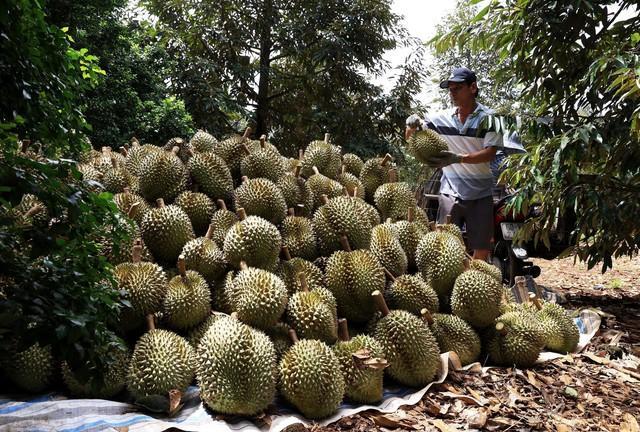
According to various Vietnamese media reports on May 30, customs data shows that from January to April, durian exports reached $293 million (approximately 442 billion won), a 60% increase compared to the same period last year. Of this, exports to China accounted for $257 million (about 388 billion won), marking a 142.7% increase, while South Korea recorded a 201.5% growth, entering the top 10 markets.
◆ South Korean Market Sees 201.5% Surge, Frozen Products Offer a Breakthrough
The South Korean market demonstrated the most significant growth rate. However, the export value remains just over $1 million, indicating that the absolute scale is still small.
Nguyen Duy Phuc, Secretary-General of the Vietnam Fruit and Vegetable Association, stated, "Vietnam has not yet been able to export fresh durians to South Korea; currently, we are only exporting frozen whole fruit or separated flesh." He noted that the recent export growth rate to South Korea had even reached 500%, attributing this to the expanding demand from the Vietnamese community, students, and workers in Korea.
Additionally, the perception of durian as a unique fruit in South Korea contributes to its growth. South Korea has strict food safety standards, including the Pesticide Residue Management System (PLS). As a result, frozen durians are being used as an alternative to reduce the risk of spoilage during logistics. Nguyen emphasized, "South Korea has high purchasing power and long winters, presenting opportunities not only for durians but for all Vietnamese agricultural products."
◆ Dong Thap Province, a Major Production Area, Struggles with Inspection Shortages
However, the situation in production areas contrasts sharply with export statistics. Dong Thap Province, located in the Mekong Delta and a key cultivation area producing hundreds of thousands of tons of durians annually, is facing challenges in shipping due to a lack of facilities for testing cadmium and Aflatoxin O residues.
According to the Dong Thap Department of Agriculture and Rural Development, the area dedicated to durian cultivation spans 32,100 hectares, with an expected production of about 111,221 tons in May and June. Despite this, the price of the Ri6 variety has recently dropped to around 30,000 dong per kilogram, a 46% decrease compared to after the 2026 Lunar New Year.
Although durian exports exceeded $221 million in the first quarter, local farmers and purchasing companies are struggling to prepare export documents on time due to inspection delays. The Dong Thap Durian Association has received complaints that some inspection centers have refused to accept samples or have extended processing times.
◆ Limited Certified Laboratories and Canceled Approvals
There are only 12 cadmium testing laboratories and 8 Aflatoxin O testing laboratories recognized by China in Vietnam. In the Mekong Delta, there are 8 certified facilities, but only 5 can conduct cadmium testing.
Nguyen Khanh Ngoc, Deputy Director of the Can Tho Technical Standards and Quality Center, stated that the center currently only performs Aflatoxin O testing, as cadmium testing has been suspended due to the cancellation of approval by Chinese authorities. He mentioned that a supplementary application was submitted in December 2025, and they are awaiting re-approval, adding, "If operational, we have the capacity to process 50 to 60 containers a day, which would greatly benefit the region."
The Regional Center No. 5 for Agricultural and Fishery Quality in Ca Mau has laboratories capable of testing both substances but has not yet resumed operations. Reasons cited include the review of new regulations, distance from production areas, and a lack of concentrated cultivation areas for exports.
According to the Crop Protection Bureau under the Ministry of Agriculture and Rural Development, as of early May, 16 out of 21 cadmium testing laboratories and 19 out of 22 Aflatoxin O laboratories were operational, while the rest were temporarily suspended. Deputy Director Nguyen Quang Hieu emphasized, "Export companies must conduct food safety and cadmium testing before loading containers."
Meanwhile, netizens have expressed strong dissatisfaction with the recurring lack of inspection infrastructure. One user remarked, "It's unfortunate that no one is held accountable in these articles, and the expression 'we will do it' is repeated without any real intention to solve the problem." Another user pointed out, "With such a large production area lacking testing facilities, equipment is stalled due to a shortage of technicians and processing technology." Some argued, "The failure of state management to keep pace with industrial growth has resulted in a need for a clear management system to determine who is responsible for what."
* This article has been translated by AI.

Copyright ⓒ Aju Press All rights reserved.