

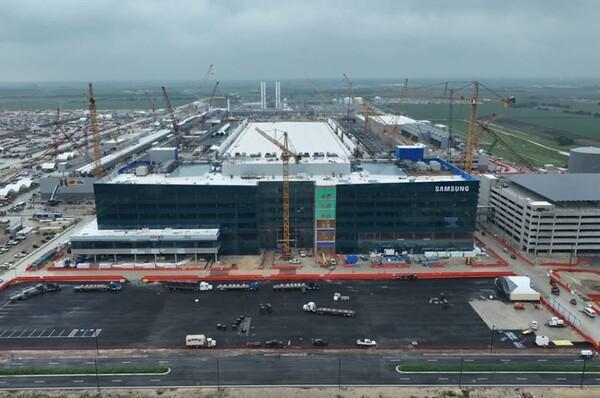
Samsung Electronics plans to officially begin operations at its Texas foundry facility in Taylor next year. Recently, Vice Chairman Lee Jae-Yong has taken a hands-on approach to securing overseas clients, raising expectations for improved performance in the struggling non-memory semiconductor sector.
According to industry sources, Samsung confirmed on May 28 during the Samsung Foundry 'SAFE Forum 2026' held in the U.S. that production at the Taylor Fab will commence next year. More details about the advanced processes will be revealed at the SAFE Forum scheduled for July 1 in South Korea.
The Taylor facility, which broke ground in 2022, is a key part of Samsung's $17 billion (approximately 25.5 trillion won) investment plan in the U.S. semiconductor sector. Once completed, it is expected to enhance Samsung's competitiveness in the foundry market, rivaling Taiwan's TSMC. Currently, Tesla has reserved $16.5 billion (about 22 trillion won) worth of production for its next-generation AI and autonomous driving chip, AI6, set for mass production in 2027. Recently, key executives from Apple also visited the Taylor Fab to discuss potential chipset partnerships.
Samsung is also focusing on advancing its foundry processes for high-performance AI chip development. For instance, semiconductor design software company Synopsys has collaborated with Samsung Foundry to fully integrate AI into the semiconductor design process. To support the multi-die architecture essential for high-performance AI chips, Samsung has enhanced its 3rd generation 2-nanometer process and next-generation 3D IC platform. This transition from manual to AI-automated circuit design has significantly reduced development costs and design errors.
These advancements in foundry technology are expected to strengthen Samsung's competitiveness in next-generation high-bandwidth memory (HBM). Samsung has supplied the world's first 12-layer samples of the 7th generation HBM, 'HBM4E,' to global clients. The collaboration between Samsung's memory and foundry divisions has been credited with accelerating development. HBM4E utilizes both the validated 1c (10-nanometer class 6th generation) DRAM and 4-nanometer foundry processes. As advanced packaging and 3D stacking technologies become increasingly important, Samsung's in-house foundry capabilities are directly linked to its competitiveness in next-generation HBM technology.
Historically, the foundry and non-memory sectors have been significant challenges for Samsung. The foundry and system LSI division reportedly incurred an operating loss of approximately 6.8 trillion won last year. While the memory sector achieved record operating profits of around 53 trillion won in the first quarter of this year, the non-memory division is expected to have recorded losses in the hundreds of billions of won.
However, there is optimism for a turnaround in the foundry business next year. Major clients such as Tesla, Qualcomm, and Apple are expected to drive new demand, along with AI startups like Anthropic. As TSMC's advanced factories operate at near full capacity, supply shortages are becoming evident. There is a growing trend of clients seeking Samsung as an alternative supplier.
Lee Jae-Yong is personally overseeing the foundry business. After recently concluding labor negotiations, he traveled to Taiwan to meet with executives from MediaTek, a semiconductor design firm currently relying on TSMC for production. Samsung aims to leverage its stable supply of memory and HBM, along with competitive pricing, to attract new foundry clients.
Park Yoo-ack, a researcher at Kiwoom Securities, stated, "Samsung's non-memory division is expected to improve significantly, turning from a 3.6 trillion won loss this year to an 1.8 trillion won profit by 2027." Kim Dong-won, head of research at KB Securities, also noted, "Samsung's foundry orders are expected to increase by over 100% compared to last year, with the foundry division likely to transition from a loss of about 7 trillion won last year to profitability next year."
* This article has been translated by AI.
Copyright ⓒ Aju Press All rights reserved.