

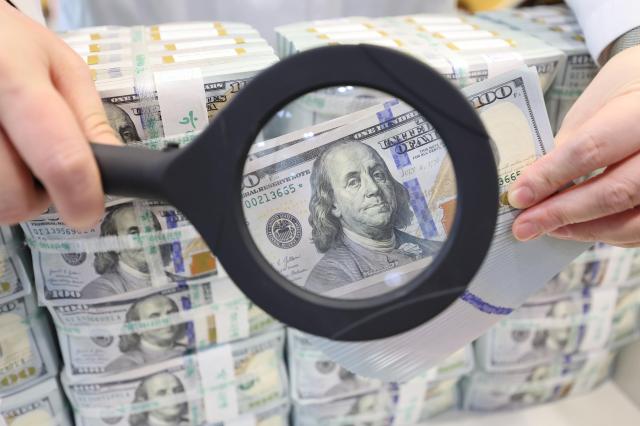
Last month, South Korea's foreign exchange reserves decreased by over $800 million due to market stabilization measures.
According to the Bank of Korea on June 4, the country's foreign exchange reserves stood at $426.99 billion at the end of May, down $880 million from the previous month.
A Bank of Korea official explained, "The decline was primarily due to market stabilization measures, including foreign exchange swaps with the National Pension Service."
The foreign exchange swap with the National Pension Service allows the pension fund to borrow dollars directly from the foreign exchange market instead of commercial banks when making overseas investments. This mechanism is seen as a buffer to prevent a sharp rise in the won-dollar exchange rate, which could occur if the pension fund enters the foreign exchange market to purchase dollars.
In May, the U.S. dollar index (DXY) rose 0.1% to 99.02, up from 98.96 at the end of the previous month.
By asset type, securities decreased by $3.39 billion, while deposits increased by $2.59 billion. The International Monetary Fund's Special Drawing Rights (SDR) fell by $30 million. Gold remained unchanged at $47.9 billion, reflecting its purchase price rather than market value.
As of the end of April, South Korea's foreign exchange reserves were $427.9 billion, ranking 12th in the world. China holds the largest reserves at $3.41 trillion, followed by Japan at $1.38 trillion and Switzerland at $1.08 trillion.
Other countries in the top rankings include Russia ($758.7 billion), India ($690.7 billion), Taiwan ($602.5 billion), Germany ($599.2 billion), Saudi Arabia ($494.8 billion), Italy ($456.1 billion), France ($449.4 billion), and Hong Kong ($442.1 billion).
* This article has been translated by AI.

Copyright ⓒ Aju Press All rights reserved.