

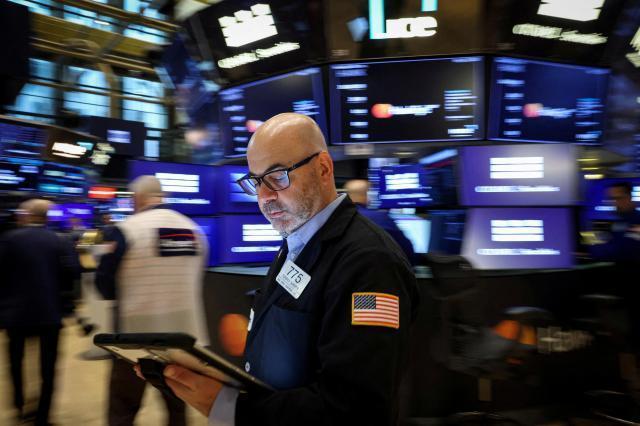
The New York stock market fell due to rising tensions in the Middle East and increasing oil prices. After reaching record highs, profit-taking occurred, and concerns that surging oil prices could disrupt inflation and interest rate forecasts dampened investor sentiment.
On June 3, the Dow Jones Industrial Average closed down 620.72 points (1.21%) at 50,687.07. The Standard & Poor's 500 index fell 56.06 points (0.74%) to 7,553.72, while the Nasdaq composite dropped 239.92 points (0.89%) to 26,853.98.
Middle East tensions have pushed oil prices higher, adding pressure to the stock market. Renewed airstrikes between the U.S. and Iran have destabilized a fragile ceasefire, raising concerns about potential disruptions in oil supply. Reuters reported that "the rise in oil prices could extend beyond energy costs, contributing to overall inflationary pressures, which weighed on the market."
Interest rate forecasts have also been shaken. According to the CME FedWatch, financial markets now reflect a 41.1% chance of a Federal Reserve interest rate hike in December, a significant increase from 9.1% a month ago. The potential for prolonged conflict and the possibility of closing the Strait of Hormuz have heightened inflation concerns, making it more difficult for the Fed to lower rates.
Sector performance was mixed, with technology and financial stocks struggling. The S&P 500 software and services index fell 4.0%, impacted by competitive concerns related to the artificial intelligence (AI) transition. Conversely, energy stocks rose significantly, benefiting from higher oil prices.
AI semiconductor stocks showed relative strength, with the Philadelphia Semiconductor Index rising 1.4%. Companies like Marvell, Intel, Qualcomm, and SanDisk saw increases between 3.7% and 6.7%. However, among the seven major AI-related stocks, only Meta gained 4.2%, while the others declined. The strength in AI semiconductor stocks was not enough to offset the overall market downturn.
In individual stock movements, asset management firms declined after Swiss Partners Group announced restrictions on an $8.6 billion private equity fund redemption, leading to drops of 3.9% to 4.2% for KKR, Blackstone, Blue Owl, and Ares Management. GameStop, however, rose 6.0% following a quarterly revenue increase and a $2 billion stock buyback announcement.
Market breadth was weak, with declining stocks outnumbering advancing stocks by a ratio of 3.04 to 1 on the New York Stock Exchange. On the Nasdaq, declining stocks outnumbered advancing ones by 2.59 to 1. As concerns over rising oil prices and interest rate pressures resurfaced, the market closed lower despite some strength in AI semiconductor stocks.
* This article has been translated by AI.

Copyright ⓒ Aju Press All rights reserved.