

The Bucheon International Fantastic Film Festival (BIFAN) is a key example of this shift, having established a new section called 'Bucheon Choice: AI Films' last year, officially recognizing AI films as part of its screenings and competitions. This marks a significant step in questioning how AI films can be introduced and evaluated within existing international film festivals.
BIFAN's initiative continued at this year's Cannes Film Market. Shin Chul, the executive director of BIFAN, was invited to present on 'BIFAN's AI Leadership Strategy' during the 'Cannes Next' program, which took place during the 79th Cannes Film Festival.
This program brought together media, technology, investment, and policy stakeholders to discuss Asia's AI-driven cultural ecosystem. BIFAN shared its experiences and insights on operating an AI film section with international film industry representatives. Shin also participated in the 'AI for Talent Summit,' a key event at the Cannes Film Market, contributing to discussions on the evolving role of AI in the film industry.
Cannes is approaching the topic cautiously. There remains a careful atmosphere regarding how to handle works where AI takes the lead in creation within major competition categories. However, discussions around AI production, investment, copyright, and creative ethics are expanding at the film market. The industry is navigating a path between using AI as a production tool and recognizing AI as a creative entity.
As AI films begin to enter traditional film festivals, the next question is about evaluation criteria. The mere technical novelty of being created by AI is insufficient for acceptance within the language of film festivals. It is essential to assess the possibilities and limitations demonstrated by AI feature films that have been screened in theaters, as well as how they can navigate issues of creative ethics and rights.
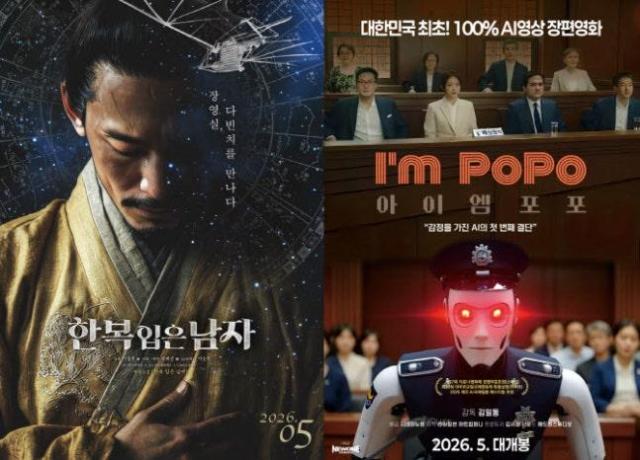
In South Korea, AI feature films have already begun to screen in theaters. In May, two films, 'I Am Popo' and 'The Man in Hanbok,' both created entirely with generative AI, premiered simultaneously. 'I Am Popo' tells the story of an AI robot born to serve humans who kills a potentially criminal human, while 'The Man in Hanbok' depicts a fictional historical drama where the Joseon scientist Jang Yeong-sil meets Leonardo da Vinci in Renaissance Florence. These films illustrate that AI filmmaking is no longer limited to short experiments but has entered the realm of feature narratives and theatrical releases.
However, alongside their potential, limitations have also emerged. Both films attracted only a few hundred viewers, indicating limited commercial impact. Beyond technical experimentation, the challenge remains of how convincingly these films can engage audiences. Generative AI struggles to maintain consistent facial expressions and backgrounds over extended periods, and producing feature films requires numerous repetitive tasks and scene-by-scene adjustments.
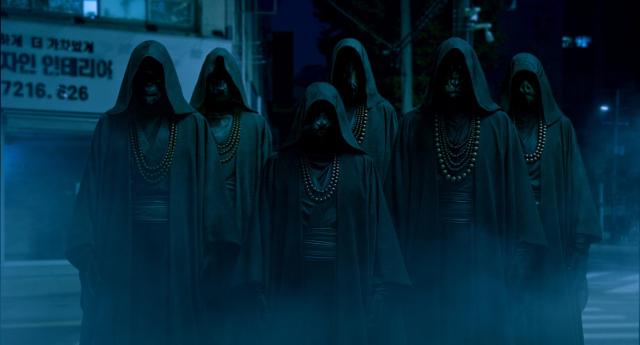
'Intermediate Realm,' directed by Kang Yoon-sung and noted as South Korea's first feature film utilizing AI, also showcases both potential and limitations. Kang revisited a screenplay he had prepared 25 years ago, modifying it with AI technology in mind, and visualized characters like the Twelve Zodiac Gods and Yeomra, the King of the Underworld, which were challenging to realize with existing budgets and technology. In an interview, he stated, "A screenwriter always thinks about the budget first. Using AI breaks that constraint. The moment you think, 'Is this possible?' you can envision a new world."
However, for AI films to be accepted into established film festivals, technical feasibility alone is insufficient. Creative ethics and rights issues must be addressed first. The controversy surrounding the short film 'Meter Reader,' which used AI to replicate the face and voice of actress Yeom Hye-ran, directly highlighted this issue in the South Korean film industry. While the production team claimed they had obtained permission for the use of her likeness, her agency stated there had been no prior consultation or approval, leading to the video's removal from public view.
Similar controversies are occurring internationally. In Hollywood, the emergence of the AI actor 'Tilly Norwood' has sparked backlash from industry professionals, including actors and directors, who fear that human performances and images could be replaced by cheap data. The American actors' and broadcasters' union is advocating for the introduction of a so-called 'Tilly Fee,' which would require AI actors to be compensated at rates comparable to human actors.
Despite these challenges, creators are not entirely rejecting the use of AI. If proper consent, compensation, and rights protection are ensured, AI can enhance production efficiency and broaden creative expression. The issue lies in the fact that sufficient standards to support these possibilities have yet to be established. For AI to become a collaborator with creators, the sources of training data, rights compensation, and the scope of consent from actors and performers must be clarified.
Film critic Yoon Seong noted, "Relying solely on the technical marvel of AI films looking 'just like real people' may be a one-dimensional approach. Ultimately, storytelling is what matters in film. The advantage of AI lies in its ability to attempt scenes that are physically difficult to realize without significant budgets, so how that technology is utilized to create unique characteristics in a work is crucial."
He added, "For now, I believe it is appropriate to evaluate AI films in a separate section. The technology is not perfect, and there are points where immersion is broken compared to live-action films. However, we must now view the issue as how to utilize and tool AI within the films we know, rather than whether to recognize AI films as films at all."
AI films are no longer confined to the realm of 'possibility.' They are already being created, screened, and becoming topics of discussion at film festivals and markets. What is now needed is to move beyond mere admiration for technological novelty to examine the completeness of these films as works, the involvement of creators, and issues of copyright, likeness rights, and industrial responsibility. As AI films begin to find their place within established film festivals, these festivals are becoming arenas to test both the potential and standards of this new medium.
* This article has been translated by AI.

Copyright ⓒ Aju Press All rights reserved.