

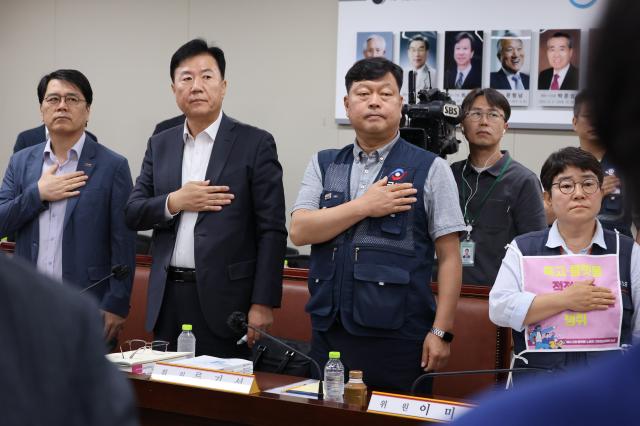
During the meeting, employer representatives argued that discussing minimum wage applications for special types of workers and platform workers falls outside the commission's authority. Ryu Ki-jung, executive director of the Korea Employers Federation, stated, "Determining minimum wage for individuals not recognized as employees is neither the role nor the authority of the Minimum Wage Commission. Special types of workers, except for a few recognized by the courts, are essentially self-employed individuals."
He further noted, "The way labor representatives are demanding minimum wage is unprecedented globally," adding that it could be perceived as an attempt to selectively benefit from both employer and employee statuses.
Yang Ok-seok, head of the Human Resources Policy Department at the Korea Federation of Small and Medium Enterprises, emphasized, "Contract agreements are made on the condition of completing a job, and no country treats contract agreements under minimum wage laws." He warned that imposing unreasonable minimum wage standards on contract workers could disrupt the distribution systems of small businesses reliant on contracts and platforms, urging a swift transition to discussions on industry-specific applications.
Conversely, labor representatives contended that it is possible to apply minimum wage standards to special types of workers and platform workers within the current system. Ryu Gi-seop, secretary-general of the Korean Confederation of Trade Unions, argued, "The Minimum Wage Commission's task is not to reassess the employment status of contract workers but to decide how to apply minimum wage standards. Delaying this decision is no longer acceptable."
He asserted that the Ministry of Employment and Labor's surveys, statistics, international examples, and the special provisions in the minimum wage law regarding contract and similar forms provide sufficient grounds for applying minimum wage to contract workers.
Ryu also pointed to the minimum wage calculation methods for delivery riders in New York and Seattle, as well as the fair pricing system in the UK and the experience of safety freight rates for domestic cargo transport workers, demonstrating that a separate minimum wage calculation method suitable for contract work is feasible.
Lee Mi-sun, vice-chairperson of the Korean Public Service and Transport Workers' Union, highlighted that delivery riders, designated drivers, and private tutors suffer from unpaid labor due to waiting times, travel times, and time lost from customer cancellations. She argued that applying minimum wage standards to special types of workers would also aid in preventing industrial accidents and strengthening social safety nets.
Sung Jae-min, a member of the public interest committee and deputy director of the Korea Labor Institute, remarked, "Through previous meetings, we confirmed that this issue encompasses various complexities and real-world conditions that require comprehensive examination. I hope today's meeting allows for a deeper discussion of the raised issues and ample listening to each other's opinions and concerns."
* This article has been translated by AI.

Copyright ⓒ Aju Press All rights reserved.