

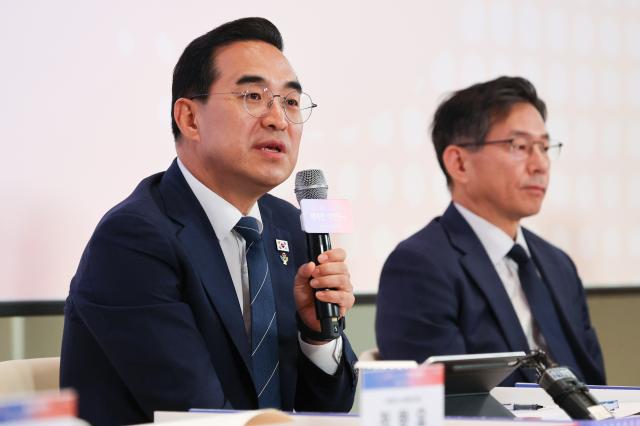
The debate was ignited during a public discussion on expenditure restructuring hosted by the Ministry of Economy and Finance on June 8. Minister Park Hong-geun emphasized the need for efficient reallocation of national finances and targeted education grants as a key area for reform.
In the context of growing concerns over tax revenue shortfalls and increasing national debt, the government expressed its determination to address the current grant system, which allocates substantial funding annually despite a decreasing student population.
Established in 1972, the local education funding system has been a driving force behind the growth of public education in South Korea. Under current law, education grants are automatically allocated to the 17 city and provincial education offices based on 20.79% of total domestic tax revenue and a portion of education taxes.
While the system contributed to the establishment of new schools and the implementation of compulsory education during periods of economic growth, it is now seen as a hindrance to financial efficiency amid an unprecedented demographic shift.
In contrast, local education superintendents and education experts argue that the government's approach oversimplifies the complexities of education funding and prioritizes economic efficiency at the expense of educational quality. They contend that a decrease in student numbers does not proportionately reduce the fixed costs associated with operating schools.
Ban Sang-jin, a professor emeritus at Jeonbuk National University and a member of the National Education Commission, stated in a phone interview, "Criticizing the funding for primary and secondary education solely based on declining student numbers is a dangerous mindset. Budget cuts should not be based on simplistic metrics; instead, we should focus on long-term investments to enhance public education infrastructure and stabilize the educational environment."
Experts emphasize that the current landscape of college admissions and class sizes necessitates maintaining or even increasing the number of classes, which in turn raises fixed costs such as teacher salaries and facility maintenance.
Professor Um Moon-young from Seoul National University warned, "It is not the time to cut budgets based solely on economic logic. We still need macro-level investments to address educational disparities and restructure small schools due to the declining school-age population. If financial pressures continue, we risk diminishing the quality of public education and driving students toward private education, creating a paradoxical effect."
Moreover, there are concerns that the post-COVID-19 era requires significant resources to address students' social and learning deficits. Lee Deok-nan, an official from the National Assembly's Legislative Research Service, noted, "The learning and social deficits among students who experienced the COVID-19 pandemic are severe. Schools need substantial financial and administrative support to restore diverse human-centered experiential opportunities and to reestablish teacher authority for safe educational activities." He argued that budget cuts would equate to abandoning this critical responsibility.
Another source of tension between the government and local education offices stems from complex financial interests regarding the integration of early childhood education and care funding. The government plans to transfer responsibilities and budgets for childcare from the Ministry of Health and Welfare and local governments to the Ministry of Education and local education offices starting next year. However, there is currently no legal guarantee for the full transfer of existing childcare budgets, leading to significant backlash from local education authorities.
Local education officials criticize the unilateral transfer of financial responsibilities from the government and local governments as a direct threat to the quality of primary and secondary education. An anonymous education official stated, "If the government pushes ahead with the integration without clearly legislating the transfer of existing childcare budgets, we will have to cover the increasing costs of early childhood education from primary and secondary education grants, which could halt necessary investments in aging school facilities and future education initiatives."
Additionally, mismatches in the timing of mandatory transfers from local governments to education offices and moves to reduce non-mandatory educational collaboration funds have further weakened the revenue structure of education offices.
Education experts suggest that instead of resorting to extreme measures that unilaterally dismantle funding barriers, a more balanced approach is needed. They propose establishing a "Local Education Cooperative Fund" where local governments and education offices contribute equally. This fund could be used flexibly for integration efforts or local care infrastructure, matching the accumulated stabilization funds from education offices during times of revenue surplus.
Furthermore, to mitigate the vulnerability of education offices to economic fluctuations that could halt core projects during revenue shortfalls, experts advocate for the establishment of a "financial smoothing system" that allows for the accumulation of funds during prosperous times and stable withdrawals during downturns, rather than drastic reductions in the domestic tax allocation ratio.
