

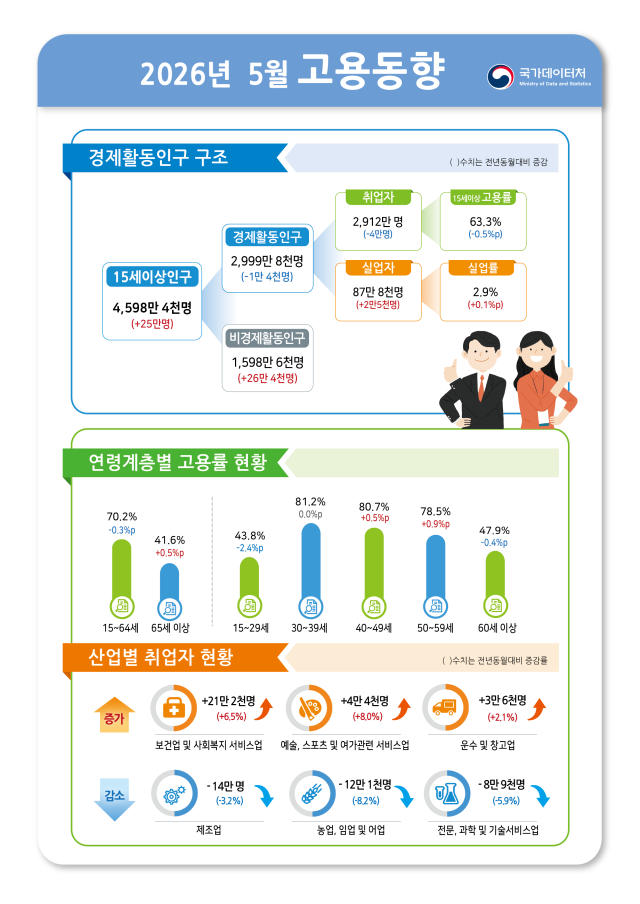
According to the "May 2026 Employment Trends" report released by the National Data Agency on June 11, the number of employed individuals fell by 40,000 from the same month last year, totaling 29.12 million. This marks the first decline since December 2024, when the number dropped by 52,000 following the declaration of a state of emergency.
The increase in employment this year peaked at 108,000 in January, but fell to the 70,000 range by April after maintaining around 200,000 in February and March.
Notably, significant declines were observed in manufacturing (-140,000), agriculture, forestry, and fishing (-121,000), and professional, scientific, and technical services (-89,000). The drop in manufacturing employment is the largest since February 2019, when it decreased by 151,000.
Bin Hyun-jun, head of the Social Statistics Bureau at the National Data Agency, stated, "As the Middle East conflict prolongs, supply and demand disruptions have occurred in certain sectors, and high oil prices have impacted various industries, leading to an overall decline in employment. Notably, the automotive and industrial plastics sectors have seen significant job losses within manufacturing."
While semiconductors have driven export growth, they have not contributed significantly to employment increases. The agency noted that semiconductors account for a relatively small share of total employment.
Bin explained, "In regional employment surveys, semiconductors represent about 4% of total employment. According to Bank of Korea data, semiconductors are classified as having a relatively low employment multiplier compared to other manufacturing sectors, indicating their limited impact on job creation relative to industrial production increases."
The retail sector's struggles are attributed to long-term trends such as online shopping, automation, and unmanned services.
Last month, the employment rate for individuals aged 15 to 29, as per OECD standards, was 70.2%, a decrease of 0.3 percentage points from the previous year. The overall employment rate for those aged 15 and older saw its largest drop in over five years since February 2021.
The youth employment crisis persists, with 255,000 fewer employed individuals aged 15 to 29 compared to last year, the largest decline since January 2021, when it fell by 314,000. The employment rate for this age group also dropped by 2.4 percentage points from May of last year, settling at 43.8%.
Bin noted, "The recent shift from public recruitment to on-demand hiring, along with a growing preference for experienced hires, appears to have contributed to the decline in youth employment. Particularly, sectors where young people typically find jobs, such as information technology and hospitality, have experienced reductions, leading to a drop in the employment rate."
Last month, the total number of unemployed individuals reached 878,000, an increase of 25,000 from the previous year, with the unemployment rate rising by 0.1 percentage points to 2.9%.
The economically inactive population increased by 264,000, with those on leave rising by 47,000.
The government's support measures for high oil prices and the youth New Deal initiatives have yet to show significant effects. A Ministry of Finance and Economy official stated, "To improve youth employment, we will expedite the implementation of key tasks under the 'Youth New Deal' and establish a basic plan for employment stability amid industrial transitions as soon as possible."
* This article has been translated by AI.
Copyright ⓒ Aju Press All rights reserved.