

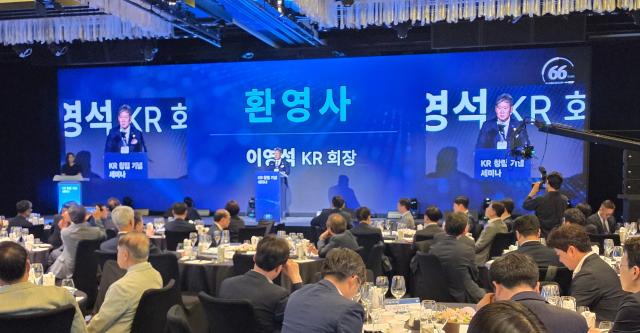
On June 11, KR hosted a technology seminar in Seoul to commemorate its 66th anniversary, focusing on the theme of 'Strengthening K-Maritime Leadership through AI.'
In his welcoming remarks, KR Chairman Lee Yong-seok stated, "In this era of significant transformation driven by decarbonization and the convergence of AI and digital technologies, it is challenging to maintain competitiveness without technological innovation. KR is committed to advancing AI integration across all operational areas to contribute to Korea's leadership in global maritime standards."
Park Jeong-seok, President of the Korea Shipping Association, emphasized, "The global maritime environment is rapidly changing due to decarbonization regulations, supply chain restructuring, and digital transformation. The technological standards and digital solutions developed by Korean Register, incorporating AI and AX, will be essential for supporting the future competitiveness of our shipping industry."
The first keynote speech was delivered by Kim Hyung-kwan, CEO of HD Hyundai Heavy Industries. He discussed the changes AI technology will bring to the shipbuilding industry and outlined HD Hyundai's digital transformation strategy under the theme 'Next Voyage in the AI Era.'
Kim noted that with a declining working-age population and increasing technological competition from China, AI and digital transformation have become essential for maintaining the competitiveness of the domestic shipbuilding sector. He stressed the need to enhance productivity and competitiveness by integrating design and production data through AI-based digital manufacturing (DM) and accelerating the establishment of smart shipyards.
The second keynote address was given by Yoo Hyun-kyung, Vice President of Microsoft Korea, who spoke on 'Preparing for the Agentic AI Era: What Should Companies Do?' She explained the direction of AI technology development and corporate response strategies. Yoo pointed out that merely adopting AI is insufficient and that organizations must redesign their culture and workflows around AI to enhance competitiveness.
In the third keynote speech, Kim Dae-heon, Vice President of KR, introduced KR's digital transformation strategy under the theme 'KR: Technological Innovation and Future Challenges through AX.' He stated, "We must transition to a digital register through AX, which embeds AI across all work processes, and establish an intelligent maritime service system."
The event was attended by KR Chairman Lee Yong-seok, Lee Soo-ho, Director of the Maritime Safety Bureau at the Ministry of Oceans and Fisheries, Park Jeong-seok, President of the Korea Shipping Association, as well as numerous representatives from the domestic shipbuilding, shipping, and equipment industries, along with officials from government agencies.
* This article has been translated by AI.
Copyright ⓒ Aju Press All rights reserved.