

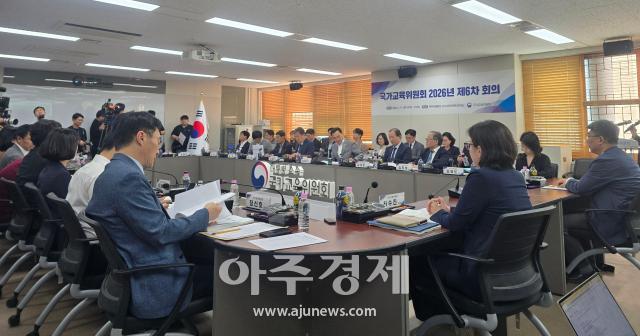
The Commission convened its 6th meeting on June 11 at the Government Seoul Building, where it reviewed the Education Ministry's request for revisions to the middle and high school history curriculum. The meeting lasted over an hour and included Chairman Cha Jeong-in, Secretary General Choi Soo-jin, and members Ban Sang-jin and Kim Young-do, along with Education Ministry officials including Vice Minister Choi Eun-ok and School Policy Director Kim Young-jin.
Education Ministry: "Revisions are essential to combat historical distortion and foster critical thinking"
The discussion was sparked by three key proposals from the Education Ministry: 1) to increase the proportion of modern history (from the opening of ports to the present) in middle school history textbooks from the current 20% to over 30%; 2) to secure instructional time for middle school social studies (including history and ethics); and 3) to introduce a new elective course titled in high school.
Kim Young-jin, the Education Ministry's School Policy Director, emphasized the need for these revisions, stating, "The rampant dissemination of distorted historical materials online and on platforms like YouTube complicates classroom instruction and negatively impacts students' historical understanding." He added that the new course aims to help students critically assess the perspectives behind historical content, asserting that verifying sources from diverse viewpoints is essential for developing democratic citizens.
Regarding the increase in modern history content, he noted, "Currently, modern history constitutes only 20% of the middle school history curriculum, which leads to significant omissions of important historical facts. To learn history in a contextual and in-depth manner, we must increase the proportion of modern history in Korean history education."
Kim Young-jin, the Education Ministry's School Policy Director, emphasized the need for these revisions, stating, "The rampant dissemination of distorted historical materials online and on platforms like YouTube complicates classroom instruction and negatively impacts students' historical understanding." He added that the new course aims to help students critically assess the perspectives behind historical content, asserting that verifying sources from diverse viewpoints is essential for developing democratic citizens.
Regarding the increase in modern history content, he noted, "Currently, modern history constitutes only 20% of the middle school history curriculum, which leads to significant omissions of important historical facts. To learn history in a contextual and in-depth manner, we must increase the proportion of modern history in Korean history education."
Disagreement among commissioners: "Increasing hours infringes on school autonomy and equity among subjects"
However, there was a clash between the Commission's members over the Education Ministry's proposals. Concerns about equity among subjects were raised, particularly regarding adjustments to middle school history hours and content. Commissioner Kim Kyung-hoe pointed out, "The Education Ministry's idea of increasing modern history content while maintaining or expanding history hours contradicts the principle of school autonomy." He suggested that increasing hours for one subject would necessitate reducing hours for others, which is impractical for current third-year middle and high school students and inappropriate from an equity standpoint. He proposed further discussion on the matter. Commissioner Lee Kwang-ho also expressed skepticism about adopting the Education Ministry's proposal as is, highlighting the haste of the discussions.
Debate over the introduction of : "A solution through integrated subjects" vs. "Resistance from teachers and increased burden"
The most contentious issue during the meeting was the proposal to introduce the high school course . While commissioners agreed on the importance of the course's intent, they suggested modifying it to an integrated elective that encompasses social studies and ethics.
Commissioner Lee Kwang-ho argued, "In the diverse media environment of the AI era, many social phenomena cannot be addressed through text alone, so it is advisable to revise it into an integrated subject that allows for a combined understanding of history and society." Commissioner Kim Kyung-hoe added, "Issues of information distortion, bias, and discrimination involve not just history but also geographical and ethical content," and proposed a modification to an integrated elective format, noting that the increasing number of high school subjects could be burdensome.
However, there was significant pushback from education officials and members with backgrounds as parents and teachers. Commissioner Kang Eun-hee, the Daegu City Education Superintendent, criticized the proposal, stating, "Creating a new subject seems excessively irresponsible." She argued that media literacy is already adequately covered in existing language courses, questioning the need for a new subject that appears to focus on superficial analysis without in-depth research. She warned that introducing another subject in an already crowded selection would disrupt the normal operation of schools.
Commissioner Yoon Geon-young, the Chungbuk Education Superintendent, also expressed concerns about the risks of partial revisions. He stated, "Curriculum changes require thorough preparation, and developing and certifying textbooks can take at least three to four years. We must seriously consider whether the course is truly urgent at this time. If passed without sufficient professional review and discourse, who will guide and take responsibility in schools?"
Concerns were also raised about the expertise and receptiveness of teachers in the field. Commissioner Kim Joo-sung cautioned, "Creating integrated subjects must be approached with great care," recalling past experiences where ambiguous subject identities made it difficult to establish specialized teachers. Commissioner Ahn Sang-hyun noted that education is highly path-dependent, and even minor changes to textbooks can provoke significant resistance from teachers, who may face challenges in managing multiple subjects and assessment methods. Commissioner Kim Young-do, the President of the Korea Association of Community Colleges, questioned whether frontline teachers are prepared to teach critique and analysis, warning that it could inadvertently instill errors and biased perceptions of history in students.
Conversely, a minority opinion argued for preserving the original intent of strengthening history education. Commissioner Jeon Eun-young, representing parents, stated, "There is a growing sense of urgency and demand for history education among parents. If we merge it into an integrated subject, we risk losing the distinctiveness and context of history education, so I agree with emphasizing the identity of history education to promote historical discussions."
Commissioner Lee Kwang-ho argued, "In the diverse media environment of the AI era, many social phenomena cannot be addressed through text alone, so it is advisable to revise it into an integrated subject that allows for a combined understanding of history and society." Commissioner Kim Kyung-hoe added, "Issues of information distortion, bias, and discrimination involve not just history but also geographical and ethical content," and proposed a modification to an integrated elective format, noting that the increasing number of high school subjects could be burdensome.
However, there was significant pushback from education officials and members with backgrounds as parents and teachers. Commissioner Kang Eun-hee, the Daegu City Education Superintendent, criticized the proposal, stating, "Creating a new subject seems excessively irresponsible." She argued that media literacy is already adequately covered in existing language courses, questioning the need for a new subject that appears to focus on superficial analysis without in-depth research. She warned that introducing another subject in an already crowded selection would disrupt the normal operation of schools.
Commissioner Yoon Geon-young, the Chungbuk Education Superintendent, also expressed concerns about the risks of partial revisions. He stated, "Curriculum changes require thorough preparation, and developing and certifying textbooks can take at least three to four years. We must seriously consider whether the
Concerns were also raised about the expertise and receptiveness of teachers in the field. Commissioner Kim Joo-sung cautioned, "Creating integrated subjects must be approached with great care," recalling past experiences where ambiguous subject identities made it difficult to establish specialized teachers. Commissioner Ahn Sang-hyun noted that education is highly path-dependent, and even minor changes to textbooks can provoke significant resistance from teachers, who may face challenges in managing multiple subjects and assessment methods. Commissioner Kim Young-do, the President of the Korea Association of Community Colleges, questioned whether frontline teachers are prepared to teach critique and analysis, warning that it could inadvertently instill errors and biased perceptions of history in students.
Conversely, a minority opinion argued for preserving the original intent of strengthening history education. Commissioner Jeon Eun-young, representing parents, stated, "There is a growing sense of urgency and demand for history education among parents. If we merge it into an integrated subject, we risk losing the distinctiveness and context of history education, so I agree with emphasizing the identity of history education to promote historical discussions."
Chairman Cha Jeong-in: "Modern history content is lacking compared to global standards... We will proceed cautiously"
As the debate among the commissioners continued without resolution, Chairman Cha Jeong-in referenced global standards to clarify the nature of the discussions. He stated, "Internationally, the proportion of modern history ranges from 35% to 60%, and in Germany, modern history is taught as a significant majority in high school to cultivate global citizens. Compared to this, our 20% is too low. We need to move beyond fragmented narratives and superficial descriptions to provide contextual storytelling."
Chairman Cha acknowledged the concerns raised by commissioners about the portrayal of Korean history as a conflict between progressives and conservatives, as well as the lack of context in the narratives of industrialization and economic development that leave students without a sense of pride. However, he made it clear that he would not rush to a conclusion, reflecting the confusion and concerns in the field.
He stated, "While there is an educational necessity and it is a task we must undertake, we cannot rush given the difficulties in subject organization and the significant concerns of parents." He declared that the proposals for the course and the integrated subject modifications would undergo formal review and coordination by expert committees and monitoring groups before being discussed again at the next meeting.
Following the meeting, the Commission announced via a separate text notification that it would conduct further discussions at the next meeting, considering various aspects based on the matters discussed today.
Chairman Cha acknowledged the concerns raised by commissioners about the portrayal of Korean history as a conflict between progressives and conservatives, as well as the lack of context in the narratives of industrialization and economic development that leave students without a sense of pride. However, he made it clear that he would not rush to a conclusion, reflecting the confusion and concerns in the field.
He stated, "While there is an educational necessity and it is a task we must undertake, we cannot rush given the difficulties in subject organization and the significant concerns of parents." He declared that the proposals for the
Following the meeting, the Commission announced via a separate text notification that it would conduct further discussions at the next meeting, considering various aspects based on the matters discussed today.
* This article has been translated by AI.
Copyright ⓒ Aju Press All rights reserved.