

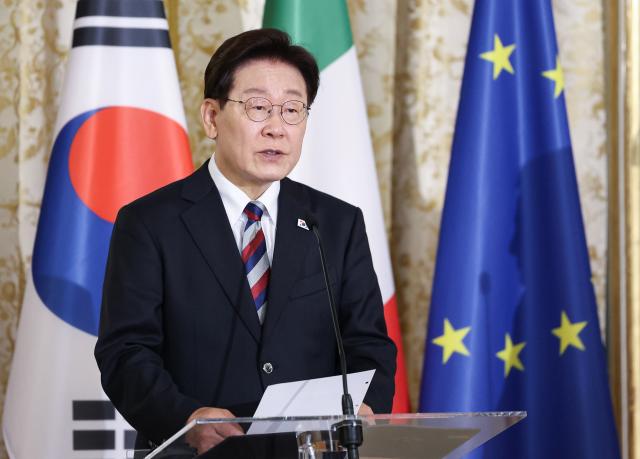
In a post on social media, President Lee noted, "Former Speaker Kono was a respected elder statesman in Japan who worked to build reconciliation and trust with neighboring countries, playing a significant role in the development of Japan-Korea relations."
He described the 1993 Kono Statement as the first official document to acknowledge the historical facts that left deep scars on the honor and dignity of many women regarding the comfort women issue, emphasizing Kono's heartfelt apology and remorse.
President Lee added, "Former Speaker Kono faced historical facts without avoidance and expressed his determination not to repeat the same mistakes." He remarked that the courage to reflect on the history contained in the Kono Statement and the empathy for the victims have become crucial cornerstones for developing a future-oriented relationship between Japan and Korea. He pledged to continue efforts to foster a future-oriented Japan-Korea relationship based on mutual respect and trust, cherishing the achievements and noble intentions left by the late Kono.
Prime Minister Kim Min-seok also expressed his condolences on social media, noting that Kono was close to his political mentor, former President Kim Dae-jung, and recognized the coercion involved in the mobilization of comfort women, making him a rare politician in Japan.
According to Japanese public broadcasters NHK and Asahi Shimbun, Kono passed away on June 8. As Chief Cabinet Secretary, he issued the Kono Statement on August 4, 1993, acknowledging for the first time the coercive nature of the comfort women issue, stating that life in comfort stations was painful under forced circumstances.
* This article has been translated by AI.
Copyright ⓒ Aju Press All rights reserved.