

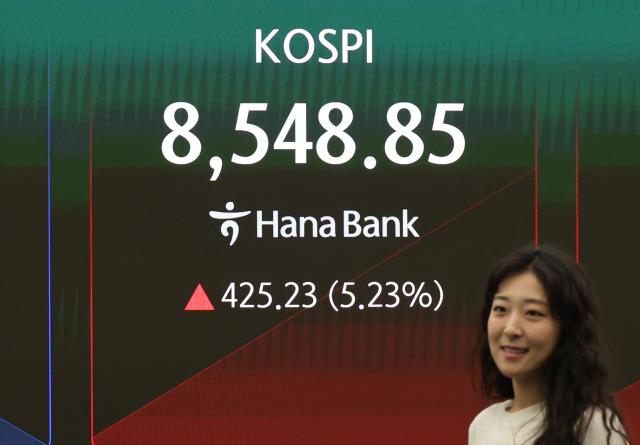
The KOSPI index is displayed on the board at Hana Bank's dealing room in Jung-gu, Seoul, on June 15, following a rise due to the ceasefire agreement in the U.S.-Iran war. [Photo=Yonhap News]
Last month, foreign investors significantly sold off domestic stocks, leading to a major outflow of securities investment funds for the first time in two months. Over $31.8 billion left the stock market, marking the largest outflow since records began, while bond investments saw an increase due to the inclusion effect in the World Government Bond Index (WGBI).
According to the Bank of Korea's report on 'International Financial and Foreign Exchange Market Trends' released on June 15, foreign securities (stocks and bonds) experienced a net outflow of $26.15 billion in May. This indicates that the amount of foreign capital leaving the domestic securities market exceeded the inflow.
The net outflow of foreign securities investment reached $36.55 billion in March, the highest on record, followed by the second-largest outflow in May.
Foreign stock investments saw a net outflow of $31.83 billion, the largest since the data was first compiled. This continued a trend of five consecutive months of outflows, driven by portfolio rebalancing and profit-taking amid rising domestic stock prices.
In contrast, bond investments recorded a net inflow of $5.68 billion, a significant increase from the previous month's inflow of $550 million. This surge is attributed to inflows from WGBI-tracking funds and bargain buying due to rising market interest rates.
The credit default swap (CDS) premium for Korean government bonds (based on five-year foreign exchange stabilization fund bonds) averaged 25 basis points, down from 31 basis points the previous month. The short-term external borrowing premium rose from 19 basis points to 24 basis points due to longer maturities, while the medium- to long-term external borrowing premium remained stable at 44 basis points, down from 45 basis points the previous month.
Last month, the fluctuation rate of the won-dollar exchange rate was 0.45%, a decrease from 0.59% in the previous month. The fluctuation range also decreased to 6.6 won, down from 8.9 won in April.
A Bank of Korea official explained, "The exchange rate rose due to increased uncertainty in the Middle East and the net selling of domestic stocks by foreigners, but the increase was mitigated by the government's market stabilization messages and news of the National Pension Service's forward foreign exchange sales."
* This article has been translated by AI.
Copyright ⓒ Aju Press All rights reserved.