

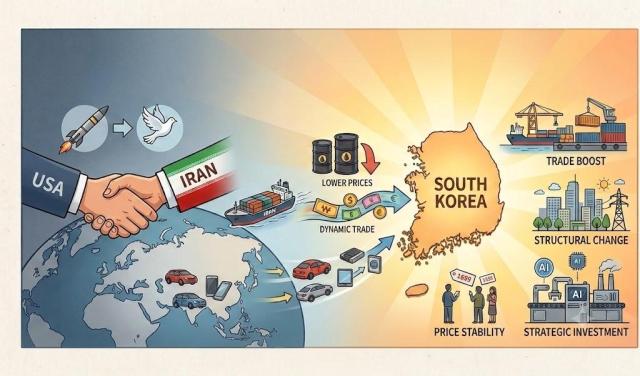
The U.S. and Iran's move toward a peace agreement has brought renewed hope to South Korea's economy, which has been mired in high inflation, high exchange rates, and high interest rates. Amid a transformative boom in the artificial intelligence (AI) sector, the semiconductor industry is experiencing robust growth, yet economic polarization is deepening more than ever.
The gap is widening between those receiving substantial bonuses and those struggling for survival, as well as between those inheriting wealth through real estate and those facing the burden of rising rental costs due to the disappearance of jeonse (long-term lease) options.
The end of the U.S.-Iran conflict represents a significant macroeconomic shift. However, it should not be viewed merely as a bonus for economic recovery. It must serve as a crucial moment to address structural challenges and fundamentally transform our economy.
According to analyses from major research institutions like the Hyundai Research Institute, a 10% drop in international oil prices could lead to an approximate 0.27% increase in South Korea's GDP and a 0.41% rise in gross national income (GNI). While the numerical benefits of reduced costs for key industries like refining and chemicals and improved trade balances are important, the core issue lies elsewhere.
We must utilize the financial relief from falling oil prices to invest in transitioning from a high-energy-consuming manufacturing structure to an eco-friendly, high-efficiency industrial framework. Only by leveraging this opportunity can we achieve meaningful structural improvements.
Stimulating domestic demand and stabilizing prices for ordinary citizens must also be approached with a focus on changing the economic structure. The Korea Development Institute (KDI) states that in a context of severely depressed domestic consumption, falling oil prices can act as a strong catalyst, potentially lowering consumer prices by about 0.46%.
Reducing distribution and logistics costs, along with easing pressures from rising public utility fees, will help restore the purchasing power of households, invigorating the private consumption market, which accounts for nearly half of GDP.
We must not settle for merely increasing consumption. The focus should be on bridging the gaps created by high inflation. We need to address the chronic structural vulnerabilities of small businesses and local economies while promoting a virtuous cycle of household income distribution.
This is an opportunity to transform a fragile domestic economy, which has relied on debt, into a self-sustaining and robust structure.
Geopolitical instability in the Middle East has led to a flight of capital toward the safe-haven U.S. dollar, resulting in the excessive depreciation of the Korean won. The agreement between the two countries will help calm market fears and stabilize exchange rates, improving profit margins for businesses. It will also alleviate the dual challenges of soaring shipping costs and prolonged logistics timelines.
We must not limit ourselves to merely securing price competitiveness or short-term profit preservation. Now is the time to fundamentally diversify supply chains that are overly concentrated in specific regions and sectors, while making bold investments in next-generation semiconductors, AI, and aerospace—key strategic technologies that will shape the future of humanity.
The financial resources and market stability gained from reduced geopolitical risks should empower our tech companies to gain an edge in the global competition for technological supremacy.
With external uncertainties easing, it is the optimal time for the government and businesses to collaborate on bold regulatory reforms and push for a significant transition to high-value-added advanced industries. We must overcome the limitations of an economy that has been reactive to external shocks and focused on short-term fixes.
We need to ensure that the positive external factors do not result in just a slight uptick in growth rates, but instead provide the wisdom and agility necessary to withstand the impending global multifaceted crises.
* This article has been translated by AI.
Copyright ⓒ Aju Press All rights reserved.