

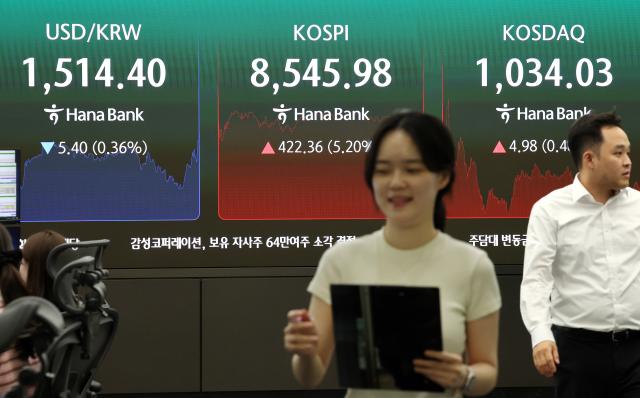
The KOSPI index soared as geopolitical risks in the Middle East eased. Following the announcement of a peace agreement between the U.S. and Iran, investor sentiment improved rapidly, raising expectations that the KOSPI could reach the historic 9,000 mark. However, caution remains regarding the upcoming Federal Open Market Committee (FOMC) meeting and future interest rate trajectories.
On June 15, the Korea Exchange reported that the KOSPI closed at 8,545.98, up 422.36 points (5.2%) from the previous trading day. At one point, the index surged by 479.86 points (5.91%) to reach 8,603.48, briefly touching the 8,600 level. The KOSPI also triggered a trading halt for the second consecutive day due to program buying.
The surge in the stock market was driven by the reduction of geopolitical uncertainties in the Middle East. Early on June 15, U.S. President Donald Trump announced via social media platform Truth Social that a peace agreement with Iran had been reached. This effectively ended a conflict that began on February 28 with U.S.-Israeli airstrikes on Iran, concluding after 106 days. Both sides agreed to cease military operations across all fronts, including Lebanon, and to sign a formal memorandum of understanding (MOU) in Switzerland on June 19.
The news of the peace agreement also helped lower international oil prices and the won-dollar exchange rate, which had been pressuring the domestic economy and stock market. On June 15, the won-dollar exchange rate fell by 8.7 won to 1,511.1, aided by foreign capital inflows into the domestic stock market. Brent crude futures for August delivery and West Texas Intermediate (WTI) futures for July delivery dropped to $83 and $80 per barrel, respectively.
The stabilization of oil prices and the exchange rate led to significant foreign investment. On this day, foreign investors net purchased approximately 1 trillion won in the stock market, contributing to the index's rise.
Analysts believe that with the easing of inflationary pressures from oil prices and exchange rates, the KOSPI's long-term potential has significantly expanded. However, geopolitical uncertainties remain until the final signing on June 19, along with monetary policy risks from the FOMC meeting scheduled for later in the week. There is also the possibility of unexpected actions from Israel, and scenarios regarding changes in the Federal Reserve's dot plot remain. Kim Hak-kyun, head of research at Shin Young Securities, stated, "While inflation pressures have decreased, the direction of interest rates, especially with potential changes in the Fed chair, will be an important risk going forward."
* This article has been translated by AI.
Copyright ⓒ Aju Press All rights reserved.