

The 'Middle East risk' that has overshadowed the South Korean economy for over three months is expected to be resolved soon. This risk has been identified as one of the three major external factors affecting the economy, alongside interest rate hikes and the potential for an artificial intelligence (AI) bubble. With expectations that the Middle East risk will soon dissipate, optimism for the KOSPI reaching 10,000 has resurfaced in the stock market. Improved investor sentiment following peace negotiations between the U.S. and Iran has led experts to weigh the possibility of further gains in the second half of the year.
◆ Middle East Risk Eases After Three Months
On June 15, the KOSPI index surged by 5.2% following news of an agreement between the U.S. and Iran. At one point, the index rose nearly 6%, recovering above the 8,600 mark, prompting a buying sidecar. Analysts believe that the easing of tensions in the Middle East could lead to a decline in international oil prices and reduced inflationary pressures.
Market analysts widely agree that one of the obstacles to the KOSPI reaching 10,000 has been removed. With the end of the Middle Eastern conflict and anticipated corporate earnings in the second half of the year, many expect the upward trend in the KOSPI to continue.
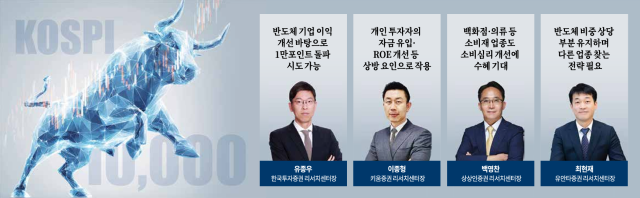
Yoo Jong-woo, head of research at Korea Investment & Securities, projected the KOSPI's range for the second half to be between 8,000 and 11,000. He stated, "A breakthrough above 10,000 is possible based on improved earnings from semiconductor companies."
Lee Jong-hyung, head of research at Kiwoom Securities, also forecasted a performance-driven bull market. He noted, "The increase in corporate earnings will support stock price rises in the second half, with inflows from individual investors, improvements in return on equity (ROE) due to policy effects, and valuation attractiveness compared to global markets acting as upward factors."
Choi Hyun-jae, head of research at Yuanta Securities, predicted that the current official forecast is 10,000, and if conditions develop positively, it could reach 11,600. He explained, "If tensions in the Middle East ease and energy prices stabilize, inflationary burdens will decrease, and concerns about U.S. monetary policy may also ease. Stability in oil prices and bond yields will positively impact stock market valuations."
Baek Young-chan, head of research at Sangsin Securities, remarked, "Oracle's earnings have reaffirmed demand for AI, and Samsung Electronics and SK Hynix's second and third-quarter results are likely to exceed market expectations. Improved earnings and expanded AI demand will lead to further index gains." He added, "The likelihood of the KOSPI reaching 10,000 in the third quarter is high."
Interest in sectors beyond semiconductors is also increasing. Analysts believe that relatively neglected sectors such as finance, chemicals, and consumer goods may benefit from a rotation in the market.
Baek noted, "The financial sector is positively affected by changes in the interest rate environment, and energy sectors like refining and chemicals also have room for further gains. Consumer goods sectors such as department stores and apparel are expected to benefit from improved consumer sentiment." Yoo also advised paying attention to the potential for improved earnings in the chemical sector following the resolution of the Middle East issue.
◆ The Biggest Risk in the Second Half is Interest Rates
The common risk factors for the second half include U.S. monetary policy and changes in the semiconductor industry. Choi stated, "The market's upward momentum relies on improved semiconductor earnings and expectations for U.S. interest rate cuts. If either of these falters, the market may reconsider its direction." He warned that if Samsung Electronics and SK Hynix's results fall short of expectations, investor sentiment could weaken.
Lee pointed out that after the second-quarter earnings announcements, discussions about profit peak-out may resurface, and the direction of the Federal Reserve's monetary policy and the continued strength of the dollar are also key variables. Baek identified the possibility of further interest rate hikes in the U.S. as a risk factor.
Regarding investment strategies, many experts suggested maintaining a semiconductor-focused portfolio while managing volatility.
Choi emphasized, "Most of this year's earnings growth is coming from the semiconductor and IT sectors, so it is essential to maintain a significant portion in semiconductors while seeking opportunities in other sectors." Baek advised that given the ongoing demand for AI and improved earnings, there is no need to rush to sell semiconductors.
Lee cautioned, "In a volatile market like this, investors should be wary of both chasing purchases and panic selling. It is advisable to check the proportion of AI and semiconductor investments while diversifying sectors and securing some cash to manage volatility." He added, "Long-term investors should maintain a perspective of gradually buying quality stocks that have not been fundamentally damaged, while refraining from short-term directional bets."
* This article has been translated by AI.
Copyright ⓒ Aju Press All rights reserved.