

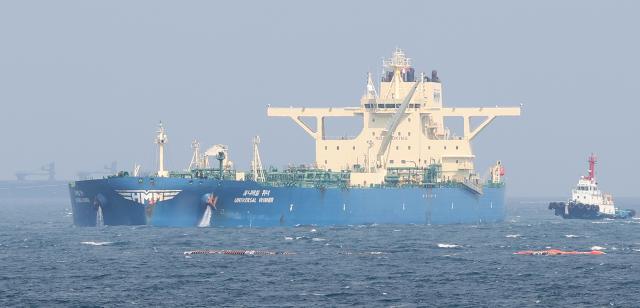
The HMM supertanker 'Universal Winner,' the first South Korean vessel to exit the Strait of Hormuz since the Middle East conflict, arrives off the coast of Ulsan for oil unloading on June 10. [Photo=Yonhap News]
The decline in international oil prices has led to a decrease in import prices for the second consecutive month in May. Analysts expect that the easing of supply concerns from the Middle East due to a peace agreement between the U.S. and Iran will further alleviate upward pressure on import prices in June.
According to the Bank of Korea's statistics released on June 16, the import price index in won terms (preliminary figure, 2020 level set at 100) stood at 168.05 in May, down 0.3% from the previous month, marking a second month of decline.
The drop in import prices was influenced by falling prices of mineral products, coal, and petroleum products as international oil prices decreased. The average price of Dubai crude oil fell by 2.4%, from $105.70 per barrel in April to $103.14 in May.
Raw materials, particularly mineral products like crude oil, decreased by 1.0% compared to the previous month. Intermediate goods saw a decline in coal and petroleum products, but an increase in primary metal products resulted in a flat reading (0.0%) month-over-month. Capital goods and consumer goods each rose by 0.3%. Notable declines were seen in specific items such as butadiene (-27.9%), diesel (-19.2%), and naphtha (-7.5%).
In May, the export price index (in won terms) rose to 188.58, an increase of 0.3% from the previous month, marking the 11th consecutive month of growth. Compared to the same month last year, the export price index increased by 46.9%.
The rise in export prices was attributed to increases in computer, electronic, and optical equipment, amid a rising won-dollar exchange rate. The average exchange rate rose by 0.2%, from 1,487.39 won in April to 1,490.11 won in May.
Agricultural and fishery products saw a 1.8% increase, primarily driven by frozen seafood. While coal and petroleum products decreased, the overall industrial goods category rose by 0.3%, supported by gains in computer, electronic, and optical equipment, as well as primary metal products. Significant declines were noted in diesel (-18.9%), jet fuel (-12.7%), and ethylene (-17.0%).
The trade index for May (in dollar terms) showed that the export volume index was 139.12, up 14.7% compared to the same month last year. The export value index was recorded at 209.24, reflecting a 56.8% increase. Imports also saw growth, with the volume index at 116.13, up 5.2% year-over-year, and the value index at 155.69, up 21.3%.
The terms of trade index, which indicates how much a unit of exports can purchase in imports, stood at 112.18, reflecting an 18.7% increase year-over-year, as export prices (up 36.8%) rose significantly more than import prices (up 15.3%).
The income terms of trade index rose to 156.06, a 36.1% increase, driven by gains in both the terms of trade index and the export volume index.
Lee Moon-hee, head of the price statistics team at the Bank of Korea, stated, "As of June 12, the price of Dubai crude has fallen by 11.8% compared to the previous month, while the won-dollar exchange rate has risen by 2.3%. We expect that the peace agreement between the U.S. and Iran will somewhat ease upward pressure on import prices."
However, he cautioned that "the pace of normalization of oil facilities in the Middle East and the conditions for passage through the Strait of Hormuz could affect international oil prices, raw material prices, and exchange rate trends. There remains uncertainty, and we will need to monitor future developments closely."
* This article has been translated by AI.
Copyright ⓒ Aju Press All rights reserved.