

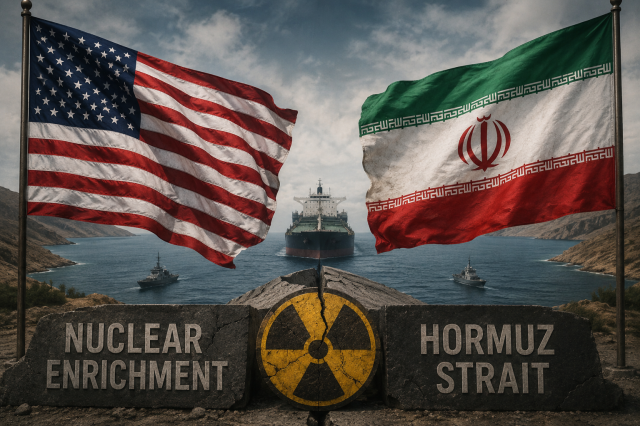
The United States and Iran have signed an electronic memorandum of understanding (MOU), but key issues such as tolls for the Hormuz Strait, sanctions relief, and the release of frozen funds remain unresolved and will be addressed in follow-up negotiations over the next 60 days.
On June 15, local time, Reuters reported that U.S. President Donald Trump, Vice President JD Vance, and Iranian Parliament Speaker Mohammad Bagher Ghalibaf signed the MOU electronically. An official signing ceremony is scheduled for June 19 in Geneva, Switzerland.
Vice President Vance stated in an interview with ABC News' "Good Morning America" that the U.S. and Iran have already digitally signed the agreement. President Trump confirmed, saying, "The agreement has been signed, and the Hormuz Strait is partially open, with full access expected on the 19th."
However, the text of the agreement has not yet been made public. A senior U.S. official indicated that the document would be released within 24 to 48 hours, but President Trump mentioned that it might be disclosed after the official signing event on the 19th. Specific provisions are expected to be clarified once the text is available.
The most contentious issue is the toll for passage through the Hormuz Strait. U.S. officials noted that the MOU includes a provision for toll-free passage for 60 days. However, it remains uncertain whether this principle will be maintained in the long term. In a CNBC interview, Vice President Vance expressed hope that the Hormuz Strait would remain toll-free in the long run, stating that related conditions would be discussed during technical negotiations.
Sanctions relief and the release of frozen funds will not occur immediately. Vice President Vance clarified in the ABC News interview that no funds would be paid to Iran as a result of the MOU signing, and this will not change in the future. He explained that sanctions relief could be possible if Iran takes steps to remove highly enriched uranium and accepts verification measures.
A senior U.S. official also stated that the U.S. is prepared to consider sanctions relief and the release of frozen funds, but emphasized that this is contingent upon Iran's compliance. If Iran demonstrates a willingness to fulfill its commitments, the U.S. may review corresponding measures.
The issue of Israel's withdrawal from Lebanon was not included in the MOU conditions. A U.S. official clarified that the withdrawal of Israeli forces from Lebanon is not a prerequisite for the U.S.-Iran agreement, and that Israel retains the right to defend itself in the event of attacks by Hezbollah.
The U.S. plans to maintain its troop levels in the Middle East until a final agreement is reached.
* This article has been translated by AI.
Copyright ⓒ Aju Press All rights reserved.