

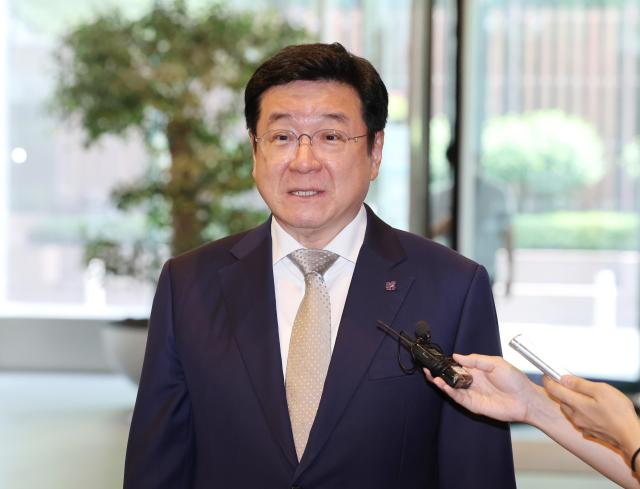
Lee Chan-hee, chairman of Samsung's Compliance Committee, recently stated that investments in the Honam region should be evaluated based on "corporate sustainability." While he acknowledged the need for balanced regional development, he emphasized that large-scale semiconductor investments should be driven by management decisions considering location, workforce, power supply, water resources, and supply chains, rather than political demands.
On June 16, ahead of a regular meeting of the Samsung Compliance Committee at the Samsung Life Insurance building in Seocho, Seoul, Lee addressed questions from reporters regarding the proposal to establish a semiconductor factory in the Honam region. He reiterated that the Compliance Committee does not directly influence specific investment decisions but reaffirmed that "Samsung is a company for the people."
Recently, there have been calls from both the political and business sectors to attract large-scale semiconductor production facilities to Honam, as current production bases are concentrated in the Seoul and Chungcheong regions. The argument is that, given the strategic importance of semiconductors to the national economy, production sites should be diversified for balanced regional development.
However, establishing a semiconductor factory is not as simple as securing land. It requires substantial power and water resources, a stable transportation network, a robust ecosystem of partner companies, and a skilled workforce. The more advanced the manufacturing process, the more tightly integrated the supply chains for equipment, materials, and components must be. The investment involved can reach tens of trillions of won.
Lee's comments reflect a principled stance considering these realities. He indicated that Samsung's investment decisions cannot be made solely based on regional distribution but must also take into account corporate competitiveness and national industrial competitiveness. The Compliance Committee's emphasis on lawful and sustainable management ultimately aligns with responsible decision-making over reckless investments.
Samsung Electronics currently operates semiconductor production bases primarily in Pyeongtaek, Hwaseong, and Giheung. Investments in advanced memory and foundry services are concentrated in areas where existing infrastructure, workforce, and partner networks are already established. The expansion of the Yongin semiconductor cluster and the Pyeongtaek campus follows the same rationale.
The proposal for a factory in Honam presents a challenging dilemma for Samsung. While the justification of balanced regional development is significant, actual investments require a comprehensive package that includes power networks, water resources, workforce training, relocation of partner companies, and logistics infrastructure. Without sufficient support from the government and local authorities, it would be difficult for the company to shoulder the burden alone.
In the business community, Lee's remarks are seen as setting boundaries for Samsung's investment principles. As a major player in the national economy, Samsung cannot ignore community expectations. At the same time, any investment failures would impact shareholders, employees, partner companies, and the national economy as a whole.
Meanwhile, the Samsung Compliance Committee is an independent external body that monitors the lawful management of Samsung's major affiliates. It does not have direct authority over investment decisions but has consistently provided input on key group issues, including responsible management, governance, labor relations, and compliance risks.
With the addition of Samsung E&A, the fourth Compliance Committee now includes eight affiliated companies, up from seven. The addition of the plant and engineering affiliate has broadened the scope of oversight, necessitating scrutiny of compliance risks in overseas operations and large-scale projects.
* This article has been translated by AI.
Copyright ⓒ Aju Press All rights reserved.