This is the fifteenth installment of AJP's Spiritual Asia series exploring the religious traditions, philosophical ideas and moral foundations that have shaped Asia's civilizations. This chapter turns to Zoroastrianism, one of the world's oldest living faiths, and examines how its teachings on truth, free will and moral responsibility continue to resonate in an age increasingly shaped by artificial intelligence.
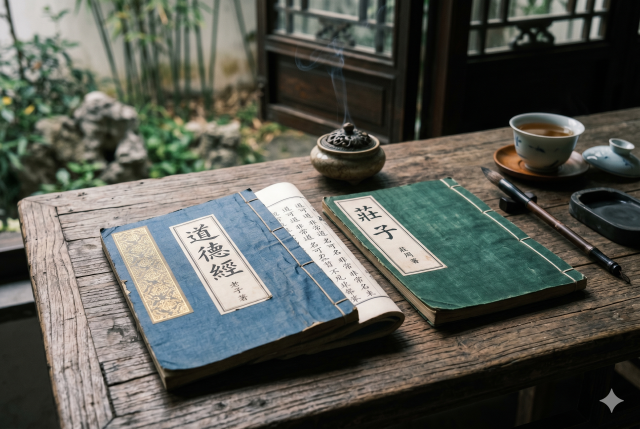
Most of humanity’s great religions and philosophies left behind scriptures. Hinduism in India has the Vedas and the Upanishads; Buddhism has the Heart Sutra, the Diamond Sutra, and the Lotus Sutra; Christianity has the Bible; and Islam has the Quran. Daoism—one of the spiritual wellsprings that drove Chinese civilization—also left behind great scriptures. At the center of them stand the Tao Te Ching and the Zhuangzi.
If the Tao Te Ching is a book that explains the mechanics of the universe, the Zhuangzi is a book that shows how to embody those mechanics within human life. If Laozi was the philosopher of the cosmos, Zhuangzi was the philosopher of freedom; if Laozi explained the source of order, Zhuangzi showed the human being living freely within that order. This is why the history of Chinese thought frequently pairs them under the term Lao-Zhuang (老莊) philosophy. Though Laozi and Zhuangzi lived in different eras, together they completed a single spiritual world centered on the Dao.
Laozi’s Tao Te Ching is a short book of roughly 5,000 characters. Yet its influence is truly immense. It has been read by countless people across the globe, widely cited as the most translated Eastern classic after the Bible. It consists of 81 chapters in total, and this number is no accident. In the East, the number 9 symbolizes completion, and 81—being 9 times 9—signifies the perfect cosmic order. Interestingly, the Korean people’s Cheonbugyeong (Heavenly Code) also consists of exactly 81 characters. While no direct link between the two has been proven, the characteristic Eastern drive to compress the principles of the universe into the briefest possible form reveals itself in both texts.
The Tao Te Ching startles the reader from its very first sentence.
“The Dao that can be told is not the eternal Dao; the name that can be named is not the eternal name.”
It means that a Dao that can be explained in words is not the true Dao, and anything that can be pinned down with a label is not the eternal name. Laozi is speaking to the absolute limits of human language. We try to explain the universe, but the act of explaining itself may already be a departure from its essence. Despite being a 2,500-year-old thought, it bears a striking, almost uncanny resemblance to the core inquiries of modern philosophy and linguistics.
The heart of the Tao Te Ching can be broadly summarized into three concepts.
First is the Dao (道).
The Dao is the fundamental origin of the universe; the principle that gives birth to and nurtures all things. Laozi did not call the Dao "God," yet he viewed it as the bedrock of all existence. The passage, "The Dao gives birth to One, One gives birth to Two, Two gives birth to Three, Three gives birth to the ten thousand things," offers a masterclass in Eastern insight regarding the genesis of the cosmos.
Second is De (德, Virtue).
De is not mere social morality. It is the power to manifest the Dao within one's lived reality. If the Dao is the objective order of the universe, De is that cosmic order revealed inside the human being. Therefore, Laozi remarked that the greatest De is to never show oneself off.
Third is Wu Wei (無爲, Non-action).
Wu Wei is commonly misunderstood as sitting around doing nothing. But it is not laziness. It means doing nothing contrived; doing nothing that goes against the natural grain of reality. Laozi observed that the more human beings try to forcefully over-engineer and control the world out of excessive greed, the worse the chaos becomes.
One of the most famous passages in the text is Shang Shan Ruo Shui (上善若水).
It translates to: "The highest good is like water." Water flows to the lowest, most ignored places, yet ultimately exercises the most unstoppable force. It carves through rock, maps out rivers, and sustains life. Through water, Laozi illustrated humility, supreme flexibility, and what it actually means to be strong.
If the Tao Te Ching is a philosophical treatise on the laws of nature, the Zhuangzi is closer to a work of literature singing the praises of the emancipated human mind. Indeed, the Zhuangzi is celebrated as the undisputed pinnacle of Eastern philosophical literature.
Zhuangzi’s most iconic parable is the "Butterfly Dream" (Hudie Meng, 胡蝶夢).
One day, Zhuangzi fell asleep and dreamt he was a butterfly, fluttering about in total, unburdened bliss. Upon waking up, a thought suddenly struck him:
“Was it Zhuangzi who dreamt of being a butterfly, or is it a butterfly right now dreaming it is Zhuangzi?”
This tiny vignette throws a massive, existential wrench into the human condition. What is reality, and what is a dream? What is life, and what is death? Do any of us actually possess the "absolute" truth?
Zhuangzi realized the world was infinitely more relative than we give it credit for. He proposed that the vast majority of things human beings treat as sacred, unshakeable absolutes are, in reality, just trivial differences in camera angles.
Another of his masterworks is Xiaoyaoyou (逍遙遊, Free and Easy Wandering).
In it appears a mythical, gargantuan bird named the Peng (大鵬). When the Peng takes flight, its wings obscure the sky for thousands of miles. Through this creature, Zhuangzi argued that humans, too, must break out of the low-ceilinged birdcages of their petty desires and local prejudices to go look for a much grander sky.
Zhuangzi’s philosophy is a philosophy of freedom.
However, it is not an anarchic, self-indulgent freedom. It is a freedom achieved in lockstep harmony with the rhythm of nature; the freedom of emptying the vessel of the "self" so completely that you accidentally become the world.
Zhuangzi was particularly allergic to our desperate obsession with "right and wrong."
He argued that the big and the small, the strong and the weak, success and failure, the VIP and the nobody—are all entirely subject to the observer. Centuries later, this exact posture would collide with the Buddhist concept of Śūnyatā (空, Emptiness) to form one of the master load-bearing pillars of East Asian culture.
In fact, when Zen (Chan) Buddhism first migrated into China, the primary reason it took root in the soil so effortlessly was because the ground had already been tilled by Lao-Zhuang philosophy. In their shared conviction that ultimate truth is caught via a flash of direct intuition rather than the clumsy fishing net of vocabulary, Zhuangzi and Zen hold hands.
Beyond these two, Daoism holds a rich library of texts—the Liezi, the Taipingjing, the Huangtingjing, the Nanhua Zhenjing. Yet the ones that cast the longest, most permanent shadows remain the Tao Te Ching and the Zhuangzi.
Even today, a massive contingent of the world's most powerful CEOs and heads of state keep Laozi and Zhuangzi on their nightstands. Because the more suffocatingly complex an era gets, the more desperately it requires the high technology of simplicity. The more cutthroat the market, the higher the premium on internal equilibrium. The more blindingly fast the scenery changes, the more you need an eye trained strictly on the stationary horizon.
Ultimately, the Tao Te Ching and the Zhuangzi back the human being into a corner and force a single question:
“What are you tied to right now?”
Is it your bank account? Your job title? Your reputation?
Or is it just your own fear?
Zhuangzi answers for us: true freedom isn't packing a bag and escaping to a cabin in the woods; true freedom is standing right in the middle of the noisy town square, entirely un-capturable by it.
This is why Daoist scripture cannot be filed away as mere religious artifact. It is a declaration of human independence, and a quiet, devastatingly deep inquiry into how an organism called a human is supposed to spend its short time inside a place called the cosmos.
Laozi talked about the Way. Zhuangzi talked about getting loose.
And twenty-five hundred years later, the species is still standing right where they left us, trying to figure out the answer to the prompt.
Copyright ⓒ Aju Press All rights reserved.