This is the sixteenth installment of AJP's Spiritual Asia series exploring the religious traditions, philosophical ideas and moral foundations that have shaped Asia's civilizations. This chapter turns to Zoroastrianism, one of the world's oldest living faiths, and examines how its teachings on truth, free will and moral responsibility continue to resonate in an age increasingly shaped by artificial intelligence.
2,500-Year-Old Wisdom Summoned Anew Before the Crisis of Civilization
Human civilization is currently standing before a massive turning point. An era where artificial intelligence challenges human intelligence is opening up, quantum computers are tearing down the limits of existing computing, and space exploration is once again rising as the centerpiece of national competition. Biotechnology attempts to extend the human lifespan, and robots have begun replacing human labor. If the Industrial Revolution and the Information Revolution transformed how humans live in the past, today's AI Revolution is attempting to redefine human existence itself.
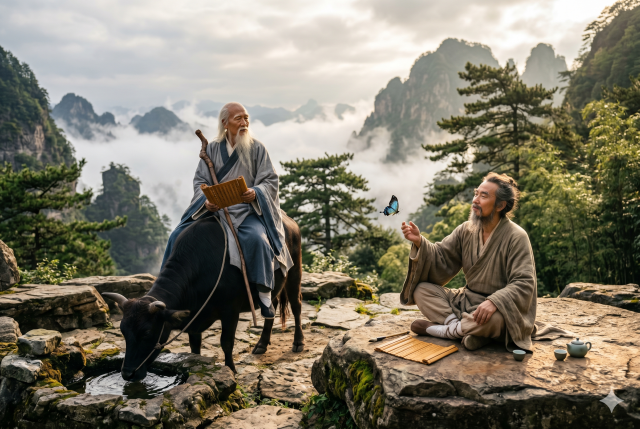
Yet, a remarkable phenomenon is unfolding. In the very places where the most cutting-edge technology is concentrated, where the fastest innovation occurs, and where the highest added value is generated, people are ironically turning back to read the 2,500-year-old Chinese philosophers, Laozi and Zhuangzi.
Indeed, countless entrepreneurs and executives in America's Silicon Valley are reading the Tao Te Ching. Apple founder Steve Jobs had a deep interest in Eastern thought during his youth, and executives at numerous tech giants—including Google, Meta, and Nvidia—utilize meditation and Eastern philosophy as crucial management assets. Ray Dalio, one of the founders of the world's largest hedge funds, has publicly emphasized Eastern philosophy and the principles of nature.
Why is this happening?
What does it mean that humanity is seeking out the oldest philosophy during its most advanced era?
It is because modern civilization has entered a massive paradox.
Humanity is living in the most materially abundant era in history, yet simultaneously living in its most anxious. Information overflows, but wisdom is scarce. Hyper-connection has increased, but loneliness has deepened. Technology has advanced, but happiness has not grown in proportion. People have become faster, but they increasingly have no idea where they are supposed to go.
Laozi already warned of these dangers 2,500 years ago.
He observed that when humans forget the order of nature and pursue only their desires, civilization begins to fall ill. Humans try to possess more but remain unsatisfied; they try to climb higher but fail to find peace. Laozi explicitly warned against this vicious cycle of endless greed.
There is a passage in the Tao Te Ching: "He who knows that he has enough is rich."
While modern economics preaches growth, production, and consumption, Laozi preached contentment. He argued that true abundance comes not from possessing more, but from knowing when something is enough.
This is not merely an attitude for an individual's life. It serves as a warning to modern civilization as a whole.
The environmental crises humanity currently faces are, in reality, the direct consequences of an industrial civilization that has pursued endless growth. Climate change, desertification, the collapse of biodiversity, and marine pollution all stem from humans viewing nature as an object to be conquered.
However, Laozi did not view nature as an object of conquest. He believed that humans are not the masters of nature, but merely a part of it.
The Tao (Way) spoken of in Taoism is not an order exclusive to human beings. It is the order that moves the entire universe. Humans are simply existences contained within it.
Therefore, Taoism can be considered one of the oldest philosophies of ecology.
The reason ecology is taking root as a vital ideology in Europe and the United States today is ultimately because it forces us to rethink the relationship between humans and nature. Amazingly, Laozi was already asking this exact question 2,500 years ago:
Should humans dominate nature? Or should we live in harmony with it?
Today's climate crisis proves just how visionary Laozi's questions were.
Zhuangzi takes this a step further.
If Laozi spoke of the order of nature, Zhuangzi spoke of the freedom of the human spirit.
Modern humans live tied down by countless things. They are constantly shaken by money, jobs, status, competition, social media validation, and the judgment of society. People talk about freedom, but in reality, they live trapped inside invisible prisons of their own making.
Zhuangzi saw this aspect of humanity more sharply than anyone else. He observed that human beings construct the largest prisons inside their own minds.
The "Butterfly Dream" (Hudie Meng) is not a simple fable.
It is a profound interrogation of the reality that humans believe to be absolute.
Zhuangzi asks:
“Is what you believe to be true actually true?”
“Is what you think is important actually important?”
These questions are becoming even more critical in the age of AI.
Today, artificial intelligence can process vastly more information than humans. AI learns from millions of books and offers answers faster than any person could. However, an abundance of information does not automatically generate wisdom.
AI can provide the answers, but humans must be the ones to ask the questions. AI can calculate, but it cannot explain meaning. AI can predict, but it cannot tell us why we should live.
It is precisely at this juncture that Laozi and Zhuangzi re-emerge.
The deeper we step into the AI era, the more humans will be forced to ask what it truly means to be human. The essence of humanity is not speed. It is not competition. Nor is it mere productivity.
The core of humanity is self-reflection. And Laozi and Zhuangzi are the ultimate philosophers of reflection.
This explains why meditation and Eastern philosophy are trending in Silicon Valley.
The leaders of the world's top tech firms are more competitive and move faster than anyone else. Yet, at the same time, they know that technology alone cannot make human beings happy.
So, they turn back to read Laozi. Because solving complex problems requires the lens of simplicity. Because staying grounded in a rapidly shifting world requires a solid center. Because it is not the strongest organization that survives, but the most flexible.
Laozi's philosophy of water is frequently cited in modern management theory. Water is the softest thing, yet the strongest. Water flows to the lowest places, but it ultimately carves through mountains and maps out rivers.
Laozi saw that true strength does not come from crushing one's opponent, but from emptying oneself.
This philosophy applies directly to modern leadership. Authoritarian organizations do not last long. Flexible, adaptable organizations survive. Cooperation matters more than domination, and empathy matters more than issuing commands.
Thus, 21st-century management is steadily inching closer to Laozi.
The Korean thinker Daseok Ryu Young-mo also harbored a profound interest in this Lao-Zhuang philosophy. Daseok was a thinker who extensively studied the religions and philosophies of both the East and the West. He sought the essence of the human spirit by exploring Confucianism, Buddhism, Christianity, and Lao-Zhuang philosophy together.
Daseok frequently spoke of "emptying." He argued that a true human being must empty themselves—emptying greed, emptying the stubborn ego, and emptying arrogance.
This thought connects deeply with Laozi's concept of Wu Wei (Non-action). Laozi's Wu Wei does not mean doing nothing. It means doing nothing contrived. It means not going against the natural flow of reality.
Daseok, too, never tried to forcefully possess the truth. He believed that while the truth is one, the paths leading to it are many. Consequently, he never absolutized any single religion.
He sought to find the shared undercurrent of truth flowing through Confucianism, Buddhism, Christianity, and Lao-Zhuang thought.
In this regard, Daseok—who could recite the Gospel of John by heart—can be seen as an inheritor of a uniquely Korean Lao-Zhuang philosophy. Laozi's Tao and Daseok's Eol (Spirit) use different vocabularies, but they point in the exact same direction.
Both believed that humans can approach a grander truth only when they empty themselves.
What, then, is the greatest legacy Taoism left to humanity?
It is harmony. Harmony over force. Coexistence over conquest. Balance over competition.
Laozi and Zhuangzi did not tell humans to conquer the universe. They told us to live alongside nature. They did not tell us to dominate our opponents. They told us to find a way to live together.
Today, humanity is marching toward an era of AI, robotics, quantum computers, and space exploration. But no matter how far technology advances, if humans lose their harmony with nature, our civilization cannot endure.
Artificial intelligence may become smarter than humans. But whether it can become wiser than humans remains unknown. Wisdom does not emerge from calculation. Wisdom emerges from deep reflection on the essence of life.
That is why we read Laozi again. That is why we read Zhuangzi again.
This is why the brief sentences left behind by an old Chinese philosopher 2,500 years ago continue to inspire the world's highest-level scientists, entrepreneurs, philosophers, and religious leaders today.
Taoism is not a mere religion. It is an ancient wisdom that awakens us to the reality that humans, nature, and the cosmos are a single, living community. Simultaneously, it is the exact future-oriented philosophy required by humanity as it navigates the age of AI.
What is truth?
It is realizing that the universe and humanity exist within a single order.
What is justice?
It is creating a harmony where nature and humans, the strong and the weak, can live together.
What is freedom?
It is escaping the prison of desire and obsession to recover one's true, original self.
Laozi spoke of the Tao, and Zhuangzi spoke of freedom. And Daseok reinterpreted them through the language of Korea.
The reason voices from 2,500 years ago remain alive today is completely clear. Because no matter how far humanity travels, we must ultimately return to our essence.
Laozi and Zhuangzi are ancient lanterns pointing directly toward that essence. And those lanterns continue to burn brightly, even in the darkness of the artificial intelligence era.
Copyright ⓒ Aju Press All rights reserved.