
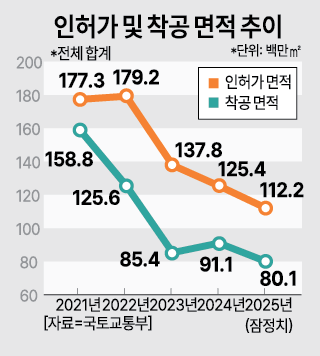
Although construction orders have significantly increased this year, the lack of actual groundbreaking and investment has left the recovery of the construction market only partially realized. While the public and civil engineering sectors are driving the rise in orders, the private housing sector continues to struggle, leading to a backlog of projects that have received permits but have yet to commence, dampening the overall sentiment in the field.
According to the Ministry of Land, Infrastructure and Transport, the cumulative construction order amount from January to April this year reached 70.7746 trillion won. Although this marks an increase compared to the previous year, experts caution that the concentration of orders in the public and civil engineering sectors makes it premature to interpret this as a broad recovery in the construction market.
The issue lies in the bottleneck preventing orders from translating into actual groundbreaking. The ministry reports that the area of residential construction starts fell by 55.2%, from 59.8 million square meters in 2021 to 26.8 million square meters last year. Similarly, the area for non-residential construction starts decreased by 46.2%, from 99 million square meters to 53.3 million square meters during the same period.
The gap between permits and groundbreaking is also widening. Over the past five years, the average annual gap between permitted and started construction areas has been recorded at 38.2 million square meters. The cumulative gap has reached 190.9 million square meters, which is 1.8 times the average annual area of groundbreaking. This effectively means that nearly two years' worth of projects have received permits but remain unstarted.
The sluggish groundbreaking is also leading to a decline in construction investment. From January to April this year, public construction investment increased by 6.3% compared to the same period last year, while private investment fell by 8.7%. Last year, real construction investment also dropped by 9.9%, marking the largest decline in 27 years since the 1998 financial crisis.
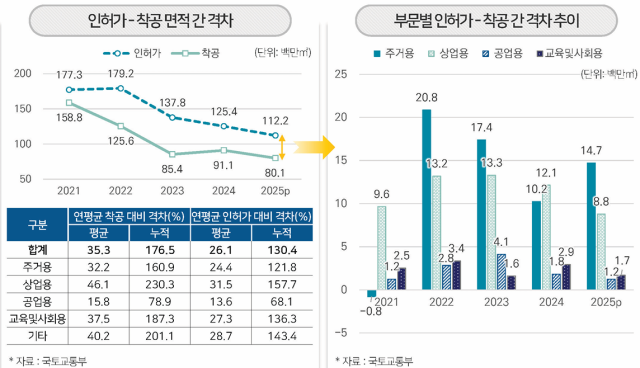
Industry experts note that the time taken for orders to transition into groundbreaking and construction has lengthened compared to the past. An analysis by the Korea Construction Industry Institute indicates that in the recent five years (2021-2025), it takes about three quarters, or nine months longer, for orders to connect to actual construction compared to the previous five years (2016-2020).
Lee Ji-hye, a researcher at the Korea Construction Industry Institute, stated, “While recent construction orders are showing signs of recovery, particularly in public housing and private civil engineering, high interest rates, rising construction costs, stricter project financing reviews, and unsold inventory in local markets are preventing actual groundbreaking. If the bottleneck persists, it could lead to a decrease in occupancy rates two to three years down the line.”
Seo Jin-hyung, a professor at Kwangwoon University’s Department of Real Estate Law, remarked, “Ultimately, the declining profitability of projects and unfavorable conditions for sales are causing delays in groundbreaking. The government needs to create an environment that facilitates smooth supply through the normalization of the project financing market and support for funding.”
The Ministry of Land, Infrastructure and Transport is also working on measures to alleviate the groundbreaking bottleneck. Kim Gi-yong, head of the construction policy division at the ministry, stated on June 18, “The increase in orders has not translated into groundbreaking, construction, or investment recovery. The sluggishness in permits and groundbreaking could affect future occupancy rates as well as the rental market.” He added that the ministry is considering tailored support measures for projects experiencing delays in groundbreaking.
* This article has been translated by AI.
Copyright ⓒ Aju Press All rights reserved.