
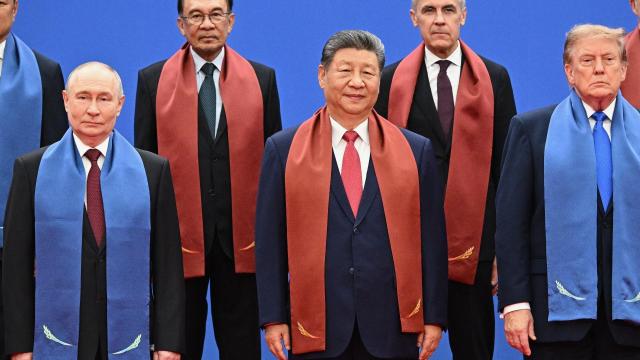
SEOUL, November 19 (AJP) —U.S. President Donald Trump brought together the leaders of China and Russia for an unprecedented three-way summit Thursday, seeking a new nuclear arms agreement and progress on wars in Ukraine and Iran, but the historic gathering ended without an immediate breakthrough.
The meeting with Chinese President Xi Jinping and Russian President Vladimir Putin marked a striking display of great-power diplomacy that could reshape the U.S.-dominated international order. Yet the three leaders remain divided over nuclear strategy, territorial conflicts and their competing visions of global security.
"We are really making history," Trump declared as the leaders opened their talks at the Kylin Villa in Shenzhen on the sidelines of the Asia-Pacific Economic Cooperation (APEC) summit.
The meeting lasted more than an hour, with no immediate joint statement or concrete agreement announced.
Trump made nuclear arms control the centerpiece of the talks, calling on the world's three largest nuclear powers to cooperate in reducing their arsenals and preventing the spread of nuclear weapons.
He acknowledged the formidable challenge of persuading nuclear-armed countries to surrender weapons they regard as essential to national security.
"Once you have the nuclear weapons, it's very hard not to have them," Trump said.
The initiative comes after the New START treaty, the last remaining nuclear arms control agreement between Washington and Moscow, expired in February, leaving the world's two largest nuclear arsenals without binding limits.
Trump wants a new agreement that includes China, but Beijing has long resisted joining the negotiations, arguing that its nuclear stockpile is much smaller.
China is estimated to possess more than 600 nuclear warheads, compared with more than 5,000 each held by the United States and Russia.
Xi called for the eventual elimination of nuclear weapons and the creation of a nuclear-free world, according to Chinese state media. He also urged the three powers to maintain dialogue, avoid crossing each other's red lines and prevent confrontation.
Putin invoked the three countries' common history as victors in World War II, emphasizing their shared responsibility for international peace and security.
Despite the conciliatory language, their differences remain substantial.
China continues to expand its nuclear capabilities even while advocating global disarmament. Washington wants Beijing included in any future arms control framework, while Moscow's war in Ukraine has deepened tensions with Western governments.
The gathering also highlighted a shifting balance among the three powers.
Trump has placed considerable emphasis on his personal relationships with Xi and Putin, but the Chinese and Russian leaders have built a closer strategic partnership rooted in shared opposition to aspects of U.S. global influence.
China has remained an important economic partner for Russia since Moscow's 2022 invasion of Ukraine, helping cushion the impact of Western sanctions.
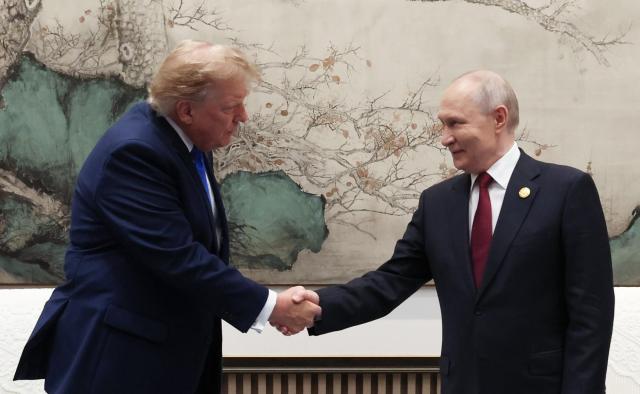
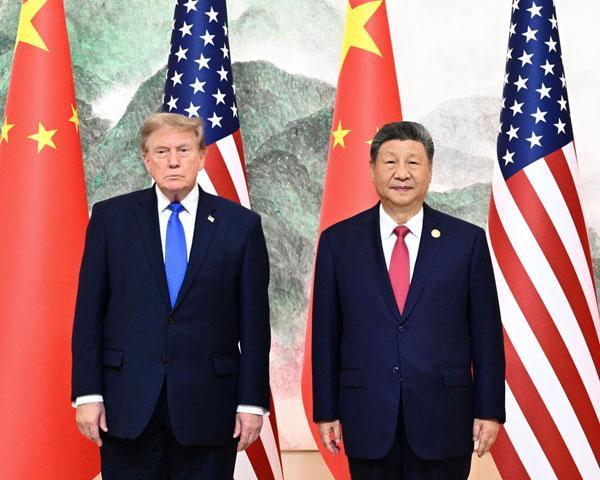
Trump held separate bilateral meetings with both leaders before the trilateral session.
His meeting with Putin, their first since an inconclusive summit in Alaska in 2025, lasted about 40 minutes and focused heavily on Ukraine. Trump suggested that progress was possible but offered no details of a potential settlement.
During his meeting with Xi, Trump raised the importance of keeping oil flowing through the Strait of Hormuz amid disruptions caused by the Iran war. Trade, agricultural purchases and Taiwan were also discussed.
For all the diplomatic spectacle, the central questions remain unresolved: whether China will enter serious nuclear arms negotiations, whether Putin will make concessions on Ukraine and whether Trump can reconcile competing interests that have resisted years of diplomacy.
The three leaders have demonstrated their willingness to sit together. Whether they can agree on anything substantial is another matter.
Copyright ⓒ Aju Press All rights reserved.
Related News
-
 Trump tells Xi, 'We do not support Taiwan independence'... Agreement on action plan for stable relations
President Donald Trump stated during a summit with Chinese President Xi Jinping that "the United States does not support Taiwan independence." The two leaders also agreed to establish a 'constructive strategic stability action plan' for the stable development of US-China relations.According to China's state-run Xinhua News Agency, President Xi held a summit with President Trump on the afternoon of November 19 in Shenzhen, China, during the Asia-Pacific Economic Cooperation (APEC) summit. Xi remarked, "In recent months, from Beijing to Washington, President Trump and I have sought ways for the US and China to coexist correctly," adding that a new status of constructive strategic stability in US-China relations has been established based on respect, fairness, and equality.He further evaluated that "the overall trend of US-China relations is stable and improving, bringing substantial benefits to both peoples and providing stability and certainty to the world." He emphasized that "we need to expand the list of cooperation and reduce the list of issues," and that disagreements that cannot be resolved in the short term should be constructively managed to prevent the escalation of conflicts.Regarding the Taiwan issue, he urged that the US must do the right thing and ensure that significant repercussions do not occur in US-China relations. He also stated that in the economic and trade sectors, communication should be strengthened to alleviate mutual concerns and realize mutual benefits. He emphasized the need for both countries to cooperate to prevent safety risks associated with artificial intelligence (AI) and ensure that AI remains under human control.President Trump reiterated, "The United States does not support Taiwan independence." This statement publicly addressed China's longstanding demands regarding the Taiwan issue. However, it does not indicate a change in US policy, which has maintained that it does not support Taiwan independence.Trump also provided a positive assessment of the bilateral relationship, stating, "I have maintained close communication with President Xi, and the friendship between our two leaders is deepening." He added that the trend of stable development in US-China relations should be maintained. He emphasized the need to strengthen cooperation in agriculture, energy, and superintelligence, and to handle the concerns of both countries fairly. He also stated, "The United States is very strong, and China is also very strong," asserting that both countries should jointly lead and promote global peace and stability.The two leaders agreed to establish a 'constructive strategic stability action plan.' Following their agreement on a new relationship during the Beijing summit in May, they discussed concrete actions at the Washington meeting in September. This time, they decided to specify the principles of relationship stability into an implementation plan. However, the specific details and timeline of the action plan were not disclosed. Key contentious issues such as trade, Taiwan, and advanced technology are expected to be reflected in the actual action plan.The two leaders evaluated the summit as positive and constructive, agreeing to implement the agreements made and to build a constructive strategic stability relationship based on respect, fairness, and equality. They also exchanged views on international and regional issues of mutual interest.* This article has been translated by AI.
-
Kim Min-seok Discusses Trump and North Korea's Galma District, Cautions on Dialogue Expectations
Kim Min-seok, leader of the Democratic Party, revealed that during a meeting with U.S. President Donald Trump in March, while he was serving as Prime Minister, they discussed the North Korean Wonsan Galma coastal tourism district as a potential point of progress in U.S.-North Korea relations. He explained that President Trump also expressed considerable interest in advancing U.S.-North Korea relations.On November 19, Kim appeared on the Democratic Party's YouTube broadcast 'Minty 07' and reflected on his meeting with President Trump in March, stating, "He expressed considerable interest in advancing U.S.-North Korea relations," adding, "President Trump suggested that it would be good to explore these options and gave several direct instructions on-site."He continued, "For the first time today, I would like to mention that the topic of the Galma tourism district came up. The Galma tourism district was briefly discussed as an area of mutual interest between the U.S. and North Korea, and there was a significant conversation about it."Kim also noted that the North Korean issue was a major topic during his meeting with U.S. Vice President JD Vance. He stated, "Whether it was during my conversation with President Trump or with Vice President Vance, surprisingly, the first question was always about North Korea," adding that questions included what North Korea's thoughts on U.S.-North Korea relations might be and how to approach dialogue or relations with North Korea.However, he took a cautious stance regarding speculation that U.S.-North Korea dialogue is imminent. In response to Chinese President Xi Jinping's mention of supporting various efforts to ease tensions on the Korean Peninsula, he stated, "I don't think it needs to be interpreted excessively," and added, "It may be a bit of a stretch to interpret this as an indication that U.S.-North Korea dialogue is imminent."Meanwhile, Kim strongly criticized the first-instance acquittal of Daegu Mayor Choo Kyung-ho on charges of important duties related to insurrection. He remarked, "It seems like a bizarre ruling that ignores the context or deliberately overlooks facts that are clearly contrary to the truth, trying to create a forced acquittal," asserting, "It will be corrected in the appeals court, and it must be corrected."Regarding the scheduled ruling on the appeal of former Prime Minister Han Duck-soo on charges related to important duties concerning insurrection, he stated, "It will be difficult to stray from the results that the public is judging with common sense," but added, "If an unexpected outcome arises, we will make an immediate decision in response to that."* This article has been translated by AI.
-
Japan Seeks to Secure Trump with Rare Earths and 'Free and Open Indo-Pacific' Card Ahead of US-China-Russia Summit
Japan and the Quad, a four-nation alliance with the United States, Australia, and India, held a summit for the first time in two years, agreeing to strengthen supply chain cooperation and maritime security with China in mind. With the US-China-Russia summit just two days away, Japan focused on solidifying ties with the US by emphasizing the practical benefits of rare earth cooperation and the shared ideology of a 'Free and Open Indo-Pacific' (FOIP). Nevertheless, Japan remains anxious that President Donald Trump may overlook the interests of allies while engaging with China and Russia.According to the Nihon Keizai Shimbun (Nikkei) on November 18, Japanese Prime Minister Sanae Takaiichi, President Trump, Australian Prime Minister Anthony Albanese, and Indian Prime Minister Narendra Modi held a summit in Manila, Philippines, the previous day. The leaders expressed 'serious concern' over economic coercion, including arbitrary export restrictions, in a joint statement.They strongly opposed any unilateral attempts to change the status quo. Although they did not directly name China, the expressions were aimed at China's export restrictions on rare earths and its military activities in the South China Sea. The four nations also agreed to conduct their first maritime joint training exercise in 2027, involving patrol aircraft from each country.President Trump emphasized rare earth cooperation, stating to reporters before the summit that the US would 'catch up to China in rare earth production within 10 months,' asserting that the Quad 'is helpful.' China currently accounts for about 70% of global rare earth production and holds a significant share of refining. The four nations agreed to accelerate cooperation in the mining, processing, and recycling of critical minerals, which was established during a foreign ministers' meeting in May. This plan aims to reduce dependence on China by combining Australia's and India's resources with Japan's recycling and usage reduction technologies. Japan's Anxiety Ahead of US-China-Russia SummitJapan's efforts in this meeting are driven by the upcoming US-China-Russia summit during the Asia-Pacific Economic Cooperation (APEC) meeting in Shenzhen, China, on November 19. According to the Yomiuri Shimbun, China is poised to highlight the history of the US, China, and the Soviet Union uniting against Japan during World War II at this summit. The Yomiuri analyzed that Japan's insistence on a shared ideology within the Quad is a response to this.A senior Japanese government official stated, 'While the US, China, and Russia may share common ground in the past, they cannot demonstrate shared values in the present and future,' adding, 'The shared ideology is our strength.'The ideology Japan has promoted is the FOIP, advocated by former Prime Minister Shinzo Abe. According to the Yomiuri, President Trump had previously made FOIP a cornerstone of his strategy toward China during his first term, but he has not mentioned it recently. Japan sought to draw support for FOIP by emphasizing the close relationship between Trump and former Prime Minister Abe during pre-summit negotiations. The joint statement also included a reference to the 10th anniversary of Abe's FOIP advocacy. When Trump mentioned FOIP during the meeting, officials around the Prime Minister remarked that 'the strategy was successful.'However, Japan's anxieties have not been fully alleviated. The Nikkei pointed out that Trump, having suffered a significant defeat in the midterm elections, may rush to achieve diplomatic successes, potentially making excessive concessions to China and Russia. The North Korea issue is a prime example. On November 16, Trump hinted at the possibility of a meeting with North Korean leader Kim Jong-un during his upcoming visit to China, stating, 'It depends on President Xi.' The Nikkei expressed concerns that this could lead to the US tolerating North Korea's nuclear capabilities without consulting South Korea and Japan.According to the Yomiuri, a Japanese government official evaluated the results of the Quad meeting as having 'nailed it down.' However, an official from the Prime Minister's office could not hide their concerns, stating, 'Isn't it possible that as soon as Trump moves to China, he will create a friendly atmosphere with China and Russia?'* This article has been translated by AI.