

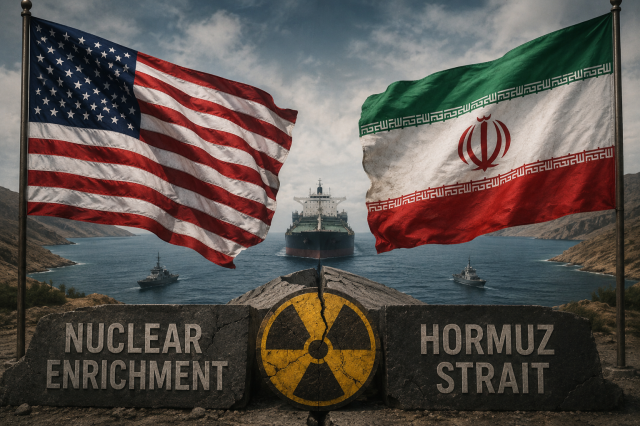
The United States and Iran held their first high-level meeting following the signing of a memorandum of understanding (MOU), but key issues surrounding Iran's nuclear program did not advance to formal negotiations. Both sides expressed agreement on the return of the International Atomic Energy Agency (IAEA) inspection team to Iran, but discussions on the handling of enriched uranium and future limits on uranium enrichment were postponed.
On June 22, U.S. Vice President JD Vance and Iranian Foreign Minister Abbas Araghchi met in Switzerland for the initial high-level talks aimed at implementing the MOU. Following the meeting, Vice President Vance stated, "Iran has agreed to allow the IAEA inspection team to return," calling it a first step toward ending Iran's nuclear weapons program.
The return of the IAEA inspection team was the most concrete outcome confirmed during this meeting. Since 2018, when then-President Donald Trump withdrew from the 2015 Iran nuclear agreement (JCPOA), Iran has gradually reduced its cooperation with the IAEA. Following a U.S. attack on Iranian nuclear facilities last year, international monitoring of damaged sites and Iran's enriched uranium stockpile has also been limited.
However, the resumption of inspections does not immediately resolve nuclear issues. The U.S. demands the handling of Iran's enriched uranium and future restrictions on enrichment capabilities, while Iran maintains that it cannot abandon its right to peaceful nuclear energy. Key issues such as uranium export, dilution, enrichment cessation, and access to nuclear facilities will still need to be addressed in subsequent negotiations.
The focus of this meeting leaned more toward managing the implementation of the MOU rather than nuclear negotiations. The two sides discussed ensuring freedom of navigation in the Strait of Hormuz, maintaining a ceasefire between Israel and Hezbollah, and preventing the escalation of conflicts in Lebanon. Regional security issues, which were thought to be settled with the MOU, resurfaced at the first meeting.
This reflects the shaky start of the MOU's implementation. The meeting was originally scheduled for June 19 but was postponed due to renewed clashes between Israel and Hezbollah in Lebanon, and Iran's mention of its control over the Strait of Hormuz. Iran criticized the U.S. for failing to guarantee the ceasefire as stipulated in the MOU, citing Israel's attacks in Lebanon.
Both sides assessed the meeting positively, but their emphases differed. Vice President Vance highlighted the return of the IAEA inspection team and progress in nuclear verification. In contrast, Minister Araghchi pointed to discussions on ending the Lebanon war, easing sanctions on Iran, and issues related to frozen assets as key achievements.
U.S. media evaluations varied. The Wall Street Journal noted, "The return of the IAEA to Iran indicates progress on key issues necessary to permanently end the war." Meanwhile, The New York Times pointed out that the return of the inspection team alone cannot resolve the issues of handling enriched uranium and future enrichment bans. Axios reported that skepticism remains within U.S. intelligence circles regarding the likelihood of a comprehensive nuclear agreement.
The U.S. and Iran have decided to leave working negotiation teams in Switzerland to continue discussions. Future negotiations are expected to address nuclear verification methods, enrichment limits, navigation guarantees in the Strait of Hormuz, maintenance of the ceasefire in Lebanon, and the scope of sanctions relief.
* This article has been translated by AI.
Copyright ⓒ Aju Press All rights reserved.