
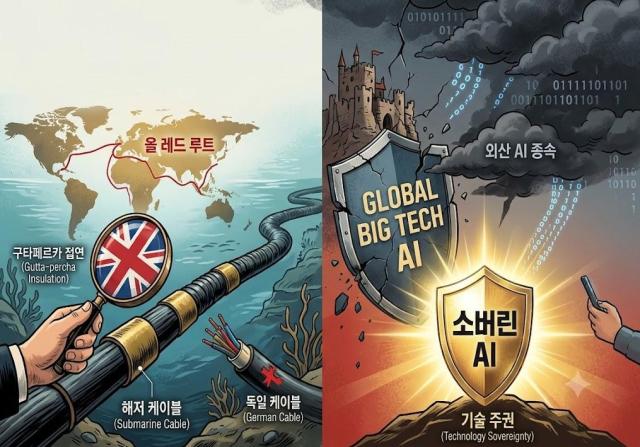
In the late 19th century, submarine cables connecting continents across the ocean marked a monumental information revolution for humanity. However, this revolution was underpinned by a history of monopoly and dependency.
At that time, telegraphy was cutting-edge technology but could not cross continents due to the absence of submarine cables that could withstand seawater. The United Kingdom solved this problem by developing a corrosion-resistant insulator called "gutapercha," monopolizing over 80% of the submarine cable market. Subsequently, Britain implemented the "All Red Route" policy, establishing a global submarine telegraph network that only passed through its colonies to efficiently control and manage them.
This allowed Britain to control all major communication traffic on Earth. By dominating the global information network through communication, Britain exercised its power by blocking communications from countries that opposed its interests. Shortly after the outbreak of World War I, Britain severed Germany's major submarine cables connecting it to the Americas and Africa, monopolizing information for itself. This history is also relevant to Korea, where Britain illegally occupied Geomundo to counter Russia's southward expansion and established a submarine telegraph base there, creating a communication network linking Geomundo, Hong Kong, and Shanghai, thus monopolizing information in East Asia.
When technology is monopolized by specific countries or a few companies, those who use that technology become more than mere consumers; they risk becoming "technological colonies." A century later, the artificial intelligence (AI) revolution stands at a crossroads of new technological dependency. The fact that 80% of South Koreans use foreign AI technologies poses significant risks.
From a user perspective, seeking the most advanced AI models is a natural and rational choice. In an environment of infinite competition, one cannot survive by ignoring the tools of global tech giants like ChatGPT or Gemini. Samsung Electronics has announced its intention to utilize OpenAI's technology across all its operations, while Naver, which possesses its own AI capabilities, is compelled to adopt foreign AI technologies in a dual-track approach to diversify its services and integrate into the global ecosystem.
However, the "bill of dependency" is severe. Nearly 80% of adults aged 19 to 69 have experienced generative AI, with most relying absolutely on specific foreign models, indicating a state of dependency. Building the backbone of our industry on the systems of global tech giants through AI transformation (AX) will only deepen this dependency.
Recently, the U.S. government imposed export controls blocking foreign nationals from accessing Anthropic's high-performance security AI model for security reasons. Each time foreign AI experiences temporary server outages, service policy changes, or export controls based on national prioritization, daily life and workplaces in South Korea are disrupted.
The minimum survival condition to escape this vast technological dominance is to establish an AI ecosystem centered around "sovereign AI." Sovereign AI is not merely about asserting the pride of domestic technology; it is the only bulwark that can ensure national security and business continuity.
AI is not just a tool; it is a strategic asset crucial for the future survival of the nation. If we fail to build our technological base against the onslaught of global capital and technological power, South Korea risks becoming a significant dependency in the digital age. Technological sovereignty is synonymous with national sovereignty.
* This article has been translated by AI.
Copyright ⓒ Aju Press All rights reserved.