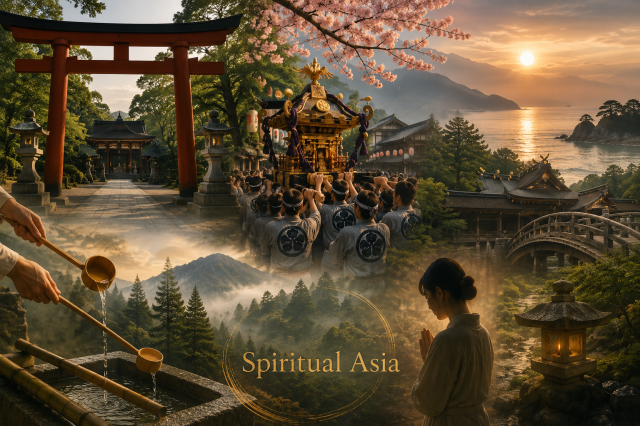
Shinto began with a sense of the sacredness of nature. At its roots was the belief that a divine presence dwelled in mountains and seas, forests and rivers, rocks and waterfalls, the sun and the wind.
But for the sacredness of nature to enter people’s daily lives, there had to be a place where it could be remembered, enshrined and encountered repeatedly. That place was the shrine.
A shrine is not merely a religious structure. It is a living site of Japanese spirituality that connects nature and humanity, ancestors and descendants, villages and the sacred.
The first thing visitors encounter when entering a shrine is the torii gate. Standing like a doorway, usually painted red or left in its natural wooden color, the torii is one of the most powerful symbols of Japanese Shinto.
It is not simply an entrance. It marks the boundary between the secular world and sacred space.
As people pass through a torii, they momentarily set aside the noise and desires of everyday life. They step back from the world of business and competition, anger and calculation, fatigue and anxiety, and enter with the mindset of standing before the divine.
Shinto is not a religion of many words. Yet a single torii can say a great deal: from this point onward, one must enter with a different state of mind.
The torii is important because Shinto is, in many ways, a religion of space.
Unlike Buddhism, with its vast canon of scriptures, or Christianity, with the Bible, Shinto has no single sacred text endowed with absolute authority. Instead, it expresses itself through places and rituals, gestures and repetition.
Bowing before the torii, walking along the approach to the shrine, washing one’s hands and mouth, and bowing and clapping before the sanctuary are themselves forms of religious language.
Rather than explaining the gods through long sentences, Japanese people have traditionally encountered the sacred by lowering themselves within a holy space.
Near the entrance to most shrines is a water basin known as a temizuya or chozuya. Worshippers wash their hands and rinse their mouths there.
This is not simply an act of hygiene. In Shinto, water symbolizes purification.
As people go about their daily lives, their minds become unsettled, their bodies become unclean and their relationships leave them wounded. Before standing before the gods, they must first compose and cleanse themselves.
Washing the hands signifies a desire to purify one’s actions, while rinsing the mouth reflects a resolve to speak with care.
Shinto purification rituals tell us that to encounter the sacred, one must first empty and prepare oneself.
The basic etiquette of shrine worship also carries deep meaning.
The customary form is to bow twice, clap twice and bow once more. Although details may differ from shrine to shrine, the basic structure reflects the spirit of Shinto.
Bowing is an act of humility. Clapping announces one’s presence to the deity and awakens the mind. The final bow expresses gratitude and resolve.
This is not simply an incantation for good fortune. It is an act through which people restrain their desires and restore their inner balance before a sacred order.
Most shrines contain a main sanctuary, or honden, and a worship hall, or haiden.
The honden is the central space where the kami, or deity, is enshrined, while the haiden is where people offer their respects.
Yet the essence of a shrine is not limited to its buildings. The surrounding forest, the approach, ancient trees, stone lanterns, water and wind are all part of the shrine.
The groves surrounding shrines, in particular, reveal the Shinto view of nature.
A shrine is not simply built in nature. Rather, people carefully create and preserve a space to protect the sacredness already present in nature. The shrine grove is not landscaping. It is a sacred forest.
Ise Jingu is a representative example of this kind of Shinto space.
It is regarded as one of Japan’s holiest shrines and is known as the place where Amaterasu, the sun goddess, is enshrined. It also has deep ties to the imperial family.
What makes Ise Jingu distinctive, however, is not authority alone. Its buildings are not preserved indefinitely. Instead, they are rebuilt at regular intervals in order to carry on the tradition.
The structures are renewed, but their form and spirit continue. The timber changes, but the craftsmanship is passed down.
This reflects Shinto’s philosophy of renewal. Eternity does not lie in holding on to old things unchanged, but in carrying their spirit forward through constant renewal.
Fushimi Inari Taisha in Kyoto presents another, more popular face of Shinto.
The countless red torii gates stretching along its mountain paths have become one of the most recognizable images of Japan.
Inari has long been worshipped as a deity of agriculture, prosperity and commerce. In agrarian society, people prayed for abundant harvests; in a commercial society, they prayed for business success.
Shinto kami are not confined to abstract doctrine. They are present in people’s livelihoods, food, work and aspirations. That is why Shinto has remained so close to everyday Japanese life.
Meiji Jingu in Tokyo carries yet another meaning.
Dedicated to Emperor Meiji and Empress Shoken, symbolic figures of modern Japan, it stands within a vast forest in the heart of the capital.
Meiji Jingu demonstrates how Shinto became connected to the modern state, while also showing how people in contemporary Japan seek silence and nature amid urban life.
Large numbers of people visit shrines for the first prayer of the New Year, hold weddings there and turn to them at important moments in life.
Shinto remains alive in the rites and transitions of Japanese daily life.
Shrines are also connected to ancestor veneration.
In Japanese Shinto, ancestors are not simply people who have died. They are the roots of families and villages, and beings believed to watch over the lives of their descendants.
Ancestor worship reminds people that they are not born or destined to live alone.
We are all descendants of someone, and we will become ancestors to someone else.
Shinto ancestor worship reinforces this sense of continuity. The individual is not cut off from the past but exists within a chain of memory, bloodline and community.
To Korean eyes, this is not entirely unfamiliar.
Korea also had traditions involving mountain spirits, village guardian shrines, sacred trees, ancestral rites and village rituals.
People regarded large trees at the entrances of villages as sacred, offered rites to mountains and rivers and paid respects to their ancestors.
East Asian agrarian civilizations did not separate nature from ancestry.
Japanese shrine culture institutionalized and spatialized these shared East Asian sensibilities in a distinctly Japanese form.
Japan preserved them strongly through the shrine system, while Korea maintained them in more dispersed forms through Confucianism, Buddhism, shamanism and folk religion.
The power of the shrine lies in repetition.
People visit shrines at the beginning of the year, bring newborn children, and return at turning points such as school entrance, employment, marriage and the start of a business.
This should not be dismissed simply as superstition.
At important moments, people need to compose themselves before an order greater than themselves.
A shrine serves as a spiritual way station: a place where people pause amid busy lives, wash, bow, give thanks and begin again.
Shrine culture, however, has not always existed solely as a pure expression of spirituality centered on nature.
Shrines were once centers of local communities, but in the modern era they also became connected to state power.
It is therefore important to maintain a balanced view of both the original meaning of shrine culture and its potential for historical distortion.
A shrine can be a beautiful space linking nature, ancestors and community. Yet when combined with nationalism, it can also become a dangerous instrument of political mobilization.
Spirituality should be a force that humbles human beings, not a tool that sanctifies power.
Matsuri: The Spirituality of Festivals That Moves Japanese Communities
If the shrine represents spirituality in space, matsuri represents spirituality in motion.
The shrine creates a sacred place, while matsuri brings that sacredness out among the people.
A matsuri is a festival, but it is not merely entertainment.
It is a ritual in which gods and humans meet, a communal act through which a village reaffirms its identity, and a cultural mechanism that brings together seasons, labor and memory.
One cannot fully understand the Japanese sense of community without understanding matsuri.
Matsuri began with gratitude and prayer.
In agrarian society, human beings depended on nature. Rain had to fall at the right time, typhoons had to pass without destruction, rice had to ripen and the sea had to provide a plentiful catch.
People could work hard, but without nature’s cooperation they could not secure food.
Villagers therefore prayed to the gods for abundance and offered thanks after the harvest.
Matsuri emerged from this rhythm of supplication and gratitude. It was a way for people to humble themselves before nature.
Many matsuri feature a portable shrine known as a mikoshi.
People carry the mikoshi, believed to house the presence of a deity, through the village. Drums and flutes, chants and processions, dances and food, lanterns and flags accompany the event.
This is not simply spectacle.
It signifies that the sacred does not remain confined within the shrine but moves throughout the entire community.
The deity does not stay locked in the sanctuary. It enters alleyways, markets, homes, fields and shorelines.
Matsuri extends sacredness across the whole community.
Through this process, people rediscover that they belong to something larger than themselves.
A matsuri cannot be held alone. Some people carry the mikoshi, others prepare food, clear the roads, care for children, play drums or offer prayers.
A festival is an order of shared roles.
Everyone is both a participant and a supporter. This is the social power of matsuri.
People who ordinarily live separate lives come together again as one village through the festival.
Japan’s sense of order and culture of cooperation are deeply connected to the tradition of matsuri.
Matsuri teach people common rules. If someone moves ahead on their own, the procession falls apart. If someone neglects their role, the whole event is disrupted.
When carrying a mikoshi, participants must move in rhythm. One person cannot bear all the weight, and no one can simply withdraw.
It is a form of communal training.
Matsuri take the form of celebration, but within them is an ethic of responsibility and cooperation.
They are also repositories of regional identity.
Different parts of Japan have their own festivals, including Kyoto’s Gion Matsuri, Osaka’s Tenjin Matsuri, Tokyo’s Kanda Matsuri, Aomori’s Nebuta Matsuri and Sapporo’s Snow Festival.
Each reflects the history, climate and livelihoods of its region.
Some began as rituals to ward off epidemics or disasters, while others were created to pray for good harvests or abundant catches.
Matsuri are a way for regions to remember themselves.
In that sense, matsuri are more than tourist attractions.
Many festivals have, of course, become important resources for tourism and local economies. Yet at their roots lies communal memory.
When a village carries on the same festival for centuries, it means that its people have not forgotten their story.
Festivals preserve fragile memories through the body.
They are not history read in books, but history enacted through walking, carrying, singing, eating and dancing.
Shinto ancestor veneration also comes alive through matsuri.
Many Japanese festivals honor not only deities of nature but also the memory of ancestors and predecessors who protected and sustained the village.
Ancestors do not remain only in the past. They live on in the ethics and order of the community.
Through festivals, descendants express gratitude to their ancestors and realize that they, too, will one day become people remembered by future generations.
This is a community of time, in which the living and the dead, the past, present and future, all exist within a single order.
The relationship between Shinto and Buddhism is also important here.
For centuries, the two traditions influenced and blended with one another in Japan, a phenomenon known as shinbutsu shugo, or the syncretism of kami and buddhas.
Kami were sometimes interpreted as manifestations of buddhas, and Buddhist temples and Shinto shrines often coexisted in the same space.
People might pray at shrines for blessings in this life and turn to Buddhism for matters of death and the afterlife.
What may appear doctrinally contradictory became a natural form of coexistence in everyday life.
Japanese religious culture has often emphasized practical harmony over exclusive declarations of faith.
This religious flexibility has been both a strength and a limitation of Japanese culture.
Its strength lies in tolerance and harmony, allowing different beliefs and rituals to coexist in daily life.
Its weakness lies in the blurring of principles.
When religion becomes primarily custom and habit, society may fail to reflect critically on its dangers even when it becomes entangled with political power.
The history of Shinto’s alliance with modern nationalism must be reconsidered from this perspective.
What deserves particular attention, however, is the way shrines and matsuri have sustained Japanese life.
A shrine is a place of pause, while matsuri is a time of movement.
A shrine is where individuals cleanse their hearts; matsuri is when communities bring their bodies into rhythm.
Shrines teach humility before nature and ancestors, while matsuri teach people how to live with their neighbors.
Together, they allowed Shinto to take deep root in Japanese life.
Modern society is rapidly dismantling traditional communities.
Urbanization has weakened villages, while digital civilization has connected people and isolated them at the same time.
People remain connected throughout the day, yet increasingly lack a deep sense of belonging.
In such an age, shrines and matsuri pose important questions.
Is individual freedom alone enough? Can healthy individuals exist without communal memory? Can society endure without festivals and rituals?
Korean society cannot avoid these questions either.
Korea also had traditions of village communities, communal rites, cooperative labor systems, seasonal customs and festivals.
Yet much of this disappeared amid rapid industrialization and urbanization.
There is no need to admire Japanese matsuri uncritically.
Still, the power of rituals and festivals to sustain communities deserves renewed attention.
People do not live by bread alone, nor by work alone.
They become members of a community through moments of shared memory, gratitude and joy.
The greatest lesson offered by shrines and matsuri is the restoration of relationships.
They reconnect humanity with nature, the living with their ancestors, individuals with communities, and the everyday world with the sacred.
Modern people have gained much, but they have also lost many relationships.
Nature has become a resource, ancestors have become photographs, neighbors have become anonymous strangers and festivals have become consumer events.
Shinto shrines and matsuri invite us to reconsider these lost connections.
There is no need to adopt Shinto itself.
Shinto was formed through Japan’s own history and culture and belongs to Japan.
Yet its reverence for nature, remembrance of ancestors, responsibility toward community, sense of purification and celebration of the seasons are values worthy of reflection across East Asia.
What is good should be learned from, while what is dangerous should be guarded against.
That is the attitude required by truth, justice and freedom.
Ultimately, the second face of Japanese Shinto is community.
If the 20th installment of this series explored the sacredness of nature, the 21st shows how that sacredness lives and moves among people.
Shrines create sacred space. Torii gates mark boundaries. Purification rituals cleanse the heart. Worship teaches humility. Matsuri bring communities together again.
Together, these elements have shaped the spirituality embedded in Japanese daily life.
Copyright ⓒ Aju Press All rights reserved.