

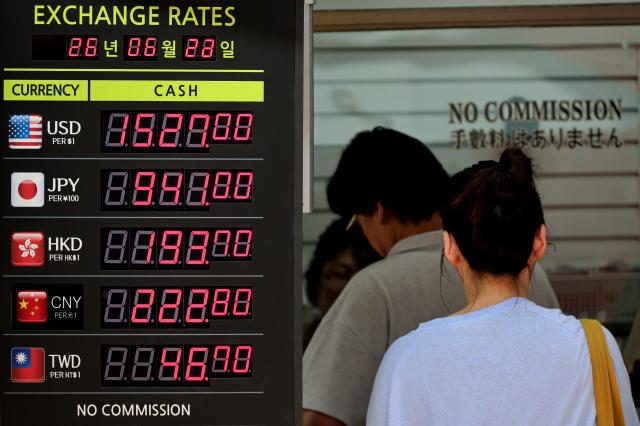
A currency exchange office in Seoul on June 28. [Photo=Yonhap News]
Despite a record high current account surplus driven by a semiconductor boom, the won-dollar exchange rate remains stubbornly high. The traditional correlation of 'current account surplus = won appreciation' appears to be breaking down due to increased overseas investments and capital outflows. Market analysts suggest that the structural changes in capital movement may lead to prolonged high exchange rates.
As of June 28, the weekly closing price for the won-dollar exchange rate was recorded at 1,532.0 won, marking 29 consecutive trading days above the 1,500 won level.
With two trading days left in June, the average weekly closing price for the won-dollar exchange rate in the second quarter (April to June) stands at 1,500.1 won. This is the highest level in 28 years and three months since the first quarter of 1998 during the Asian financial crisis, when it was 1,596.8 won.
This trend contrasts sharply with the recent record high current account surplus. According to the Bank of Korea, the current account recorded a surplus of $28.39 billion in April. The cumulative surplus for the year up to April reached $102.67 billion, nearing last year’s total surplus of $123.05 billion within just four months.
Typically, an increase in exports leading to a larger current account surplus results in greater dollar supply in the foreign exchange market, which strengthens the won. However, this linkage has noticeably weakened recently.
In a recent report titled 'BOK Issue Note: The Impact of Structural Changes in Korea's External Sector on Exchange Rates,' the Bank of Korea noted that the current account surplus no longer leads to won appreciation as it once did. The report indicated that since 2015, a 1 percentage point increase in the current account surplus relative to GDP has resulted in an average 0.65% increase in the real exchange rate, showing a reversal in the relationship between the current account and exchange rates compared to the past.
The Bank of Korea attributed this change to increased capital outflows through the financial account. In the past, a significant portion of the current account surplus contributed to an increase in foreign exchange reserves. However, since the global financial crisis, direct investments and overseas securities investments have increased, leading to a structure where dollars earned by the private sector do not remain in the country but flow back out.
Kim Ji-hyun, a senior researcher at the Bank of Korea’s International Finance Research Team, stated, "When we refer to the phenomenon of increased exports leading to a decrease in exchange rates as a 'goods shock,' and the capital outflows from domestic residents' overseas asset investments as a 'financial shock,' the frequency of financial shocks has increased since 2015."
Despite recent easing of international oil prices and geopolitical risks due to a peace agreement in the Middle East, the exchange rate remains high, which analysts believe is related to these structural changes. In fact, foreign investors have sold a net $89 billion worth of domestic stocks in the first half of the year, and capital outflows related to portfolio rebalancing due to rising domestic stock prices are expected to continue for the time being.
Jeon Gyu-yeon, a researcher at Hana Securities, noted, "The increase in the won-dollar exchange rate, despite strong semiconductor exports and record current account surpluses, is primarily due to larger capital outflows through the financial account. With the establishment of the Korea-U.S. Strategic Investment Corporation, significant investments in the U.S. are expected to be gradually executed, which may sustain structural dollar outflow pressures for the foreseeable future."
He added, "Given that the current exchange rate is approaching levels seen during the financial crisis, there may be a stronger perception of a ceiling around 1,560 won. However, considering the structural dollar outflow pressures, it is necessary to establish joint measures for exchange rate stability, such as a currency swap with the U.S."
As of June 28, the weekly closing price for the won-dollar exchange rate was recorded at 1,532.0 won, marking 29 consecutive trading days above the 1,500 won level.
With two trading days left in June, the average weekly closing price for the won-dollar exchange rate in the second quarter (April to June) stands at 1,500.1 won. This is the highest level in 28 years and three months since the first quarter of 1998 during the Asian financial crisis, when it was 1,596.8 won.
This trend contrasts sharply with the recent record high current account surplus. According to the Bank of Korea, the current account recorded a surplus of $28.39 billion in April. The cumulative surplus for the year up to April reached $102.67 billion, nearing last year’s total surplus of $123.05 billion within just four months.
Typically, an increase in exports leading to a larger current account surplus results in greater dollar supply in the foreign exchange market, which strengthens the won. However, this linkage has noticeably weakened recently.
In a recent report titled 'BOK Issue Note: The Impact of Structural Changes in Korea's External Sector on Exchange Rates,' the Bank of Korea noted that the current account surplus no longer leads to won appreciation as it once did. The report indicated that since 2015, a 1 percentage point increase in the current account surplus relative to GDP has resulted in an average 0.65% increase in the real exchange rate, showing a reversal in the relationship between the current account and exchange rates compared to the past.
The Bank of Korea attributed this change to increased capital outflows through the financial account. In the past, a significant portion of the current account surplus contributed to an increase in foreign exchange reserves. However, since the global financial crisis, direct investments and overseas securities investments have increased, leading to a structure where dollars earned by the private sector do not remain in the country but flow back out.
Kim Ji-hyun, a senior researcher at the Bank of Korea’s International Finance Research Team, stated, "When we refer to the phenomenon of increased exports leading to a decrease in exchange rates as a 'goods shock,' and the capital outflows from domestic residents' overseas asset investments as a 'financial shock,' the frequency of financial shocks has increased since 2015."
Despite recent easing of international oil prices and geopolitical risks due to a peace agreement in the Middle East, the exchange rate remains high, which analysts believe is related to these structural changes. In fact, foreign investors have sold a net $89 billion worth of domestic stocks in the first half of the year, and capital outflows related to portfolio rebalancing due to rising domestic stock prices are expected to continue for the time being.
Jeon Gyu-yeon, a researcher at Hana Securities, noted, "The increase in the won-dollar exchange rate, despite strong semiconductor exports and record current account surpluses, is primarily due to larger capital outflows through the financial account. With the establishment of the Korea-U.S. Strategic Investment Corporation, significant investments in the U.S. are expected to be gradually executed, which may sustain structural dollar outflow pressures for the foreseeable future."
He added, "Given that the current exchange rate is approaching levels seen during the financial crisis, there may be a stronger perception of a ceiling around 1,560 won. However, considering the structural dollar outflow pressures, it is necessary to establish joint measures for exchange rate stability, such as a currency swap with the U.S."
* This article has been translated by AI.
Copyright ⓒ Aju Press All rights reserved.