

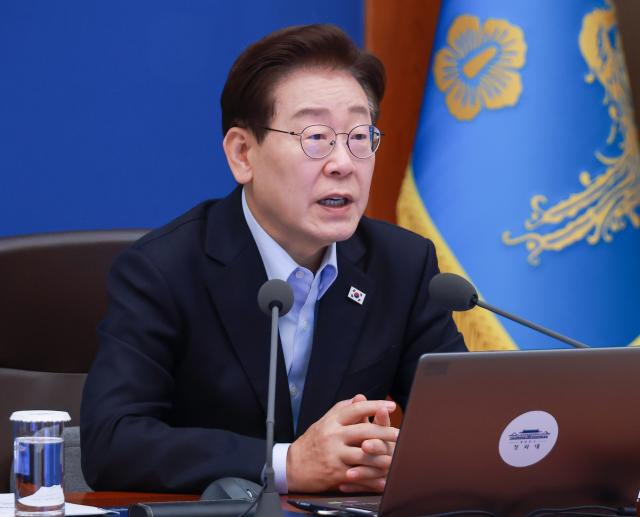
President Lee Jae-myung emphasized on July 2 that the government's recently announced "Three Mega Projects for South Korea's Great Leap" will serve as a driving force to diversify growth beyond the capital region and transform the entire country into a version of Silicon Valley.
During a chief secretary meeting at the Blue House, President Lee stated, "The three mega projects are not merely a favor to the provinces; they are the only path for South Korea to emerge as the ultimate winner of the Fourth Industrial Revolution and a historic decision for future generations."
He reflected on past administrations, noting that they have always opened doors to greater leaps through new challenges at critical junctures. He recalled that in the 1970s, the Park Chung-hee administration fostered heavy and chemical industries, paving the way for export-led growth, while the Kim Dae-jung administration in the 2000s laid the groundwork for a powerhouse in IT technology.
"Our government’s three mega projects will be the third stepping stone for South Korea to stand tall as a leading industrial powerhouse," he asserted.
President Lee instructed that the Blue House and government prioritize the organization of policies and laws, as well as budget allocations, to accelerate the progress of these initiatives. He also urged for thorough planning and execution of subsequent investment plans.
He called on the nation to unite—citizens, businesses, government, and political parties—to open greater opportunities for all youth across the country, taking responsibility for South Korea's future over the next 30 years.
Additionally, President Lee highlighted that one of the most significant challenges to address alongside creating future growth engines is alleviating the deep-seated imbalances and disparities in society. He warned that neglecting K-shaped polarization could diminish productivity, undermine growth potential, and destabilize national unity and social stability.
He stressed that the success of government policies hinges on addressing polarization and called for multifaceted policy responses. To this end, he urged a focus on strengthening basic safety nets, establishing a fair labor market, revitalizing local economies, and building asset ladders for all, including youth.
Moreover, he requested that the anticipated additional tax revenues be used efficiently to create stable investment resources for future generations.
During a chief secretary meeting at the Blue House, President Lee stated, "The three mega projects are not merely a favor to the provinces; they are the only path for South Korea to emerge as the ultimate winner of the Fourth Industrial Revolution and a historic decision for future generations."
He reflected on past administrations, noting that they have always opened doors to greater leaps through new challenges at critical junctures. He recalled that in the 1970s, the Park Chung-hee administration fostered heavy and chemical industries, paving the way for export-led growth, while the Kim Dae-jung administration in the 2000s laid the groundwork for a powerhouse in IT technology.
"Our government’s three mega projects will be the third stepping stone for South Korea to stand tall as a leading industrial powerhouse," he asserted.
President Lee instructed that the Blue House and government prioritize the organization of policies and laws, as well as budget allocations, to accelerate the progress of these initiatives. He also urged for thorough planning and execution of subsequent investment plans.
He called on the nation to unite—citizens, businesses, government, and political parties—to open greater opportunities for all youth across the country, taking responsibility for South Korea's future over the next 30 years.
Additionally, President Lee highlighted that one of the most significant challenges to address alongside creating future growth engines is alleviating the deep-seated imbalances and disparities in society. He warned that neglecting K-shaped polarization could diminish productivity, undermine growth potential, and destabilize national unity and social stability.
He stressed that the success of government policies hinges on addressing polarization and called for multifaceted policy responses. To this end, he urged a focus on strengthening basic safety nets, establishing a fair labor market, revitalizing local economies, and building asset ladders for all, including youth.
Moreover, he requested that the anticipated additional tax revenues be used efficiently to create stable investment resources for future generations.
* This article has been translated by AI.
Copyright ⓒ Aju Press All rights reserved.