The United States has a point. Recent difficulties identifying North Korean missile launches, limitations in military reconnaissance satellites and South Korea's continued reliance on U.S. intelligence, communications and strategic assets suggest Seoul has yet to eliminate some of the capability gaps that the conditions-based OPCON transition is designed to test.
Defense Minister Ahn Gyu-back on Wednesday said more than two decades of preparation had created the military and policy conditions needed for the transfer.
"Through the painstaking efforts of our military over the past two decades, the military and policy conditions have been established to the point where there would be no problem even if we recovered wartime operational control immediately," Ahn said.
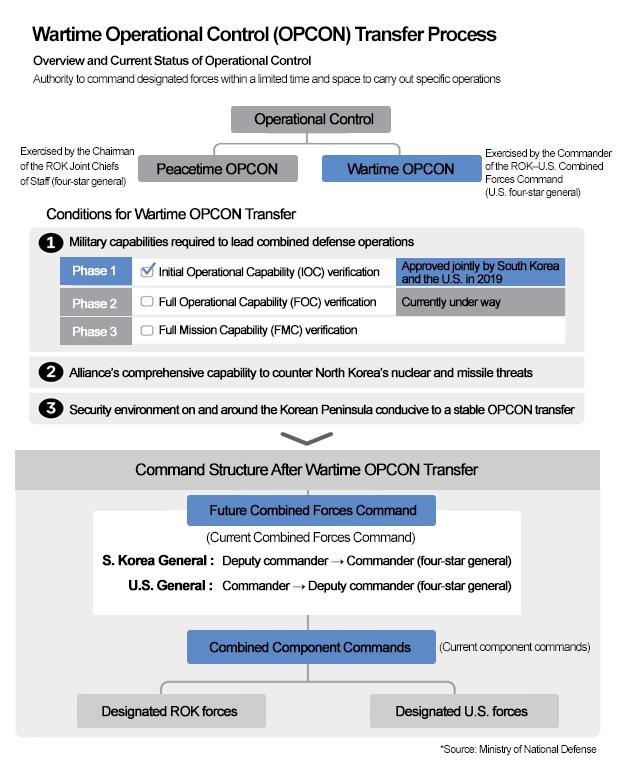
The government aims to complete this year the Full Operational Capability (FOC) verification of the future Combined Forces Command (CFC). Seoul hopes the South Korean and U.S. defense chiefs will then recommend a target year for the transfer to their presidents following the annual Security Consultative Meeting.
Under the proposed structure, a South Korean four-star general would command the future CFC, while a U.S. general would serve as deputy commander.
The transition, however, involves far more than changing the nationality of the commander.
Wartime operational control does not mean South Korea would independently command its military after the transfer. It refers to command authority exercised through the Combined Forces Command, a binational headquarters directing designated South Korean and U.S. forces during wartime. Even then, some South Korean units responsible for capital defense, rear-area security and mobilization would remain under Seoul's national chain of command.
The conditions-based transition requires the allies to determine whether South Korea can lead the combined defense, respond to North Korea's nuclear weapons and other weapons of mass destruction, and whether the regional security environment supports a stable transfer.
The first two conditions reportedly encompass dozens of major tasks and about 100 detailed requirements covering intelligence, weapons, organizations, doctrine, training and facilities. The third is inherently more subjective, involving broader strategic and political judgment.
Ahn has said the allies agreed in 2020 that South Korea had fulfilled 94 percent of the first two sets of conditions. The details remain classified, however, making it unclear whether that figure reflects completed capabilities, approved acquisition plans or an average across multiple categories.
Critics argue such progress is difficult to assess unless the allies first define the "end state" South Korea is expected to achieve.
Jeong Kyung-woon, a retired Army lieutenant colonel and senior research fellow at the Korea Research Institute for Strategy, said broad objectives such as leading combined defense or responding to North Korean nuclear threats are too vague to measure.
Without a clearly defined end state, the allies cannot determine how many units, weapons, personnel and facilities are actually required, he said.
Evaluating progress without first defining the destination, Jeong argued, is like measuring how far a traveler has gone without deciding where the journey should end.
The distinction between detecting a launch and identifying exactly what was launched helps explain why intelligence remains one of the most demanding requirements for OPCON.
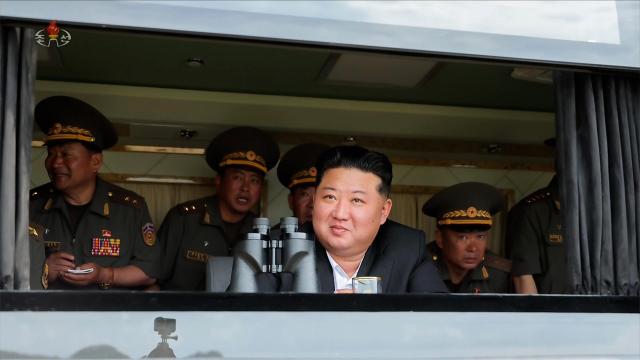
North Korea's June 25 weapons launches illustrated that challenge.
Pyongyang fired a mix of tactical ballistic missiles, upgraded 240-millimeter multiple rocket launchers and extended-range artillery shells.
South Korea's military said the allies detected and tracked the projectiles in real time but did not immediately announce the launches and was unable to promptly determine their detailed specifications.
A military expert said South Korea's ground-based radar network cannot continuously cover every part of North Korea.
Because radar beams rise with distance, projectiles launched from deeper inside North Korea may not be detected until they reach higher altitudes. South Korean sensors may therefore observe only part of a projectile's flight, making precise identification difficult.
"The South Korean detection network cannot cover every part of North Korea, and there are still significant blind spots," the expert said.
"When the detected portion of a flight is short or its characteristics are unclear, additional U.S. or Japanese data may be needed before a conclusion can be reached."
The United States can draw on reconnaissance assets based in Japan, elsewhere across the Indo-Pacific and the continental United States. South Korea has fewer surveillance platforms and a narrower coverage area, leaving it dependent on U.S. support for early warning and the identification of high-value targets.
Seoul has sought to reduce that dependence by deploying five military reconnaissance satellites under its 425 Project.
Concerns emerged, however, after one attitude-control actuator malfunctioned on both the third and fourth satellites.
A retired general involved in earlier OPCON preparations said five satellites alone cannot provide persistent surveillance of the Korean Peninsula and that South Korea remains dependent on U.S. reconnaissance assets to monitor strategic targets.
Long-range strike weapons matter only if targets can first be found, identified and tracked. Without persistent surveillance, even sophisticated missiles become significantly less effective.
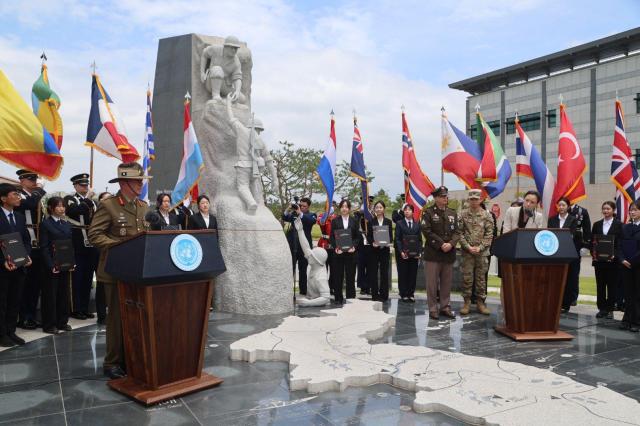
The current CFC commander also serves as commander of U.S. Forces Korea (USFK), commander of the United Nations Command (UNC) and the senior U.S. military officer stationed in South Korea.
That arrangement has long simplified coordination among South Korea's Joint Chiefs of Staff, the CFC, USFK and the UNC.
After OPCON transfer, the South Korean general commanding the future CFC would not command either the UNC or USFK, requiring new coordination mechanisms among organizations currently led by the same individual.
The change becomes especially significant during a nuclear crisis, when the future CFC would need to coordinate with the U.S. Indo-Pacific Command, U.S. Strategic Command and other organizations controlling intelligence and strategic assets.
Questions also remain over how quickly a South Korean commander could secure additional U.S. surveillance capabilities compared with today's American commander.
The same issue extends to wartime reinforcements and strategic assets such as aircraft carriers, nuclear-powered submarines, strategic bombers, reconnaissance aircraft and military satellites.
The future commander could request those assets, but their deployment would remain subject to decisions by the U.S. government and military commands. The scope of South Korea's wartime operational control would likewise depend on arrangements agreed upon by both governments.
None of this suggests Washington would reject the authority of a South Korean commander. But changing the nationality of the commander would not automatically guarantee immediate access to every U.S. capability.
Even after OPCON transfer, South Korea would continue to rely on U.S. intelligence, missile defense, communications and strategic assets. The transition is therefore not simply about replacing one commander with another.
The real test of wartime command is whether that commander can integrate South Korean and U.S. forces, fuse allied intelligence, secure strategic reinforcements and make operational decisions under combat conditions.
"Taking command is not simply putting a South Korean general in the top position," the military expert said. "It means having the ability to see the threat, assess it, make a decision and communicate that decision under pressure. That is where readiness must ultimately be proven."

Copyright ⓒ Aju Press All rights reserved.