

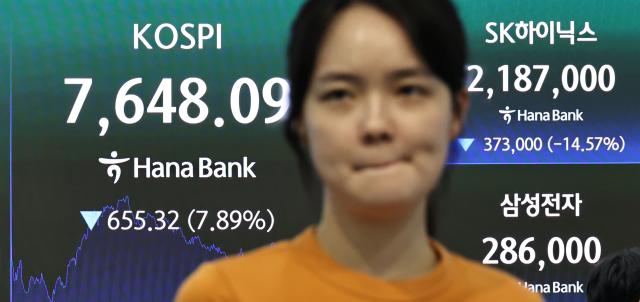
The KOSPI index took a significant hit on July 2, dropping nearly 8% to fall below the 7,600 mark, following news of Meta's expansion into the cloud business. This development raised concerns about a slowdown in artificial intelligence (AI) investments. Major semiconductor stocks, including Samsung Electronics and SK Hynix, also experienced sharp declines, fueling fears of a potential downturn in the semiconductor sector.
According to the Korea Exchange, the KOSPI closed at 7,648.09, down 655.32 points (7.89%) from the previous trading day. The index fell as low as 7,616.33 during the session due to ongoing selling by foreign and institutional investors. The KOSDAQ index also closed down 6.74%, finishing at 866.72.
The catalyst for the market turmoil was the so-called "Meta Shock." Bloomberg reported that Meta is considering entering the cloud infrastructure business by selling excess computing resources from its AI data centers. This news has led the market to interpret that AI computing supply may exceed demand, raising concerns about a slowdown in future investments in AI infrastructure and memory semiconductors.
As a result, shares of memory semiconductor companies like Micron (-10.57%) and SanDisk (-10.62%) plummeted by around 10%. Samsung Electronics fell by 9.06% to 286,000 won, while SK Hynix saw a more severe drop of 14.57%, closing at 2,187,000 won.
From a supply and demand perspective, foreign and institutional investors were significant contributors to the index's decline, with net sales of 4.8098 trillion won and 2.5743 trillion won, respectively, in the KOSPI market. Notably, the foreign net selling volume reached the 15th largest in KOSPI history.
Analysts suggest that this drop is primarily a result of profit-taking following short-term market overheating, rather than a fundamental weakening of AI demand. Kang Jae-goo, a researcher at Hana Securities, stated, "Meta's new business entry signals that the return of investments is expected to happen sooner than anticipated, rather than a decline in demand." He added that while short-term investor sentiment may be weak, the market's reaction appears to be an overreaction when considering the fundamentals for the second half of the year.
Jo A-in, a researcher at Samsung Securities, noted, "Meta's actions should be viewed as a way to alleviate investment burdens and enhance resource utilization, while the supply shortage of high-performance memory semiconductors continues." She advised that investors should prepare for volatility by monitoring the upcoming preliminary earnings results from Samsung Electronics for the second quarter.
* This article has been translated by AI.
Copyright ⓒ Aju Press All rights reserved.