

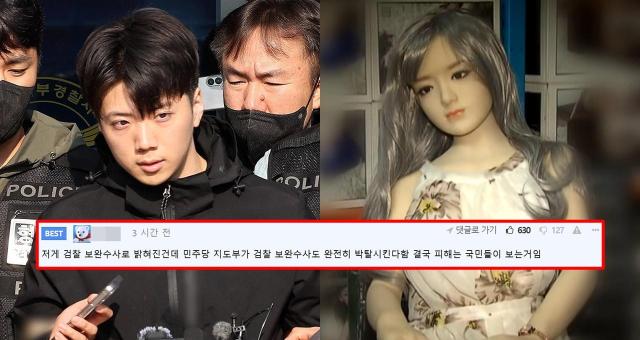
The Gwangju high school girl murder case involving suspect Jang Yoon-ki (23) has taken a troubling turn as key evidence supporting allegations of sexual crimes was reportedly destroyed by the suspect's father. This revelation has intensified scrutiny over the police's initial investigation, particularly after it was disclosed that they failed to secure this evidence during their initial search.
On July 1, SBS reported that during the early stages of the investigation, police discovered several adult dolls (real dolls) at Jang's residence but did not seize them.
According to SBS, Jang's father, a current police executive in Gwangju, disassembled the dolls into multiple pieces and disposed of them throughout the city. Additionally, it was confirmed that he incinerated several of Jang's old mobile phones.
The prosecution is conducting supplementary investigations to establish the sexual crime motive based on the destroyed dolls, video footage taken during the police search, and DNA evidence obtained from the dolls. This evidence has led to Jang being charged with rape and murder.
Justice Minister Jeong Seong-ho commented on the case, stating, "The supplementary investigation by the prosecution has clarified the sexual crime motive," and indicated that he would review whether improvements are needed in the family evidence tampering exception regulations.
The controversy has escalated due to the potential difficulty in criminally prosecuting Jang's father for evidence tampering, despite his actions.
Current Article 155, Section 4 of the Criminal Code (family evidence tampering exception) stipulates that relatives or cohabiting family members who destroy evidence for the benefit of a family member are not subject to punishment for evidence tampering. Similar provisions apply to the crime of aiding a fugitive.
Legal experts argue that while the legislative intent is to protect families, there is a need to reconsider whether it is appropriate to exempt evidence tampering in serious violent crimes.
Following the news, various opinions emerged online regarding the family evidence tampering exception and the investigation system. Some users expressed confusion over why the real dolls are considered key evidence, while others explained that they could serve as circumstantial evidence to prove the sexual crime motive.
Other commenters noted, "This seems like a case of exploiting the law. We need to reassess whether it aligns with the legislative intent," and added, "Even if prosecution for evidence tampering is difficult, disciplinary action against a police executive is a separate issue," and, "If the police had conducted a proper initial investigation, this situation might have been avoided," indicating concerns over potential legal loopholes.
Meanwhile, Jang Yoon-ki is scheduled to appear at the Gwangju District Court for his second trial on July 13.
* This article has been translated by AI.
Copyright ⓒ Aju Press All rights reserved.