

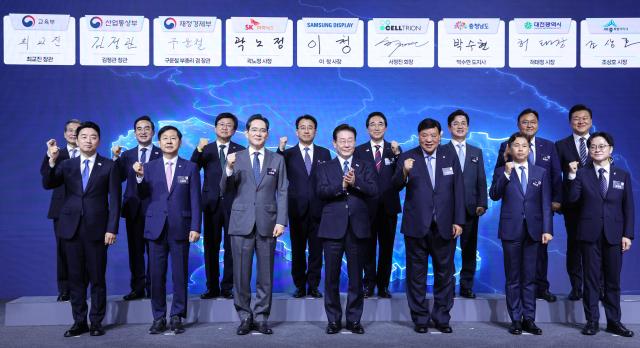
The government and industry have announced plans to establish the Chungcheong region as a global hub for advanced industries, highlighting its favorable location with access to transportation networks and stable water and power supply. Strengthening the ecosystem for materials, parts, and equipment, as well as securing specialized talent, has emerged as a key challenge.
According to the government and industry on July 2, the Chungcheong region is identified as an optimal location for new investments due to its comprehensive infrastructure, including transportation, power, water, and land. Its proximity to the metropolitan area and the ability to utilize both the Gyeongbu and West Coast KTX lines, along with highway networks, enhance accessibility for semiconductor equipment and materials, as well as skilled labor. The region's closeness to Incheon International Airport is also praised for facilitating global supply chains through efficient procurement of raw materials and export of finished products.
Existing industrial complexes are equipped with energy infrastructure and clean rooms, maximizing efficiency in semiconductor front-end and back-end processes and packaging. The areas around Cheongju and Daejeon benefit from a stable power supply using abundant water from the Daecheong Dam and nearby power generation facilities. The cities of Cheonan, Asan, and Sejong are also connected to the West Coast industrial complex's power transmission network, allowing for rapid power supply to new fabs.
Kwack No-jung, CEO of SK Hynix, emphasized at the national report meeting that "the new fab in Cheongju can immediately commence construction by utilizing the existing power and water supply from the Cheongju campus." This indicates that investments can move directly into the execution phase without the need for large-scale infrastructure development.
Cheongju will become a core hub connecting SK Hynix's NAND production base with the Cheongju Technopolis and the secondary battery synchrotron industry belt in Ochang, integrating front-end and advanced packaging processes. The Cheonan-Onyang campus will transition from a general semiconductor back-end focus to a high-bandwidth memory (HBM) advanced packaging center. Sejong aims to establish itself as a hub for high-performance package substrates for artificial intelligence (AI) servers, while Asan will expand into a cluster for next-generation organic light-emitting diodes (OLEDs) and automotive displays.
In addition, Daejeon will collaborate with KAIST and government-funded research institutions to establish research and development (R&D) for advanced packaging and a semiconductor gas performance and safety evaluation support center. The production will be concentrated in Cheongju, Cheonan, Asan, and Sejong, while Daejeon will focus on research, creating a division of labor that aims to accelerate the cluster's execution speed from R&D to mass production.
However, there are calls to strengthen the ecosystem for supporting materials, parts, and testing. The development support functions and key partner systems remain concentrated in the metropolitan area. In fact, over 70% of major partners that bridge chip design and packaging are located in the southern Gyeonggi region, such as Pangyo.
Improving living conditions and establishing tailored education systems are urgent for securing talented personnel. Kwack noted in a previous meeting with the president that "the most concerning issue when relocating to the provinces is the education of children, rather than housing and culture, as both the cooperating companies and young talent move together." This implies that even if companies establish production bases, it will be challenging to fundamentally resolve the concentration issue in the metropolitan area without a supportive educational and healthcare environment for research professionals.
Lee Jeong-hee, a professor at Chung-Ang University, stated, "Along with bold regulatory exceptions and tax incentives to create a favorable business environment, improvements in living conditions related to housing, education, and healthcare for core personnel must urgently accompany this effort." He emphasized the need to utilize this mega-special zone as a vessel for nurturing talent and driving industrial innovation, similar to the ecosystem developed around regional universities in Austin, Texas.
* This article has been translated by AI.
Copyright ⓒ Aju Press All rights reserved.