

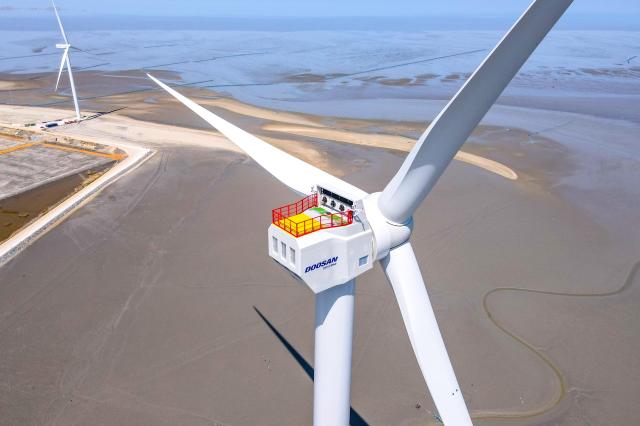
According to data from the Ministry of Climate, Energy, and Environment provided by Rep. Kim So-hee of the People Power Party, the domestic offshore wind market is still largely centered around 6-10 MW turbines, which fall short of the global standard of 15 MW.
The 6 MW turbines are supplied by Doosan Enerbility and Unison-Mingyang, while the 8 MW turbines come from Doosan Enerbility and Siemens Gamesa. The 10 MW turbines are also provided by Doosan Enerbility and Unison. In contrast, the 15 MW turbines are led by Vestas and Siemens Gamesa.
The global offshore wind market is accelerating the trend of 'turbine scaling,' as larger turbine capacities reduce costs and enable stable power supply. However, South Korea lacks the infrastructure to verify and evaluate the performance of critical components like pitch and yaw bearings, resulting in low technological independence for ultra-large turbine technology.
Currently, Doosan Enerbility produces 15 MW offshore wind turbines but assembles them at its Changwon facility using key components supplied by Siemens.
The technology independence in the support vessel (SOV) market is also weak. SOVs are vessels that assist in the maintenance and repair of offshore wind turbines.
As offshore wind farms expand into more distant waters, the importance of SOVs is increasing. However, most SOVs used in domestic offshore wind projects are owned by European shipping companies. HD Korea Shipbuilding & Marine Engineering has begun developing a Korean-style SOV, but it has yet to reach commercialization due to a lack of technological capability and infrastructure.
In contrast, the transformer and cable sectors are praised for achieving complete technological independence. Hyosung Heavy Industries and HD Hyundai Electric are expanding their global presence with transformers and ultra-high voltage power equipment for offshore substations.
LS Cable & System and Daehan Electric are also establishing themselves as key players in the global supply chain by securing contracts for ultra-high voltage direct current (HVDC) underwater cable technologies for offshore wind projects in Europe and elsewhere. Underwater cables are installed beneath the sea to connect countries or land to islands.
Notably, LS Cable & System is investing approximately 1 trillion won in its underwater cable factory in Virginia, USA, enhancing its manufacturing and construction capabilities. Its subsidiary, LS Marine Solutions, has also started building next-generation cable laying vessels (CLV) to improve its capacity for large-scale underwater power grid projects.
Experts express concern that the disparities in technological independence across different sectors could weaken the overall competitiveness of the offshore wind industry. They emphasize the need for policy support to foster domestic supply chains and reduce technological gaps as offshore wind power expands.
Park Joo-hun, a professor of economics at Dongduk Women's University, stated, "The government has focused solely on renewable energy deployment to achieve carbon neutrality. To reduce reliance on foreign imports in the offshore wind equipment sector, measures such as preferential evaluation for domestic equipment and tariff protection should be implemented alongside existing policies."
* This article has been translated by AI.
Copyright ⓒ Aju Press All rights reserved.