


What is the most enduring language in international politics? It is neither military might nor financial power. Sometimes, it is a bowl of noodles, a piece of roasted duck, or a cup of tea. China has understood this for a long time. As Confucius stated in the "Analects," "Rituals value harmony" (禮之用 和爲貴), indicating that Chinese civilization has long read its counterparts and adjusted relationships at the dining table before resorting to swords.
During U.S. President Donald Trump's visit to Beijing, China once again showcased the essence of "food diplomacy." The final lunch menu presented by President Xi Jinping was surprisingly not a lavish royal dish but Kung Pao Chicken, a Sichuan-style stir-fried chicken. At first glance, it appears to be a simple dish. However, in Chinese diplomacy, food is never just food; it serves as a code and a message.
Kung Pao Chicken is one of the most deeply rooted Chinese dishes in American society. It originated from Chinese laborers who brought it to the U.S. during the 19th century, working on railroads, in mines, and on farms. Its spicy yet familiar flavor has become a symbol of American Chinese cuisine. China chose to present this dish to President Trump.
An interesting linguistic play also emerged. Trump's Chinese name is "Chuanpu" (川普), while Sichuan cuisine is referred to as "Chuan Cai" (川菜). This reflects China's unique cultural code of ambiguity, cleverly juxtaposing Trump's rough and straightforward political style with the bold flavors of Sichuan cuisine. The menu for the state dinner exemplified how meticulous China's "food diplomacy" can be. It was not merely a display of traditional Chinese dishes; it incorporated elements of Chinese identity while considering President Trump's palate, American tastes, and Western dining culture.
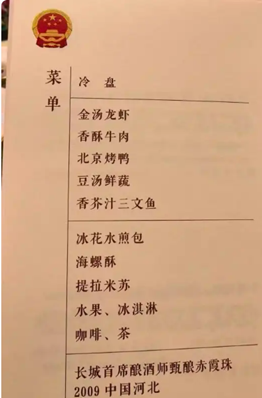
The state dinner on May 14 at the Great Hall of the People in Beijing included Peking Duck, one of China's representative dishes. Known for its crispy skin and tender meat, Peking Duck is a staple at state banquets for foreign leaders and symbolizes both royal cuisine and Beijing's pride.
Other dishes served included Cantonese lobster soup, crispy beef, and slow-cooked salmon with mustard sauce. Additionally, Chinese-style crispy dumplings, shell-shaped pastries, and Italian tiramisu were featured.
The menu was highly symbolic. Peking Duck represented China's tradition and royal culture, while the Cantonese seafood dishes signified openness and internationalism. The salmon with mustard sauce catered to Western tastes, and the tiramisu naturally connected to European sensibilities. The meal harmoniously blended Eastern and Western flavors without conflict. The dining table essentially mirrored the current state of U.S.-China relations: competitive yet coexisting, clashing yet unable to completely turn away from one another.
The atmosphere in the banquet hall was also carefully curated. The music featured a mix of American and Chinese songs. Notably, when "YMCA," a song frequently used by Trump during his campaign, played, diplomats remarked that "China thoroughly studied Trump's personal political style and preferences." This was a classic example of Chinese hospitality, aimed at acknowledging the other party's pride and narrowing psychological distances.
Sun Tzu's "Art of War" states, "The best victory is to win without fighting" (上兵伐謀). Chinese diplomacy sometimes designs its banquet menus with more finesse than missile strategies. Interestingly, this food diplomacy is not exclusive to Trump.
Earlier this year, when South Korean President Lee Jae-myung visited China, President Xi personally recommended Beijing-style Jajangmyeon at the state dinner. This was not the sweet black bean noodles familiar to Koreans but a savory and light version typical of northern China. Xi reportedly said, "Try it and see how it differs from Korean Jajangmyeon."
That remark was not merely a joke. Jajangmyeon originally came from Shandong laborers who brought it to Incheon and Seoul. However, it has since transformed into a distinctly different cultural dish in Korea. China is aware of this. In other words, Jajangmyeon represents a shared cultural memory between China and Korea, even amidst conflict and competition. Xi placed that memory on the dining table.
When hosting Russian President Vladimir Putin, China's menu changes again. China tends to favor hearty northern dishes rich in meat and flavor for Russian leaders. Smoked duck, lamb dishes, stir-fried seafood, and rich soups frequently appear. Additionally, vodka and traditional Chinese liquor, Baijiu, are served together. This is not merely hospitality; it symbolizes the geopolitical bond between two continental powers.
In fact, the banquet settings for Sino-Russian summits often resemble a representation of Eurasian order. The emphasis is on meat rather than seafood, and the robust flavors of northern cuisine take precedence over the delicate Cantonese dishes. This indicates that China views Russia not as a "maritime power" but as part of the same continental civilization.
When French President Emmanuel Macron visited Beijing, the atmosphere shifted once more. France considers food to be a part of its national identity. China highlighted Cantonese seafood paired with wine, emphasizing delicacy and artistry. It naturally connected French wine with Chinese tea culture, and the dessert selection leaned more towards European styles. This conveyed the message that "China is not just a factory but a civilization." Macron, well-versed in cultural diplomacy through the Louvre and Versailles, was accurately understood by China.
Dinners with German chancellors tend to have a more pragmatic tone. Germany values order, balance, and stability over extravagance. Therefore, China often presents relatively simple and structured courses rather than overly stimulating or decorative dishes. Typical offerings include light fish dishes, health-focused mushroom and vegetable meals, and restrained desserts. This reflects a dining experience of "trust and stability" tailored to Germany's industrial and manufacturing characteristics.
In reality, food in Chinese diplomacy is not merely about hospitality. It is a vast narrative where history, civilization, economy, strategy, psychology, and symbolism all operate simultaneously. For 5,000 years, China has been a "civilization at the crossroads." By welcoming merchants, envoys, monks, and armies along the Silk Road, China developed the skill to understand others, with food always at the center.
The "Tao Te Ching" states, "A great nation stays low" (大國者下流), meaning that stronger nations should embrace others. China sometimes seeks to embody this philosophy at the banquet table. Of course, the reality of U.S.-China relations is far from romantic. Strategic competition over semiconductors, AI, Taiwan, the South China Sea, and tariffs is becoming increasingly intense. However, it is interesting that even clashing nations still strive to respect each other's cultures at the dining table.
Trump enjoys Peking Duck, President Lee tastes Beijing-style Jajangmyeon, Putin savors Chinese lamb, Macron relishes Chinese tea, and German chancellors dine on light Cantonese fish dishes. International politics ultimately involves human interactions, and humans remember best when they share a meal. Perhaps the world order is subtly shifting not at the summit table but in the banquet halls behind it.
Between a plate of Kung Pao Chicken and a bowl of Jajangmyeon, the world continues to negotiate quietly today.
※ This article was generated using AI technology and has been reviewed by an editor.
* This article has been translated by AI.
Copyright ⓒ Aju Press All rights reserved.