

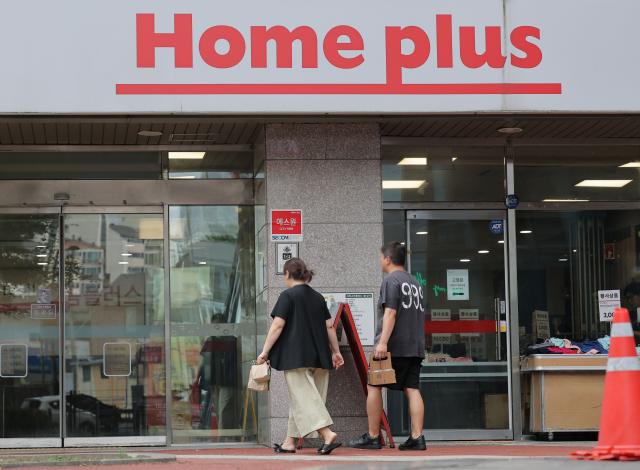
Homeplus, a major player in South Korea's retail sector, is facing the grim reality of potential liquidation following a court's decision to terminate its corporate rehabilitation process. The company is seeking to secure 200 billion won ($150 million) as its last hope, but significant gaps between its stakeholders, MBK Partners and Meritz Financial Group, make a resolution unlikely. This situation is not merely a corporate failure; the collapse of Homeplus could have widespread repercussions for employees, suppliers, small businesses, and the local economy.
It is natural for uncompetitive companies to exit the market. However, calls for the government to rescue every failing business are not constructive. Accountability for management failures must be upheld, and market principles should be respected. Yet, the goal of a market economy is not indiscriminate liquidation but rather a balance of overall economic efficiency and social costs.
As of late last month, Homeplus employed over 12,000 workers. When including its suppliers, logistics companies, and small businesses that rely on it, the number of people whose livelihoods depend on Homeplus could reach as high as 100,000. If liquidation occurs, it could lead to massive layoffs, a chain of bankruptcies, and a downturn in local economies. Small suppliers and independent merchants, who typically have less financial resilience than larger corporations, may face existential threats if they are unable to recover payments or lose business partners. Ultimately, the fallout will affect not just the company but also consumers and the broader economy.
This crisis prompts a reevaluation of the private equity-driven approach to corporate acquisitions and management. Criticism has long been directed at the focus on financial returns post-acquisition, which prioritizes short-term asset sales and financial restructuring over long-term competitiveness. The failure to adapt to the rapidly changing online retail environment also warrants a critical assessment of management strategies.
The government cannot remain passive in this situation. This does not imply that it should forcefully support a specific company. If liquidation is unavoidable, it must quickly activate employment safety nets for workers and implement emergency financial and management stabilization measures to minimize the cascading impacts on suppliers, small businesses, and other stakeholders. For the most affected small businesses, practical support such as policy financing, tax relief, and emergency liquidity should follow. On July 3, the government announced it would inject 440 billion won ($330 million) in emergency liquidity to suppliers and provide up to 21 million won ($15,800) to workers affected by wage arrears, aiming to protect employees and suppliers rather than save Homeplus itself.
The court and creditors must also consider the broader social costs in their decisions. While liquidation may be more favorable for debt recovery, the significant employment shock and costs associated with the collapse of local economies must also be factored in. The choice should not only focus on short-term recovery rates but also on minimizing overall societal losses.
The Homeplus situation is not just a corporate crisis; it highlights structural issues within our economy, where industrial ecosystems, employment, and local economies are intricately linked. Market principles must be upheld, but they should not serve as a justification for neglecting social responsibilities.
What is needed now is neither unconditional corporate bailouts nor cold indifference. A wise solution that adheres to principles while minimizing harm to employment and suppliers is essential. This approach is crucial for sustaining the market economy and fulfilling the minimum social responsibilities our economy must uphold.
* This article has been translated by AI.
Copyright ⓒ Aju Press All rights reserved.