


SEOUL, July 10 (AJP) - A serving police officer destroyed evidence in his own son's murder case, and under South Korean law he cannot be prosecuted for it.
That fact, uncovered during the investigation into the killing of a high school girl in the southern city of Gwangju in May, has pushed South Korea into a national debate over a decades-old provision of its Criminal Act that shields relatives from punishment when they hide offenders or destroy evidence on their behalf.
Prosecutors say Jang Yun-gi, 23, attacked the student after stalking her with the intent to abduct and sexually assault her. While Jang was in custody, investigators found that items prosecutors considered important to proving a sexual motive, including life-like sex dolls and mobile phones, had disappeared from his residence. Prosecutors later determined that Jang's father, a police officer, had discarded the dolls and burned the phones.
Ordinarily, destroying evidence in another person's criminal case is punishable by up to five years in prison or a fine. But Articles 151 and 155 of the Criminal Act carve out an exception: when a relative or cohabiting family member commits those acts for the benefit of the suspect, the person is not punished. The father is therefore unlikely to face criminal charges. The National Police Agency has said disciplinary measures remain possible if misconduct is confirmed, a distinction that has only intensified criticism that the law is out of step with the seriousness of the case.
The exemption rests on an old legal judgment that the state should hesitate before forcing family members to betray one another. It is the same impulse at the heart of "Mother," Bong Joon-ho's 2009 thriller about a mother who buries the truth of her son's crime; the cover-up horrifies because it feels emotionally comprehensible. Critics say the Jang case shows what happens when the law gives that impulse automatic protection: a legal safe harbor for evidence destruction in a murder case, exploited by a man sworn to uphold the law.

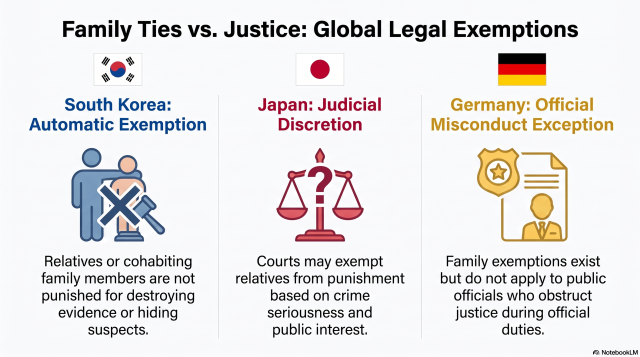
Other legal systems draw the line differently. Japan's Penal Code allows courts to exempt relatives rather than requiring it, giving judges room to weigh the gravity of the crime. Germany exempts relatives but separately punishes public officials who obstruct prosecution in the course of their duties, with no family exception. For critics of South Korea's law, that is the point: family loyalty may explain a parent's impulse, but it should not excuse a police officer's misuse of access and authority.
Defenders of the exemption warn that abolishing it entirely would create hard cases, forcing parents and spouses to help prosecute people they love. But even lawmakers sympathetic to that view see the current rule as untenable.
Rep. Min Hong-chul, a four-term Democratic Party lawmaker and former chief justice of the High Military Court, predicted a revision restricting the exemption would pass the National Assembly, saying the case had caused "such a major social impact."
"This case has exposed a blind spot in the family-member exemption system," Min said. "There were likely many undisclosed cases in which the exemption applied to serious crimes such as murder, rape and robbery."
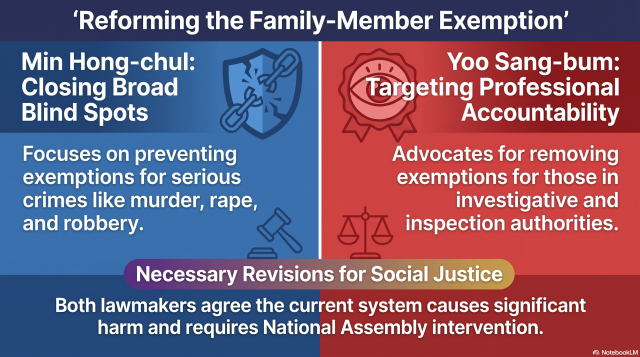
Rep. Yoo Sang-bum, a two-term People Power Party lawmaker and former chief prosecutor, said abolishing all family exemptions would go too far, but that the exemption should be removed for people in investigative and inspection authorities.
"The harm is too great to recognize the family-member exemption even for crimes committed by those responsible for uncovering the truth," Yoo said.
Neither party has yet moved beyond early discussions. "I understand that the party leadership and floor leadership are discussing the family-member exemption issue, but there has not yet been any concrete discussion at a general meeting of lawmakers," said a two-term Democratic Party lawmaker.
"This is a matter for the floor leadership, so we do not yet know the details. It will probably be discussed at Monday's general meeting of lawmakers," said a two-term People Power Party lawmaker.
Copyright ⓒ Aju Press All rights reserved.
