SEOUL, August 10 (AJP) - Artificial intelligence will run through teaching, research, administration and campus energy systems at the Korea Advanced Institute of Science and Technology under a plan its new president set out Monday, one that treats AI as a shared tool for every field of study rather than the property of specialists.
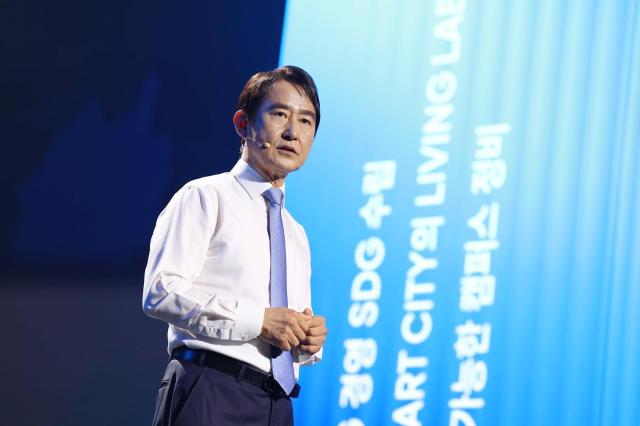
Bae Choong-sik presented the plan at his inauguration as the 18th president of the Korea Advanced Institute of Science and Technology (KAIST), held at the university's main auditorium. He took office on July 1 and used the ceremony to declare a new institutional vision, "Fundamentals First, Innovation Forward," ahead of the university's 60th anniversary in 2031.
Deputy Prime Minister and Minister of Science and ICT Bae Kyung-hoon attended, along with former president Lee Kwang-hyung and ambassadors posted to Seoul.
The changes fall under five strategies KAIST calls the Beyond Series: Beyond AI, Beyond Laboratory, Beyond Barriers, Beyond Carbon and Beyond KAIST.
The first commits the university to a curriculum rebuilt around AI use. Every course will carry an AI use grade, sorted into three levels that run from foundational teaching conducted without AI at all to courses in which students design AI systems. Undergraduate humanities and social science teaching will expand, as will laboratory practice.
"Designing learning around AI, not simply transmitting knowledge, is the beginning of AX educational innovation," Bae said, using an abbreviation for AI transformation.
Research will move toward physical AI, meaning systems that act in the world through robots, self-driving vehicles and advanced manufacturing, alongside quantum technology and climate and energy research. KAIST plans to bring more corporate satellite laboratories onto campus, following its recent cooperation with Nvidia, and to build an AI Autonomous Lab that folds AI into joint research with companies.
Startup education will reach first-year students for the first time, taught with founders drawn from the alumni network. Bae said technology companies started by KAIST graduates now hold combined assets of more than 100 trillion won.
Administration will be rebuilt on AI tools, with internal regulations cut and incentives offered to staff who lead the change. The campus itself becomes a living lab for climate and energy technology, with building energy systems linked through an AI model developed with the university's climate and energy research institute.
International work expands through dual degree programs, overseas scholars on dissertation committees and a global advisory group, under a program KAIST calls Global Connect.
The ceremony departed from the usual form. Rather than deliver a conventional address, Bae explained the strategies himself in a staged presentation directed by Kang Yi-yeon, a professor in KAIST's Department of Industrial Design. Three speakers followed with working examples, covering digital twins in shipbuilding, AI in chip production and physical AI in cars and robots.
Bae is a specialist in clean energy and carbon-neutral power engineering. He earned bachelor's and master's degrees in aerospace engineering at Seoul National University and a doctorate in mechanical engineering at Imperial College London in 1994. He joined KAIST in 1998 and later headed the School of Mechanical and Aerospace Engineering and served as dean of the College of Engineering. He chairs the sustainable combustion technology collaboration program at the International Energy Agency and was the first South Korean named a fellow of SAE International in the powertrain field.
"I will develop KAIST into a university that creates new standards beyond innovation, and into a national innovation platform leading the future of South Korean science and technology," he said.
Copyright ⓒ Aju Press All rights reserved.