

South Korea’s Joint Chiefs of Staff said it detected the missile launched from the Wonsan area at around 6 a.m.
“Our military detected a ballistic missile launched from the Wonsan area toward the East Sea at around 6 a.m.,” the JCS said. “The missile flew more than 700 kilometers, and South Korean and U.S. intelligence authorities tracked and shared related information from the early stages of the launch.”
Japan’s Coast Guard assessed that the missile reached a maximum altitude of about 90 kilometers and traveled roughly 690 kilometers.
The launch came six days after North Korea’s previous missile test on Aug. 6.
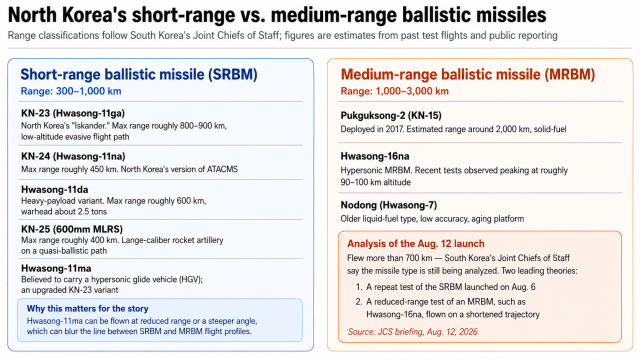
Unlike the previous launch, however, the JCS did not identify Wednesday’s missile as a short-range ballistic missile. Ballistic missiles with ranges of roughly 300 to 1,000 kilometers are generally classified as SRBMs.
When North Korea launched missiles on Aug. 6, the South Korean military specifically said it had detected short-range ballistic missiles.
The difference has prompted speculation that North Korea may have tested an upgraded version of the Hwasong-11Ma, a short-range hypersonic weapon based on the Hwasong-11Ga, better known as the KN-23, with a hypersonic glide vehicle-shaped warhead.
The Hwasong-11Ma was first unveiled during a military parade marking the 80th anniversary of North Korea’s ruling Workers’ Party in October 2025.
Its reported flight profile could support such an assessment, as the missile reached an altitude higher than the roughly 50 to 60 kilometers typically associated with the Hwasong-11Ga family and closer to the 70 to 100 kilometer range commonly associated with hypersonic glide vehicles.
Another possibility is that North Korea launched its Hwasong-16Na hypersonic medium-range ballistic missile on a shortened trajectory, given the missile’s estimated maximum altitude of around 90 kilometers.
Wednesday’s launch also comes days before South Korea and the United States are scheduled to begin their annual Ulchi Freedom Shield exercise on Aug. 17.
North Korea has repeatedly condemned the allies’ joint military exercises as rehearsals for an invasion.
AJP Takeaways
△ North Korea fired a ballistic missile from Wonsan toward the East Sea on Aug. 12, 2026, with the missile flying more than 700 kilometers.
△ South Korea’s Joint Chiefs of Staff is assessing whether the launch involved a hypersonic short-range ballistic missile or a medium-range ballistic missile flown on a shortened trajectory.
△ The launch came five days before the South Korea-U.S. Ulchi Freedom Shield exercise was scheduled to begin on Aug. 17, 2026.

Copyright ⓒ Aju Press All rights reserved.
