SEOUL, August 13 (AJP) -South Korea has hit the accelerator on President Lee Jae Myung’s “chip-and-beyond” industrial drive, clearing land and construction rules holding up more than 4.2 trillion won in planned investment as Seoul races to get new semiconductor capacity in southern region running before his term ends in 2030.
The package unveiled Thursday turns Lee’s call earlier this week for a “decisive battle” on industrial investment into a series of rule changes covering semiconductor fabs, batteries, biotechnology, AI data centers and robots.
It follows his order Monday to accelerate the Honam semiconductor cluster, including moving military functions from the Gwangju air base by mid-2028 and removing permitting and infrastructure bottlenecks.
Deputy Prime Minister and Minister of Finance and Economy Koo Yun Cheol announced the first round of the government’s on-site corporate investment and innovation support measures at a government meeting on Thursday.
The government said it was targeting projects where companies were ready to invest but construction or expansion had been held back by regulation.
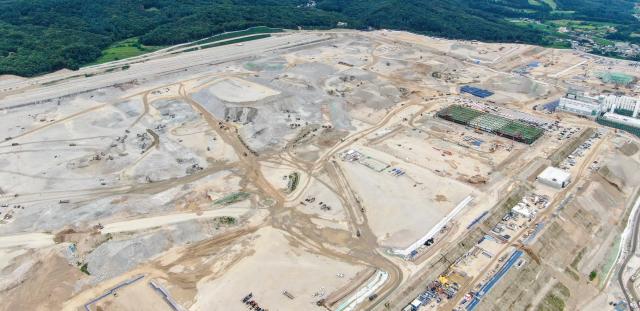
The biggest immediate beneficiary is the Yongin Semiconductor Cluster.
Under the current Building Act, the “one site, one permit” rule requires a company to amend its existing building permit whenever another structure is added. For semiconductor fabs, where designs and equipment layouts can change repeatedly while construction is under way, another expansion can arise before the previous permit amendment is finished, forcing the approval process to start again.
The government plans to amend the law in the second half of this year so that additional buildings at sufficiently large industrial complexes can receive separate permits and proceed independently. It estimates the change can bring forward about 2.5 trillion won of investment at the Yongin cluster.
The move fits a much broader race to compress Korea’s semiconductor construction calendar.
Lee told officials Monday that speed was now the overriding priority, citing the rapid construction of Taiwan Semiconductor Manufacturing Co.’s plant in Kumamoto, Japan. His government is pushing to have the first Honam semiconductor fab completed in 2029, before his five-year term expires in June 2030.
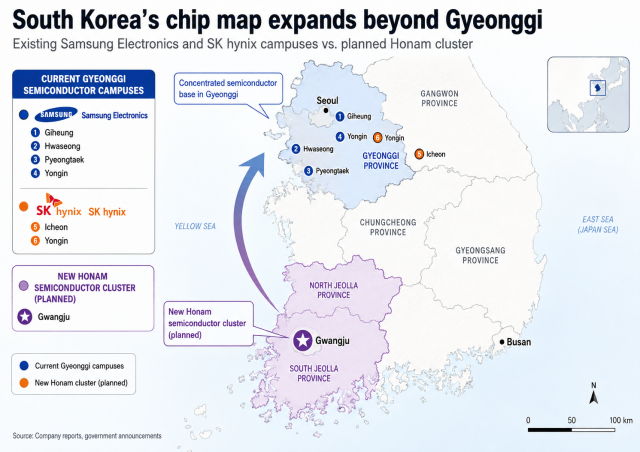
Samsung Electronics and SK hynix have pledged large-scale investment in the Honam project, where four fabs are planned on the Gwangju military airport site. The government has also been trying to advance electricity and water infrastructure so construction schedules are not dictated by utility bottlenecks. The Honam cluster alone is expected to require about 650,000 tons of industrial water a day.
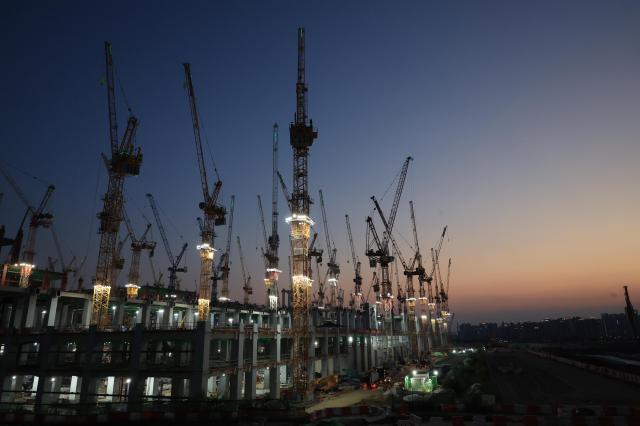
The same urgency is being applied to Yongin. SK hynix plans four fabs there, with the first cleanroom due to open in February next year and production expected as early as May. Its target for completing all four fabs has been pulled forward to 2033. Samsung Electronics, which plans six fabs at its separate Yongin complex, is targeting completion of its first fab in 2029 and the full complex by 2040.
According to the Ministry of Finance and Economy release, the government will exempt from gift tax property and other contributions made to semiconductor process verification organizations such as Trinity Fab, a shared testbed intended to help materials, parts and equipment companies validate technologies across five semiconductor processes. The project carries investment of about 800 billion won through 2031.
For batteries, recycling businesses will be allowed into the Gumi and Pohang national industrial complexes. Recycling has been treated as a waste-related business even though recovered lithium, nickel, cobalt, manganese and graphite feed directly back into battery manufacturing. Opening the complexes to those companies is expected to support about 100 billion won of new investment.
In biotechnology, Cheongju will move to convert municipally owned green space adjoining an existing plant in the Ochang Science Industrial Complex into industrial land, allowing a manufacturer to build a physically connected expansion. The government puts the resulting investment at about 530 billion won.
Another 350 billion won is expected from the Iksan National Food Cluster after land reserved for beverage manufacturers is opened more broadly to food and beverage producers.
Beverage-only lots had a sales rate of just 22.2 percent at the end of last year, compared with 90.3 percent for food-and-beverage sites.
The second part of the package attacks rules written for factories and buildings that look increasingly different from the facilities now being built.
For six advanced strategic industries — semiconductors, batteries, displays, biotechnology, robots and defense — the government plans to introduce performance-based fire-safety design that uses computer simulations instead of applying uniform building requirements.
Safety inspections required when semiconductor fabs expand their city-gas systems will also be shortened from seven days to three. The government said fabs can carry out roughly 1,800 such expansions a year, making repeated inspections a source of equipment start-up delays.
AI data centers will get their own regulatory relief. Because they require relatively few on-site workers, server-room space will be excluded when calculating some parking, elevator and artwork-installation requirements under implementing rules for the AI Data Center Special Act.
The government will also draw clearer safety rules for collaborative and mobile industrial robots so machines designed to work alongside people can operate without being forced into standards written mainly for fixed robotic arms. Detailed KS and ISO-based guidelines are due in the first half of 2027.
Land-use rules will be loosened as well. Industrial complexes will be allowed to designate as much as 50 percent of their industrial land for zones open to otherwise restricted industries when needed for new businesses or RE100 projects, up from 30 percent. Requirements for special industry districts will also be eased from consent by two-thirds of landowners to a simple majority.
For nationally important industrial complexes, the land minister will be empowered to designate “urban innovation zones” allowing far denser mixed-use development. Such zones have no fixed use restrictions and can theoretically exceed the statutory floor-area ratio ceiling of 1,500 percent.
The first package is part of a wider push accompanying Lee’s three mega-project strategy spanning semiconductors, AI data centers and physical AI. The government said a second round focusing on other advanced projects and green industries will follow in the third quarter.
AJP Takeaways:
- South Korea is cutting red tape for mega AI and semiconductor projects, easing land, construction and industrial-zone rules to accelerate private investment in strategic industries.
- The Yongin semiconductor cluster is the biggest immediate beneficiary, with separate building permits for fab expansions expected to bring forward about 2.5 trillion won ($1.8 billion) in investment and gas-safety inspections shortened from seven days to three.
- President Lee Jae Myung is pushing a broader chip-and-AI buildout beyond the existing Gyeonggi base, including the planned Honam semiconductor cluster, as Seoul seeks faster execution of projects involving Samsung Electronics, SK hynix and related AI infrastructure.
Copyright ⓒ Aju Press All rights reserved.