A model calibrated to South Korean households found that women would have had 28 percent more children in the absence of what researchers call a "status externality" in education — the pressure on parents to invest in their children's schooling not simply for its absolute benefits, but to keep them from falling behind other children.
For women born between 1970 and 1975, the study estimates average completed fertility would have risen from 1.92 children to 2.45 without that competitive pressure.
"The status externality plays an important role in fertility decisions," the researchers wrote, because it pushes up education investment, "which makes children costly and induces parents to have fewer offspring."
The researchers' model also points to a potentially provocative policy response, suggesting taxing private education spending and using the proceeds to support families with children.
The welfare-maximizing policy for the current generation combined a 22 percent tax on private education investment with moderate pro-natal transfers. Under the simulation, average fertility rose about 11 percent while education spending fell 39 percent.
The BOK summary of the research said taxing spending by higher-income households could be particularly effective because their education spending often sets the benchmark that other families feel compelled to follow.
The researchers, however, also identified a trade-off. Lower spending on each child's education reduces human-capital investment, meaning a policy that raises the welfare of today's parents could leave future generations with lower human capital and output.
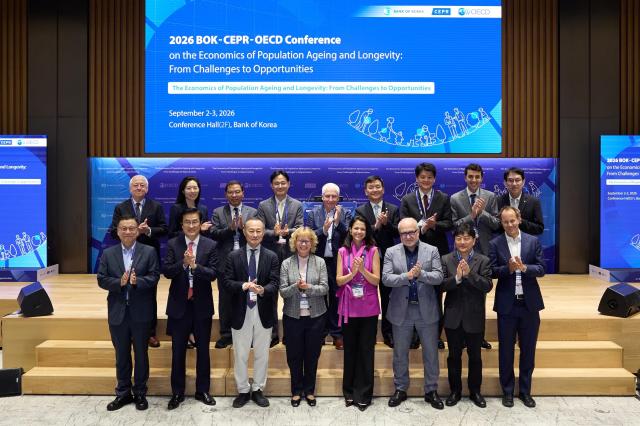
The findings were presented Wednesday by Kim Seong-eun of Sejong University at a two-day conference jointly hosted by the Bank of Korea (BOK), the Centre for Economic Policy Research and the Organisation for Economic Co-operation and Development in BOK headquarters in Seoul Wednesday.
The research wa co-authored by Yum Minchul, an associate professor of economics at Virginia Commonwealth University and Michèle Tertilt of the University of Mannheim on the causes and implications of ultra-low fertility.
BOK Governor Shin Hyun-song in opening the forum under the theme of "Economics of Population Aging and Longevity: From Challenges to Opportunities" stressed that "what is happening in Korea today foreshadows what many other countries will face tomorrow," adding that "demography is not destiny."
The country's total fertility rate rose to 0.80 child per woman in 2025 from 0.75 in 2024, marking a second consecutive annual increase after hitting a record low of 0.72 in 2023.
The rebound has accelerated this year. The total fertility rate reached 0.88 in the second quarter of 2026, up 0.11 from a year earlier and the highest for a second quarter since 2019. June births surged 15.6 percent from a year earlier to 23,111, while births in the first half climbed 15.4 percent.
Whether the trend will last remains uncertain, leaving policymakers searching not only for ways to subsidize childrearing but for structural forces that make Koreans reluctant to have more children.
At the center of the researchers' argument is a familiar feature of Korean family life - that parents do not make education decisions in isolation.
If one family spends more on private tutoring, cram schools and other education to improve its child's relative position, other families have an incentive to follow. Their additional spending then raises the benchmark for everyone else.
The result can resemble an arms race in which individual families behave rationally but collectively spend more than they otherwise would, raising the perceived cost of having each additional child.
The underlying paper estimates that a 10 percent reduction in education spending among the richest 15 percent produces roughly a 0.5 percentage-point reduction among the lower half of the income distribution.
In other words, poorer parents appeared to spend less when richer parents around them spent less. That is important because the relative burden of Korea's education race is heavier at the bottom of the income distribution.
The study found that households in the poorest quintile spent about 8.4 percent of income per child on private education, compared with 5.1 percent among the richest quintile.
In the researchers' model, removing the education status externality reduced the childlessness rate among the lowest-income quintile from about 5 percent to less than 1 percent.
The effect was large enough to reverse Korea's unusual relationship between income and fertility: poorer households currently have fewer children, whereas in many other countries fertility tends to decline as income rises.
The pressure remains visible in more recent data even as Korea's overall private education bill has begun to decline.
South Korean households spent 27.5 trillion won ($20 billion) on private education for elementary, middle and high school students in 2025, down 5.7 percent from a year earlier as the student population and participation rate fell.
Yet among students who still received private education, average monthly spending rose 2 percent to 604,000 won. For high school students participating in private education, the average reached 793,000 won a month. Some 75.7 percent of all students remained involved in private education.
The study also found the Korean pattern was not purely domestic. Using World Values Survey measures, the researchers found countries where parents expressed greater concern over educational competition tended to have lower fertility rates and faster fertility declines, with Korea, Singapore and Chile among the notable cases.
The findings point toward a different policy approach from the cash subsidies that have dominated Korea's efforts to raise births.
The researchers modeled a combination of taxes on private education investment and child allowances. Their welfare-maximizing scenario for the current generation imposed a 22 percent education investment tax alongside moderate pro-natal transfers.
Under that simulation, fertility increased about 11 percent while education spending fell 39 percent.
Less spending on each child's education means lower human-capital investment.
Although the policy combination improves the welfare of the parents' generation in the model, future generations could end up with lower human capital, output and consumption.
That makes the research less a prescription for taxing hagwons than evidence that Korea's fertility problem cannot be understood solely through housing prices, childcare subsidies or cash payments.
AJP Takeaways
- Education competition carries a fertility cost: Removing the "status externality" in the model raised completed fertility by 28 percent, from 1.92 to 2.45 children per woman.
- Rich households help set the spending benchmark: A 10 percent drop in private education spending among the top 15 percent of earners also reduced spending among lower-income households.
- The burden falls harder on poorer families: The lowest-income quintile spent 8.4 percent of income per child on private education, versus 5.1 percent for the richest quintile.
Copyright ⓒ Aju Press All rights reserved.