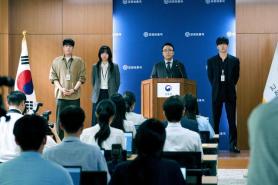
SEOUL, September 14 (AJP) -The Netflix series Teach You a Lesson, in which a fictional government agency steps into troubled schools to restore teachers’ authority when students and parents cross the line, created a splash this summer and raised a sober question that brought teachers and judges together Monday to seek real-world solutions for restoring dignity in the classroom.
The show, which topped Netflix’s non-English TV chart after its June release, struck a nerve in South Korea, where teachers say the real system still leaves many of them exposed to abusive complaints and lawsuits.
The divide between fiction and reality was on display Monday as teachers and judges gathered at the National Assembly in Seoul to discuss how South Korea should protect educators from what are commonly called “malicious complaints,” while preserving parents’ legitimate right to raise concerns.
The meeting was co-hosted by Reform Party lawmakers Cheon Ha-ram and Lee Ju-young.
Cheon said fear of complaints and legal action has increasingly shaped ordinary school activities, from field trips to lunchtime sports.
“‘If you do nothing, nothing happens’ must not become the highest truth in education,” Cheon said, arguing that teachers should not be forced to bear legal and administrative risks alone.
The concern has persisted despite a series of reforms introduced since the July 2023 death of a young teacher at Seoul’s Seoi Elementary School. Her death, later recognized by the government as work-related, triggered massive teacher rallies and a national debate over parental complaints, child-abuse accusations and declining classroom authority. Police found no criminal wrongdoing by parents in the Seoi case, but education authorities said student discipline, parental complaints and workload appeared to have contributed to the pressures she faced.
The backlash prompted revisions to five major laws governing education and teacher protection. Among other changes, the measures strengthened protections for legitimate classroom discipline and created a system allowing superintendents to submit opinions when teachers face child-abuse allegations.
Teachers, however, say much of the burden still falls on individuals.
Kang Seok-jo, head of the Elementary School Teachers’ Union, told Monday’s meeting that a March survey of 987 elementary school teachers found 78 percent believed attempts to channel complaints through a single official school contact either did not work or existed only on paper. At schools with complaint-response teams, 71.5 percent said teachers themselves were members of those teams.
Kang described cases in which a parent sought out a teacher who was on special bereavement leave and complained for more than 40 minutes, and another in which a drunken parent sent incoherent messages at 11 p.m. Other complaints concerned mosquito bites, the temperature of soup served at school lunches and even a teacher’s messaging style. One teacher, he said, was asked about her pregnancy plans.
“The law says schools should receive complaints,” Kang said. “But it does not clearly say whom the school should put on the front line.”
He called for teachers to be removed entirely from complaint-handling duties and for schools to block complaints from reaching educators through personal phone numbers or other private channels.
The anxiety also extends to child-abuse accusations. Education Ministry data cited by teacher groups show 1,870 abuse reports were filed against teachers between September 2023 and February this year. Of 993 cases that had been concluded, 90.4 percent ended either before a formal police investigation or with prosecutors declining to indict.
Judges at Monday’s meeting stressed that stronger teacher protections must be balanced against citizens’ right to file legitimate complaints.
Presiding Judge Kim Min-cheol said the challenge begins with defining where an ordinary complaint ends and an abusive one begins.
“Litigation is a citizen’s right,” Kim said, warning that penalties aimed at abusive complainants could also discourage people with legitimate grievances. He suggested schools could reduce legal uncertainty by developing clearer internal rules, noting that courts consider school regulations when reviewing disputes.
Presiding Judge Moon Jung-heum, meanwhile, pointed to Supreme Court precedent recognizing that teachers exercise broad professional discretion in educating students and that their educational judgments should generally be respected.
Lee suggested more formal safeguards for parent-teacher consultations, including designated times and places and, where appropriate, recordings or other records of what was said.
Pressure for such measures is spreading beyond the National Assembly. Gyeonggi Superintendent of Education An Min-seok, who took office in July, has launched a superintendent-led teacher rights protection task force designed to shield educators from abusive complaints and lawsuits.
The system, which formally began operating in August with 300 designated teacher-rights protection officers, is intended to ensure that the education office — rather than individual teachers — takes responsibility for serious complaints from the initial response through resolution.
AJP Takeaways
- Netflix hit Teach You a Lesson has sharpened debate over classroom authority, as teachers and judges gathered at the National Assembly to seek real-world protections against abusive complaints and lawsuits.
- Teachers say reforms introduced after the 2023 Seoi Elementary School case still leave individuals exposed, with complaint-response systems often requiring teachers themselves to handle grievances.
- Child-abuse allegations remain a major source of anxiety: Of 993 concluded cases cited by teacher groups, 90.4 percent ended before formal police investigation or without indictment.
Copyright ⓒ Aju Press All rights reserved.