SEOUL, October 02 (AJP) - South Korea, an energy-poor but high-tech powerhouse, must pair renewables and hydrogen with storage technology to power its advanced manufacturing economy, a senior international energy expert said.
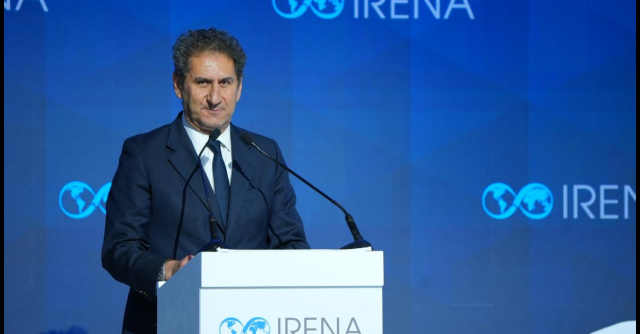
“Korea has strong technological and industrial capabilities to advance its energy transition,” Francesco La Camera, director-general of the International Renewable Energy Agency, said in an email interview with AJP. “The priority is to mobilize those capabilities through a coordinated approach to renewable deployment, infrastructure and electrification.”
La Camera pointed to batteries, transformers, subsea and terrestrial cables, power electronics and digital controls as areas where Korean manufacturing expertise could support a renewable-energy system. The country's semiconductor sector could also play a role as grids become more digitally sophisticated.
“Domestic deployment can help companies demonstrate solutions, develop skills and build experience for export,” he said.
His prescription carries greater urgency as the conflict in the Middle East stretches into its eighth month, unsettling energy-dependent South Korea and other importers ahead of winter.
Brent crude is hovering around $103 a barrel and Dubai crude around $93.38, with little sign of the crisis subsiding.
The war in Iran has disrupted the Strait of Hormuz, a passage for roughly one-fifth of the world's oil and liquefied natural gas trade. For South Korea, which sourced about 70 percent of its crude imports from the Middle East last year, the disruption has sharpened questions about energy security just as the power-hungry artificial intelligence industry drives up electricity demand.
“Renewable electricity is a strategic asset for industrial competitiveness,” La Camera said.
“What has most profoundly shaped my thinking is the growing convergence of climate action, energy security and economic opportunity,” he said, reflecting on his years at IRENA.
“The multiple crises of recent years have made the risks of dependence on internationally traded fuels more visible, while technological progress has strengthened the case for renewable energy.”
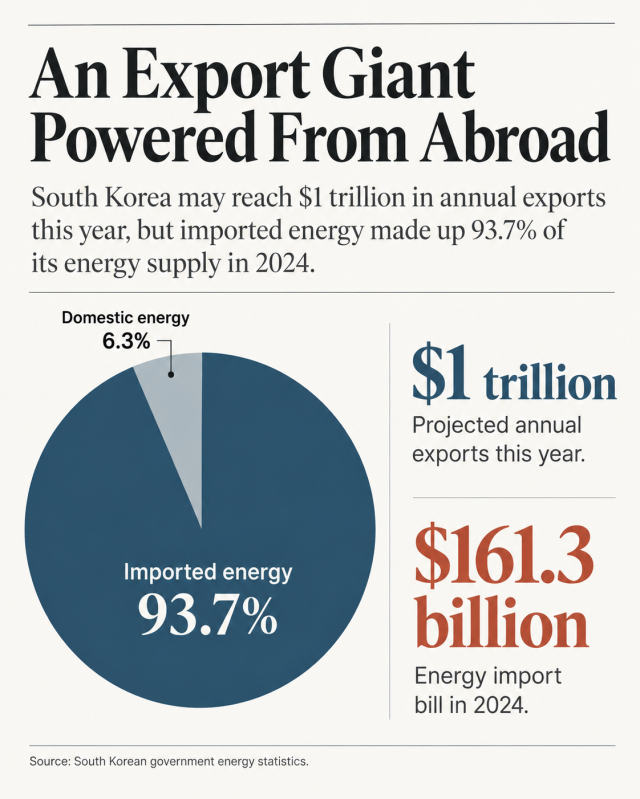
South Korea is a manufacturing powerhouse on course to reach $1 trillion in annual exports this year, yet it relies overwhelmingly on imported energy. Imports accounted for 93.7 percent of its energy supply in 2024, with the bill reaching $161.3 billion, according to government energy statistics.
The Iran conflict has turned that structural vulnerability into an immediate policy concern.
Seoul last week announced plans to cut the Middle East's share of its crude imports from about 70 percent in 2025 to 50 percent by 2035, while expanding strategic stockpiles and diversifying suppliers.
Diversification changes where imported fossil fuels come from. Renewables offer another form of insurance by allowing the country to produce more energy without importing the fuel.
The distinction lies at the heart of La Camera's argument.
He has led IRENA since April 2019 and was appointed to a second four-year term in 2023. Previously, the Italian official served as director-general for sustainable development and international environmental affairs at Italy's environment ministry and led Italian delegations to U.N. climate conferences, including COP21 in Paris.
Based in Abu Dhabi, IRENA is an intergovernmental organization devoted to renewable energy, with 170 member countries plus the European Union.
Its figures show how rapidly the global electricity system is changing.
The world installed about 692 gigawatts of renewable capacity in 2025, lifting the total to 5,149 GW. Renewables accounted for 85.6 percent of net power-capacity additions, with solar adding roughly 511 GW and wind nearly 159 GW, according to IRENA.
Renewables also overtook coal in global electricity generation for the first time in modern power-system history last year, supplying 33.8 percent of the total, according to energy think tank Ember.
Yet deployment remains too slow to meet the global goal of tripling renewable capacity by 2030.
“The central challenge is implementation at the speed and scale required,” La Camera said. “Technology is available and the economic case is strong. We now need infrastructure, policies and investment to advance together.”
South Korea illustrates that challenge.
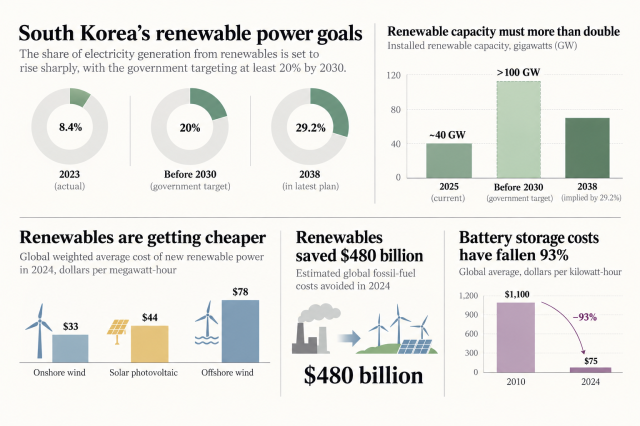
The country's latest finalized long-term power plan calls for renewables to rise from 8.4 percent of electricity generation in 2023 to 29.2 percent by 2038. The Lee Jae Myung administration has since accelerated the near-term push, targeting more than 100 GW of renewable capacity and at least 20 percent of electricity generation before 2030.
With about 40 GW currently installed, South Korea would need to more than double its renewable capacity to reach the target. The government says the country added about 3.8 GW in 2025, its largest annual increase since 2022 but well short of the pace required.
For La Camera, the task extends beyond installing more solar panels and wind turbines.
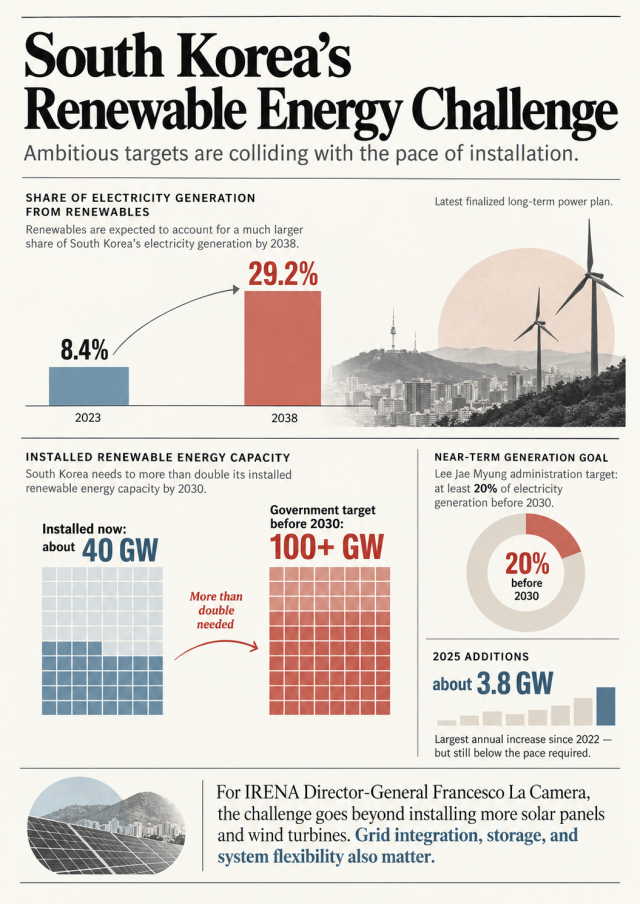
Generation, transmission networks, storage and flexible electricity demand need to be planned together, he said. Digital technology can help make better use of existing infrastructure, while faster and more predictable permitting would support new investment.
Seoul is on course. On Tuesday, the government unveiled a sweeping power-grid overhaul designed to accommodate more than 100 GW of renewable capacity by 2030.
Officials acknowledged that transmission and distribution bottlenecks have become a major barrier to development. In the southwestern Honam region, network congestion had left some new projects facing waits until after 2034 for grid connections.
The government plans to expand transmission infrastructure while making greater use of energy-storage systems and flexible grid connections, allowing renewable projects to come online before every new transmission line is completed.
Falling generation costs strengthen the case for that investment.
More than 90 percent of utility-scale renewable projects commissioned worldwide in 2025 produced electricity more cheaply than the least-expensive new fossil-fuel alternative available in their markets, IRENA found.
The global weighted average cost of new onshore wind fell to $33 per megawatt-hour, while solar photovoltaic power averaged $44 and offshore wind $78. IRENA estimates that renewable generation avoided about $480 billion in fossil-fuel costs worldwide last year.
Storage is also becoming more affordable. Battery-storage costs have fallen 93 percent since 2010, according to IRENA, allowing combinations of solar, wind and batteries in favorable locations to provide round-the-clock electricity at costs increasingly competitive with new fossil-fuel generation.
La Camera said Korea should capitalize on that shift by combining renewables with storage, greater electrification and energy efficiency. Renewable hydrogen could help meet the needs of industrial processes that are difficult to electrify directly.
That approach could be particularly important for semiconductors, steel and batteries — industries central to Korea's export economy that face growing pressure from customers and regulators to reduce the carbon embedded in their products.
Korea's industrial base also gives it an opportunity to supply the transition at home and abroad.
La Camera singled out offshore wind as an area where the country's shipbuilding and engineering expertise could translate into a global competitive advantage.
“Korea's maritime capabilities provide a strong foundation for installation vessels, offshore structures, floating platforms and associated engineering services,” he said.
Seoul is targeting 25 GW of offshore wind capacity by 2035 and plans to auction at least 4 GW of offshore projects annually to build the domestic market.
The Hormuz crisis has made the broader choice increasingly difficult to treat as abstract. Alongside larger stockpiles, alternative suppliers and overseas energy projects, Korea can reduce its exposure by generating more power from resources that do not need to pass through a strait, cross an ocean or survive a war.
In La Camera's view, energy security and renewable deployment are becoming part of the same industrial strategy. Delivering it will require more than technological strength.
“Competitive technologies alone are not enough,” he said. “Countries need infrastructure, effective institutions, affordable finance and skilled people to deploy them at scale.”
AJP Takeaways
- IRENA chief Francesco La Camera says South Korea should pair renewables with storage, grid investment and electrification to strengthen both energy security and industrial competitiveness.
- The Iran war and disruption in the Strait of Hormuz have exposed Korea’s vulnerability as a country that imports 93.7 percent of its energy and relies heavily on Middle Eastern crude.
- Korea aims to exceed 100 GW of renewable capacity before 2030, but transmission bottlenecks, permitting delays and insufficient storage remain major obstacles to meeting that target.
Copyright ⓒ Aju Press All rights reserved.