

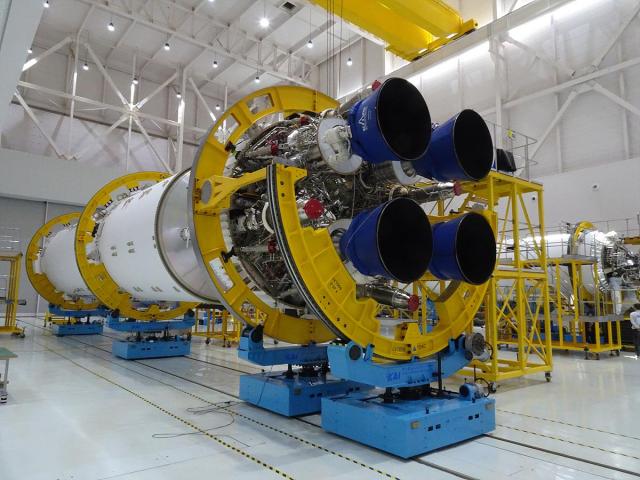
The 47.2-meter vehicle left the assembly building at 6 a.m. and crawled 1.8 kilometers to the second launch pad aboard an unmanned transporter, arriving at 7:30 a.m. after about 90 minutes, KASA and the Korea Aerospace Research Institute (KARI) said.
Engineers will stand the rocket upright with a lifting rig known as an erector, anchor it to the pad and hook up umbilical lines carrying power, fuel and oxidizer.
Installation should be finished later Tuesday if no faults surface, KARI said.
KASA will convene its launch management committee at 8 a.m. Wednesday to clear propellant loading and set the final liftoff time, weighing technical readiness, weather, the launch window and the chance of a collision with orbiting debris.
The window opens at 12:23 p.m.
The rocket is carrying 15 satellites weighing about 1,071 kilograms, its heaviest load yet, to a sun-synchronous orbit about 570 kilometers up.
Five NEONSAT microsatellites, the second through sixth in a planned 10-satellite constellation, will peel off 35 to 40 seconds apart, followed by 10 cubesats released in pairs.
KAIST's Satellite Technology Research Center oversaw their development and Satrec Initiative built them, the first units off the company's satellite production line.
Nuri's fourth flight succeeded on Nov. 27, 2025, placing 13 satellites in orbit in Korea's first overnight launch and its first mission with Hanwha Aerospace as prime contractor.
The rocket has flown successfully three straight times since falling short on its 2021 debut.
AJP Takeaways
- The Korea AeroSpace Administration said South Korea's Nuri rocket reached the second launch pad at the Naro Space Center in Goheung at 7:30 a.m. on Oct. 6, 2026, one day before its fifth flight.
- The Oct. 7, 2026 flight carries 15 satellites weighing about 1,071 kilograms, the heaviest payload of any Nuri mission, bound for a sun-synchronous orbit about 570 kilometers above Earth.
- The five NEONSAT microsatellites are the first half of South Korea's first domestically launched satellite constellation, which will image the Korean Peninsula more than three times a day once all 10 are in orbit; the remaining five are planned for Nuri's sixth flight in 2027.

Copyright ⓒ Aju Press All rights reserved.
