

South Korea has begun adding a fleet of small, lower-cost satellites to its handful of large observation satellites, giving up some image sharpness in exchange for looking at the Korean Peninsula far more often.
The first five NEONSATs, built by KAIST's Satellite Technology Research Institute and the private firm Satrec Initiative, reached orbit on the homegrown Nuri rocket on Oct. 7, and five more launching in 2027 will let the 10-satellite fleet photograph the peninsula at least three times a day.

Park Sae-jin
Experienced journalist and editor at AJU PRESS specializing in multilingual news. I cover international diplomacy, geolpolitics, and policy, consistently delivering highly accurate, compelling reporting for a worldwide audience.
Copyright ⓒ Aju Press All rights reserved.
Related News
-
 National Water Management Committee to Monitor Algal Blooms and Floods Using Satellite Data
The National Water Management Committee will utilize satellite data to monitor algal blooms, floods, and droughts as part of a new water management system. The plan aims to expand observation capabilities to border areas and unmeasured regions, enhancing disaster response capabilities.The committee, which operates under the direct authority of the president, announced on the 23rd that it will sign a memorandum of understanding on the 24th at the National Water Management Committee conference room in Sejong City with four public institutions: Korea Water Resources Corporation, Korea Environment Corporation, Korea Hydro & Nuclear Power, and Korea Rural Community Corporation, to establish a 'satellite data-based integrated watershed management cooperation system.'This agreement is part of a collaborative project initiated by the 'Integrated Water Management Council' launched in May. The goal is to proactively respond to increasingly frequent water disasters due to climate change by establishing an integrated watershed management system using satellite observation data.The five participating institutions will jointly pursue six key cooperation projects across three areas: water environment, flood and drought response, and facility management. Major projects include responding to and analyzing the occurrence and spread of algal blooms, analyzing the movement and spread of floating debris, flood response in border areas, analyzing water levels and flooding in unmeasured regions, drought monitoring, and facility safety management.Initially, satellite observations will analyze the occurrence of algal blooms in reservoirs and the movement and spread of floating debris. By leveraging the capabilities of satellites that can continuously monitor extensive areas, the plan is to quickly identify algal blooms and debris spread and respond accordingly.In border areas, satellite monitoring will be used to observe the discharge from upstream dams, such as the Bukhan River, to prevent flooding in downstream areas. In unmeasured regions where observation facilities are lacking or access is difficult, water levels and flooding situations will be analyzed to support reservoir operation decision-making and drought monitoring.To enhance the effectiveness of the agreement, the National Water Management Committee and the four public institutions will operate a working committee. Starting in the second half of 2027, they plan to jointly select pilot watersheds for on-site verification and gradually expand the application of satellite information utilization technologies.Kim Jwa-gwan, chairman of the National Water Management Committee, stated, "A rapid wide-area monitoring system based on satellites will maximize efficiency in overall water management, including floods, droughts, and water environments. We will work to eliminate data blind spots in border and unmeasured areas and complete a comprehensive and scientific climate safety net for the public through strong cooperative efforts that transcend departmental and institutional boundaries."* This article has been translated by AI.
-
 Korean firms eligible to supply EU satellite network
EU Defense and Space Commissioner Andrius Kubilius, right, and Jeoung Giyoung, deputy minister for the advanced capabilities program at South Korea’s Defense Acquisition Program Administration (DAPA), at a signing ceremony on satellite cooperation in Brussels on September 17, 2026. (Photo: © European Union) ZURICH, November 09 (AJP) -South Korean companies can supply non-sensitive parts and services for the European Union’s planned secure satellite network, a European Commission official said Monday, pointing to a potential new market for Korea’s space and defense industries. Korean firms are already eligible to join the IRIS² project as suppliers or subcontractors, the official told South Korean newspaper E-Today. Eligibility does not guarantee contracts, however, and any work would be subject to the program’s legal and technical requirements. Formal participation by the South Korean government would require a separate international agreement, the official said. The distinction gives Korean companies a potential commercial opening while Seoul and Brussels explore a broader partnership in secure satellite communications. IRIS², short for Infrastructure for Resilience, Interconnectivity and Security by Satellite, is intended to provide secure communications for governments and armed forces as well as commercial connectivity. Often described as Europe’s answer to SpaceX’s Starlink, the network is part of an EU effort to reduce dependence on foreign providers. The war in Ukraine has underscored the importance of reliable satellite links on the battlefield, adding urgency to Europe’s push for its own capabilities. “Security also depends on space,” European Commission spokesperson Thomas Regnier said, explaining that IRIS² would serve both civilian and military users. The first satellites are scheduled for launch by the end of 2029. Talks over the project’s operation and financing concluded in August, and its main suppliers have been selected. The comments follow a series of exchanges between Seoul and Brussels this autumn. On September 17, EU Defense and Space Commissioner Andrius Kubilius and a senior official from South Korea’s Defense Acquisition Program Administration (DAPA) signed an arrangement in Brussels to cooperate on secure satellite communications. The arrangement opened the way for discussions on a possible Korean link to IRIS². A joint working group held its first meeting in October, bringing together the European Commission, the European Space Agency, DAPA and South Korea’s Agency for Defense Development. The cooperation could give South Korea access to aspects of the program’s design while allowing European space companies to draw on Korean industrial expertise. Norway and Iceland are the only countries to have signed formal cooperation treaties with the EU on the program so far. South Korea is among the first countries outside Europe to enter discussions. Two Korean defense electronics companies see scope to contribute, although neither has established that its products meet the project’s requirements. Hanwha Systems cited its experience developing satellites, ground stations and terminals for low-orbit networks. It said it had not begun supplier talks. LIG D&A pointed to its satellite repeaters and advanced antennas developed for South Korea’s military satellite programs. Both companies said further checks would be needed to assess compatibility with IRIS² requirements. The potential opening would extend Korea’s growing defense business in Europe into space communications. Korean manufacturers have already secured major contracts in Poland for K2 tanks, K9 self-propelled howitzers and combat aircraft. Winning satellite work would depend on meeting a separate set of technical and security requirements. - Tags: IRIS², European Union, European Commission, European Space Agency, South Korea, Andrius Kubilius, Thomas Regnier, Defense Acquisition Program Administration, Agency for Defense Development, Hanwha Systems, LIG D&A, E-Today, Starlink, SpaceX, satellites, defense industry
-
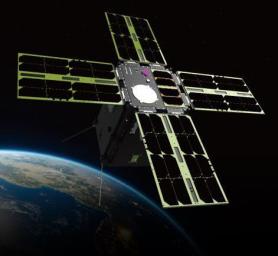 KAI's onboard AI flags capacity to fix satellite fault in orbit
An artificial intelligence module attached Cubesat/ Courtesy of KAI SEOUL, October 21 (AJP) - An artificial intelligence module built by Korea Aerospace Industries (KAI) diagnosed a simulated satellite malfunction in orbit and drafted its own remedy, the South Korean aerospace company said Wednesday. The pilot mission ran Tuesday aboard BEE-1012, a CubeSat that reached orbit on Oct. 7 aboard Nuri, South Korea's homegrown space rocket. A ground station beamed up a mock fault signal, and the module traced its cause and scope before compiling a technical report on how to respond and transmitting it back to Earth, KAI said. Conventional satellites must relay data to the ground and wait for engineers to diagnose a problem. Processing on board allows decisions in real time, which KAI said would bolster a satellite's survivability and sharply cut communication costs. KAI developed the module with defense AI firm Funzin and trained it on tens of thousands of failure scenarios, drawing on fault-prediction systems refined in its aircraft programs. It runs on a chip from Mobilint, which said it was the first Korean-designed AI processor to fly on a satellite. "We plan to integrate all space systems on the basis of AI technology," said Seo Hyun-seok, head of KAI's space business division. The company will begin its main autonomous-operation mission in December and aims to make the technology standard on satellites it builds. AJP Takeaways - Korea Aerospace Industries said on Oct. 21, 2026, that its in-house AI module diagnosed a simulated fault and generated a response report in orbit aboard the BEE-1012 CubeSat on Oct. 20. - BEE-1012 reached orbit on Oct. 7, 2026, on the fifth flight of South Korea's Nuri rocket, which carried a record 15 satellites. The module runs on a neural processing unit from Korean startup Mobilint. - KAI plans to begin its main autonomous satellite operation mission in December 2026 and to make the technology a standard feature of the satellites it builds.